
Title: Novel GPR97–Gα12–mTORC1 signaling pathway drives skeletal muscle fiber hypertrophy
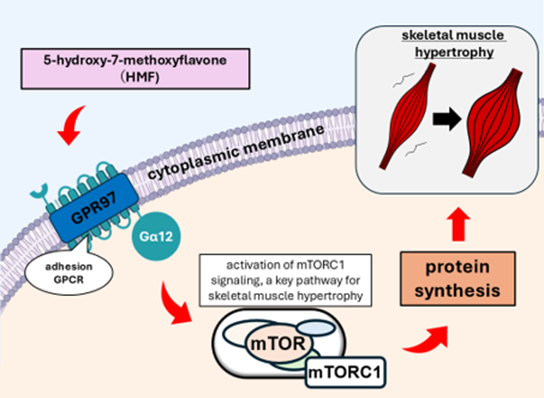
Caption: GPR97–Gα12–mTORC1 was identified as a novel pathway for driving skeletal muscle fiber hypertrophy, induced by 5-hydroxy-7-methoxyflavone (HMF).
Credit: Osaka Metropolitan University
Elucidating novel signaling pathways that drive myotube hypertrophy may provide new insights into the mechanisms regulating skeletal muscle growth. Previously, it was reported that 5-hydroxy-7-methoxyflavone (HMF) induces hypertrophy of murine C2C12 myotubes; however, the underlying molecular mechanism remains unclear. In a new Osaka Metropolitan University-led study, loss- and gain-of-function analyses revealed that GPR97 positively regulates myotube size. Furthermore, knockdown and rescue experiments demonstrated that GPR97 is required for HMF-induced myotube hypertrophy. HMF activated mTORC1 signaling in myotubes, and intramuscular administration of HMF also activated mTORC1 signaling in mouse skeletal muscle in vivo. Gpr97 knockdown abolished HMF-induced mTORC1 signaling and protein synthesis.
Furthermore, depletion of Gna12 and expression of dominant-negative Gα12 abolished HMF-induced myotube hypertrophy. Gna12 depletion also suppressed HMF-induced mTORC1 signaling and protein synthesis. Beclomethasone dipropionate, a reported GPR97 ligand, suppressed HMF-induced hypertrophy and mTORC1 signaling, while further enhancing HMF-induced serum response factor (SRF)-dependent transcription. Although dominant-negative RhoA inhibited HMF-induced SRF-dependent transcriptional activity, it did not affect myotube hypertrophy.
These findings indicate that GPR97–Gα12–mTORC1 signaling promotes hypertrophy independent of the Gα12–RhoA–SRF pathway. GPR97 was predominantly expressed on the myotube surface as a C-terminal fragment generated by N-terminal fragment (NTF) cleavage, and HMF reduced its surface expression. HMF induced hypertrophy in myotubes expressing an NTF cleavage-resistant GPR97 mutant, but not in those expressing an NTF-deleted mutant. These results indicate that NTF cleavage is dispensable and suggest that NTF contributes to GPR97-mediated hypertrophic signaling. These findings identify a novel GPR97–Gα12–mTORC1 signaling axis that mediates HMF-induced myotube hypertrophy.
Paper information
Journal: Archives of Biochemistry and Biophysics
Title: GPR97–Gα12–mTORC1 signaling drives myotube hypertrophy: identification of 5-hydroxy-7-methoxyflavone as a pathway activator
DOI: 10.1016/j.abb.2026.110964
Author(s): Shuhei Fujita, Ayano Kimura, Daisuke Maekawa, Mai Kubota, Tomoya Kitakaze, Naoki Goshima, Naoki Harada, Ryoichi Yamaji
Publication date: 3 August 2026
URL: https://doi.org/10.1016/j.abb.2026.110964
Contact
Ryoichi Yamaji
Graduate School of Agriculture
Email: yamaji[at]omu.ac.jp
*Please change [at] to @.