Research
My work focuses on nonlinear dynamics and its engineering applications, aiming to understand fundamental mechanisms underlying complex behaviors.
Control Synchronization
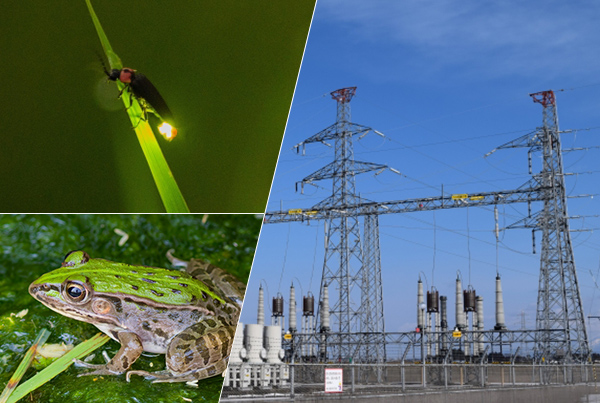
Synchronization of oscillators—famously observed in the collective flashing of fireflies—appears in many natural and engineered systems. For example, in power networks, generators across Japan rotate in unison at 50 or 60 cycles per second, enabling a stable electricity supply. In physiology, the heartbeat is produced by a large number of pacemaker cells, each with its own intrinsic rhythm, that interact and synchronize their oscillations. I study theoretical and experimental methods for efficiently inducing and controlling such synchronization phenomena.
References
- Synchronizing chaos with imperfections
Y. Sugitani, Y. Zhang, and A. E. Motter
Physical Review Letters, vol. 126, no. 16, pp. 164101-1–164101-4 (2021) - Delay-independent design for synchronization in delayed-coupled one-dimensional map networks [ PDF ]
Y. Sugitani and K. Konishi
IEICE Trans. EA, vol. 101-A, no. 10, pp. 1708–1712 (2018) - Multi-phase synchronization for peak power reduction in energy storage oscillators coupled with delayed power price
T. Imasaka, A. Ito, Y. Sugitani, K. Konishi, and N. Hara
Nonlinear Theory and Its Applications, IEICE, vol. 13, no. 3, pp. 544–557 (2022)
Control of Nonlinear Systems Using Time Delays
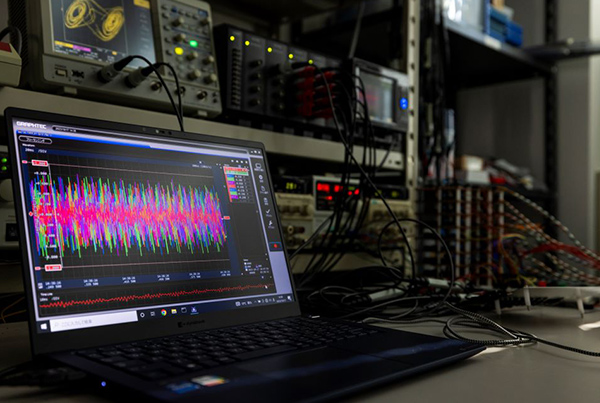
“Delay” often carries a negative impression—such as being late for school or missing a bus or train—and in engineering systems, delays are likewise usually regarded as undesirable. Indeed, signal delays inherent in a system are well known to destabilize its behavior in many situations. On the other hand, in nonlinear science, various control strategies—such as delayed feedback control and delay-coupled interactions—have been proposed to stabilize nonlinear systems by intentionally introducing time delays. My research extends the theory of such delay-based control methods and explores their potential applications to real engineering systems, including DC power-distribution buses and thermoacoustic systems.
References
- Partial amplitude death in delay-coupled oscillators with complete multipartite graphs
R. Kawano, Y. Sugitani, K. Konishi, and N. Hara
Physical Review E, vol. 112, no. 1, p. 014209 (2025) - Analysis of bifurcation and explosive amplitude death in pair of oscillators coupled via time-delay connection [ PDF ]
K. Konishi, K. Yoshida, Y. Sugitani, and N. Hara
Physical Review E, vol. 111, no. 3, p. 034206 (2025) - Amplitude death in extended time-delay coupled oscillator networks
S. Mizukami, K. Konishi, K. Yoshida, Y. Sugitani, and N. Hara
IEEE Access, vol. 13, pp. 12666–12675 (2025)