Research Interests/Concepts
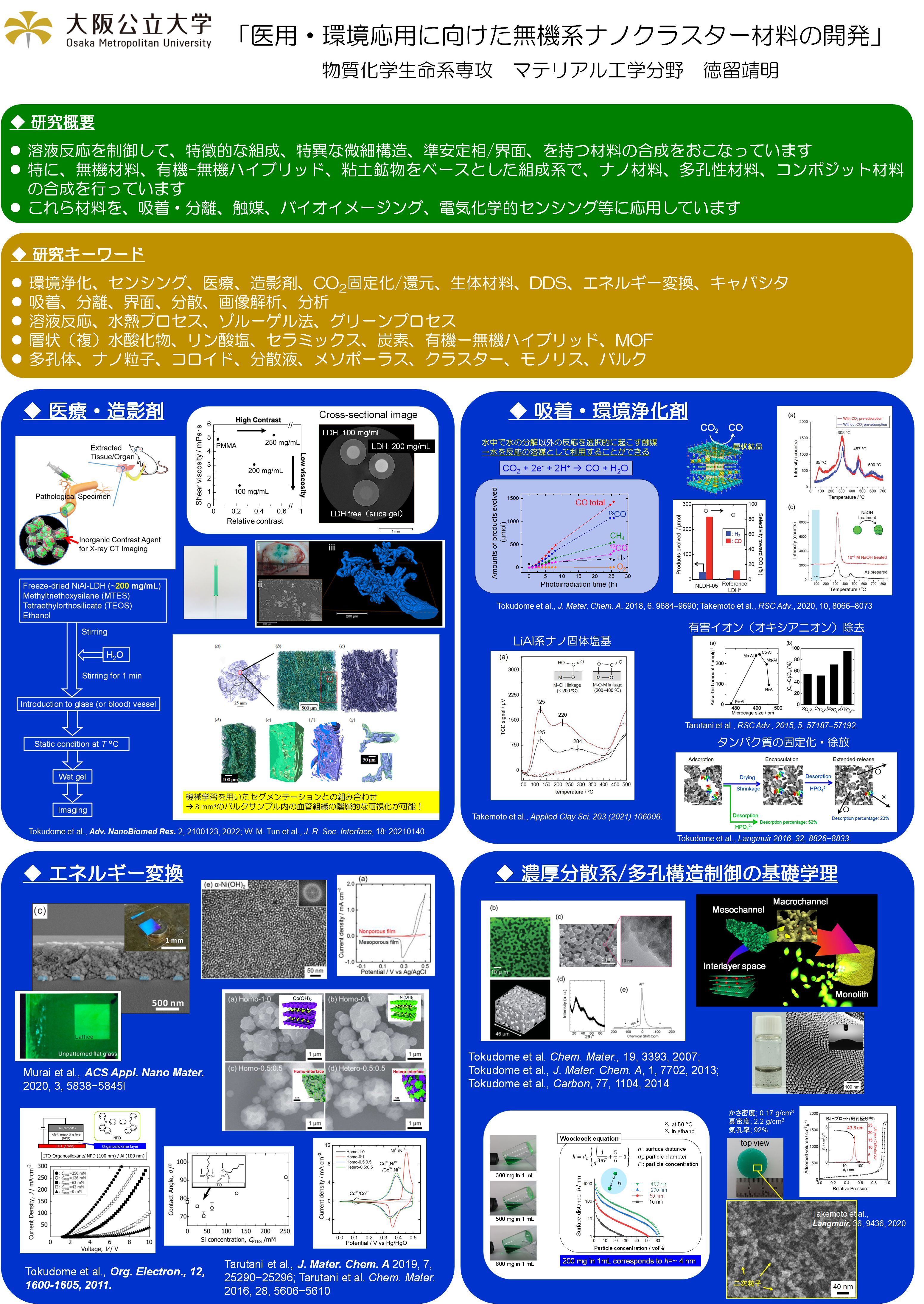
21世紀は、超高齢化社会の到来と共に、人間を中心にした研究が重要と言われています。このような背景の元、持続的社会の実現に資するバイオ関連・環境関連セラミックス材料の開発と社会応用を推進しています。
研究で取り組むのは、低エネルギープロセスを用いた(1)生体関連材料(広義な意味で生体と関連する材料)、(2)環境浄化に資する材料の開発の開発です。私たち人間から見て外の環境(周辺環境)と内なる環境(生体環境)の両者を対象として、それらの環境で適切に作用する材料を研究の対象としています。金属元素として、Mg、Fe、Si、Ca、Zn、Zr、Ti、Alのようなユビキタスかつ低環境負荷(生体親和性が高い)を構成要素とする材料の利用が好ましいと言えます。生体環境および周辺環境で利用可能な材料に求められる要求には類似点が多いため、どちらかの環境で利用可能な材料は他方の環境でも着眼点を変えて利用可能となる場合が多くなります。
機能応用に向けては、異分野融合型の共同研究を積極的に活用し、学際的な研究を推進し単独の研究グループでは成し得ない研究成果に繋げています。例えば、X線CT向けの血管造影剤の開発においては、イメージングの研究者とユーザー(医者)を交えたブレインストーミングを重ね、材料の問題点とその解決策についての研究着想を得ています。これを、基礎科学的に興味のある材料化学的なテーマに落とし込み研究を展開しています。また、学内共同研究も活用して合成・解析手法の多様化をおこない研究に拡がりを出します。
In the 21st century, with the advent of a super-aged society, research centered on humans is considered to be of increasing importance. Against this backdrop, we are promoting the development and practicial application of bio-related and environment-related ceramic materials that contribute to the realization of a sustainable society.
Our research focuses on developing materials using low-energy processes, specifically:
-
Bio-related materials (materials associated with biological systems in a broad sense).
-
Materials that contribute to environmental purification.
We focus on materials that function appropriately in both external environments (surrounding environments) and internal environments (biological environments). It is preferable to utilize materials composed of ubiquitous and environmentally low-impact (biocompatible) metal elements such as Mg, Fe, Si, Ca, Zn, Zr, Ti, and Al. Since the requirements for materials used in biological and surrounding environments share many similarities, materials suitable for one environment can often be applied to the other by shifting the perspective.
For functional applications, we actively engage in interdisciplinary collaborative research, advancing cross-disciplinary studies that lead to research outcomes unattainable by a single research group. For example, in the development of contrast agents for X-ray CT imaging, we conduct repeated brainstorming sessions with imaging researchers and medical professionals to identify material-related issues and explore solutions. These insights are then translated into material chemistry themes of fundamental scientific interest, driving our research forward. Furthermore, by utilizing intra-university collaborations, we diversify synthesis and analysis methods, expanding the scope of our research.