Research Results
Jan 20, 2023
- Lecture / Seminar
- NEWS
- Lecture / Seminar
Lecture Meeting of FY2022 Held by Research Center for Artificial Photosynthesis
- Date & Time: Friday, January 20, 2023, from 17:00 to 18:00
- Venue: Room E211 (Lecture Room 10), Science Building, Sugimoto Campus
- Host: Research Center for Artificial Photosynthesis, Osaka Metropolitan University
Program
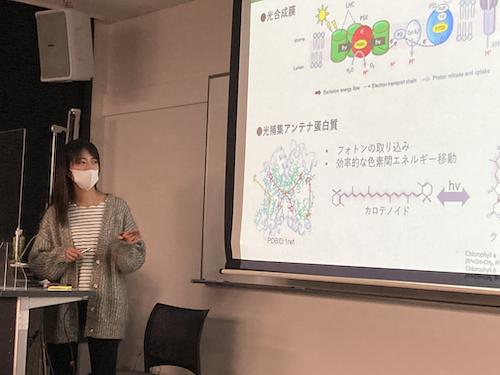
"Structural and Functional Studies of Photosynthetic Antenna Proteins Using Lipid Nanodisks"
Nami Yamano (Postdoctoral Researcher, Renmin University of China)
We are pleased to welcome Dr. Nami Yamano, who obtained her doctoral degree from our university's Department of Chemistry and is currently working as a postdoctoral researcher at Renmin University of China. Taking the opportunity of her short-term visit to Japan, she will present her recent research results. We look forward to your participation.
Caretaker: Ritsuko Fujii (ext. 3624) E-mail: ritsuko[at]omu.ac.jp (Change [at] to @)
Lecture Summary
Photosynthesis is a reaction that produces sugars from water and carbon dioxide (CO2) using light (excitation) energy from sunlight. This intake of sunlight is achieved by antenna proteins that are deployed within the thylakoid membrane lipids and bind chlorophyll and carotenoids as light-harvesting molecules. Interestingly, antenna proteins are involved not only in light harvesting but also in the dissipation of excess excitation energy within the membrane in response to varying intensities of sunlight. Although this quenching process is known to result from changes in the excited states of pigment molecules induced by protein-protein aggregation or alterations in peripheral physical properties, there is a discrepancy between molecular functional analyses using isolated proteins as samples and macro-level analysis results of leaves or thylakoid membranes. Thus, the exact molecular mechanism of light harvesting and quenching of antenna proteins within the thylakoid membrane remains unclear.
In general, functional analyses of photosynthetic proteins are conducted by dispersing isolated proteins into water as detergent micelles. However, because the permeability of polar molecules and ions is high, it can hardly be said that this system reproduces the biological environment. Liposomes have been frequently used as systems mimicking the hydrophobic membrane environment; however, it is difficult to control random protein-protein aggregation, leading to the problem that individual molecules form heterogeneous excited states. Therefore, in this study, we attempted to reconstitute antenna proteins into a lipid bilayer membrane layer called a lipid membrane nanodisk. Nanodisks allow the control of the disk diameter and the number of encapsulated proteins by adjusting the length of the scaffold proteins, enabling functional analysis of single molecules while reproducing the lipid environment. Using nanosecond time-resolved absorption and fluorescence lifetime measurements, we investigated how the energy transfer and structures between pigments bound to antenna proteins differ compared to when they are in a general detergent micelle system. The results revealed that, in the lipid membrane, the proteins exist in a conformational state more biased toward the quenched state than in the micelle system.
(Reference: Yamano et al., J. Phys. Chem. B, 126(14):2669-2676, 2022.)
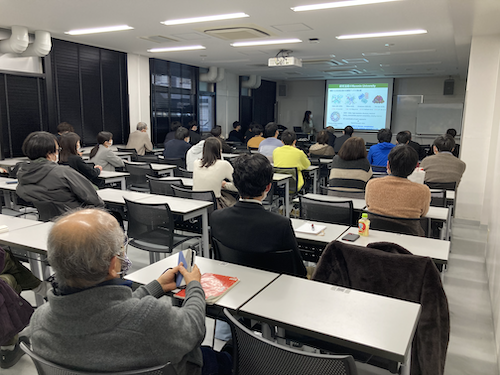
This meeting was held in person with thorough infection prevention measures. Approximately 30 participants attended and engaged in active discussions. Thank you very much.