Research Results
Dec 15, 2020
- Press Release
- Joint Research Paper
- Paper / PressRelease
- Joint research results
Press Release Issued on Joint Research Results by Associate Prof. Masazumi Tamura and Tohoku University, Featured in Mass Media
Establishing a New Transformation Method for Plastics!
─ Successful Development of a Heterogeneous Catalyst System Effective for Synthesizing Useful Chemical Products from Polyolefinic Plastics at Low Temperatures ─
This research announcement has been featured in the following media outlets:
- January 14, 2021: The Chemical Daily
- February 8, 2021: The Chemical Daily
Key Points of This Research
- Successful development of a solid catalyst that transforms polyolefinic plastics into useful chemical products such as lubricants under low-temperature conditions.
- Expected to emerge as a new solid catalyst technology for plastic transformation.
Summary
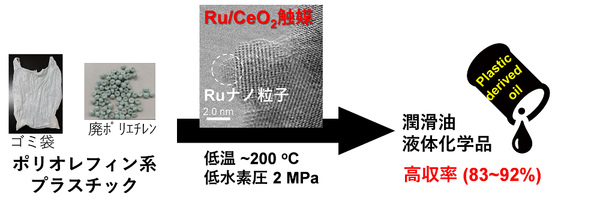
A research group led by Masazumi Tamura (Associate Professor, Research Center for Artificial Photosynthesis, Osaka City University) and Keiichi Tomishige (Professor, Department of Applied Chemistry, Graduate School of Engineering, Tohoku University) has successfully developed a solid catalyst system effective for decomposing polyolefinic plastics, which account for the majority of plastic waste. The group has demonstrated that useful chemical products, such as lubricants and liquid chemicals, can be synthesized in high yields under low-temperature conditions
While technologies such as liquefaction and gasification are known as chemical recycling methods for polyolefinic plastics, they face various problems. Therefore, establishing a technology to transform plastics under low-temperature conditions, along with a catalyst technology that enables direct and selective conversion into valuable chemical raw materials, has been highly demanded. The ruthenium catalyst supported on cerium oxide (Ru/CeO2 catalyst) developed in this research successfully lowers the reaction temperature by more than 100 degrees Celsius compared to conventional technologies
These research results were published online in Applied Catalysis B: Environmental (IF=16.68) on Thursday, December 10, 2020.
Research Background
In recent years, plastic waste has become a global issue, impacting marine environments and ecosystems. Under these circumstances, reducing plastic consumption and establishing appropriate disposal methods are required, and plastic recycling and reuse technologies are also becoming important from the perspective of resource circulation. Polyolefinic plastics account for the majority of plastic waste, making the development of its recycling technology an urgent matter. Among recycling technologies, chemical recycling is expected to be a process that enables lower carbon emissions, waste reduction, and the supply of raw materials and chemicals. While technologies such as liquefaction and gasification are known as chemical recycling methods for polyolefinic plastics, they generally require high temperatures of 400 degrees Celsius or higher and have suffered from issues such as the generation of low-value gas, large amounts of byproducts, and catalyst deactivation. From the perspective of improving energy utilization efficiency and reducing carbon dioxide emissions, it has been requested to establish a technology that enables plastic transformation under low-temperature conditions, as well as a catalyst technology that enables direct and selective conversion into high-value-added chemical raw materials.
Research Details
As a result of catalyst development using polyethylene as a model substrate, we found that a ruthenium catalyst supported on cerium oxide (Ru/CeO2 catalyst) exhibits higher activity than other metal-supported catalysts
Expected Impact
This technology will enable a resource circulation cycle for plastics and is expected to contribute to solving the plastic waste issue. Furthermore, by replacing chemical processes that have been synthesized from petrochemical resources, carbon dioxide, energy, and costs will be reduced, which is expected to lead to the construction of a low-carbon society.
Future Development
Toward practical application, we will work on developing catalyst processes using actual waste plastics.
Funding Information
This research was conducted with the support of the Environment Research and Technology Development Fund (JPMEERF20183R03) of the Environmental Restoration and Conservation Agency.
Publication Information
| Journal: | Applied Catalysis B: Environmental (IF=16.68) |
|---|---|
| Title: | Low-Temperature Catalytic Upgrading of Waste Polyolefinic Plastics into Liquid Fuels and Waxes |
| Authors: | Yosuke Nakaji, Masazumi Tamura*, Shuhei Miyaoka, Shogo Kumagai, Mifumi Tanji, Yoshinao Nakagawa, Toshiaki Yoshioka,Keiichi Tomishige* |
| URL: | https://www.sciencedirect.com/science/article/abs/pii/S0926337320312224 |