Research Results
Mar 17, 2020
- Press Release
- Joint Research Paper
- Paper / PressRelease
- Joint research results
Press Release Issued on Joint Research Results by Prof. Tomoko Yoshida, Sakai Chemical Industry Co., Ltd., et al.
Development of a Safe and High-Yield Solution Synthesis Method for Black Phosphorus, a Next-Generation Material
── Accelerating the Dream Technology of Artificial Photosynthesis ──
Summary
A joint research group consisting of Tomoko Yoshida (Professor and Deputy Director, Research Center for Artificial Photosynthesis, Osaka City University), Akiyo Ozawa (Osaka City University / Sakai Chemical Industry Co., Ltd.), and Sakai Chemical Industry Co., Ltd. has successfully developed a simple, high-yield solution-based method to synthesize black phosphorus, which functions as a catalyst for generating hydrogen from water utilizing solar energy. Black phosphorus is an allotrope of phosphorus and has garnered significant attention as a material capable of absorbing most of the visible light spectrum of sunlight; however, it has faced challenges due to the difficulty of large-scale synthesis required for industrial applications. In this study, using safe and harmless red phosphorus as a starting material, the group achieved high-yield synthesis of black phosphorus via a solution method, paving the way for mass production.
These research results were published on the online page of a specialized chemistry journal issued by the Royal Society of Chemistry (RSC) on March 12, 2020 (Japan Time).
Research Background
Global warming has become a serious social issue, and hydrogen is attracting attention as a new energy source to replace fossil fuels such as petroleum and coal, which generate carbon dioxide, a substance responsible for global warming. To date, extensive research has been conducted on generating hydrogen on photocatalysts utilizing readily available resources: solar energy and water. Black phosphorus is a highly promising photocatalyst material capable of utilizing sunlight from the ultraviolet to the near-infrared region. However, its synthesis has generally relied on methods such as high-temperature, high-pressure processes or chemical vapor deposition, which have made inexpensive mass production difficult.
To synthesize black phosphorus more affordably and in larger quantities, synthesis via a solution method has been highly anticipated. Recently, it was reported that black phosphorus could be synthesized from white phosphorus using a solvothermal method (*1), a specialized technique that synthesizes solids using high-temperature or high-pressure solvents. However, since white phosphorus is highly toxic, it was necessary to develop a method to obtain black phosphorus with a high yield from safe and harmless red phosphorus.
*1: A method for synthesizing materials through the heating reaction of a solvent.
Research Details
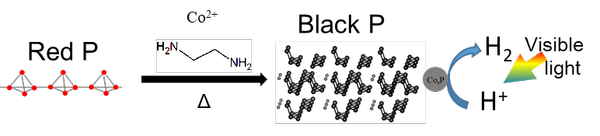
In this study, the research group discovered a method to synthesize black phosphorus with a high yield from red phosphorus via a solvothermal method using ethylenediamine (*2) as a solvent and elucidated its reaction mechanism using various spectroscopic techniques. The group clarified the reaction mechanism: red phosphorus dissolves in ethylenediamine as trivalent phosphorus, which then forms zero-valent polyphosphorus as the phosphorus aggregates to a certain extent, and finally stacks in the solution to form black phosphorus. The resulting sample had an exceptionally high content of black phosphorus, successfully improving the yield significantly from the conventional level of approximately 10% to about 90%. Furthermore, it was demonstrated that when the obtained sample supports a cocatalyst (*3), it exhibits high hydrogen generation activity from an aqueous methanol solution under visible light irradiation, making it highly promising as a photocatalyst for water splitting. (A patent is currently pending for this achievement.)
*2: An organic compound that mixes arbitrarily with water and alcohol, widely used in chemical synthesis.
*3: Attaching fine particles of metal, used as a catalyst, onto a carrier.
Expected Impact
Black phosphorus is a layered compound similar to graphite, and because it can change the wavelength of light it absorbs depending on the thickness of its layers, expectations are rising for its potential as a two-dimensional material that can utilize light ranging from visible to near-infrared. However, because a practical synthesis method had not been established, there have been very few reports of its application in industrial fields. It is expected that this study, which enables black phosphorus to be obtained with a high yield from safe red phosphorus, will further accelerate photocatalyst research utilizing black phosphorus.
Furthermore, a monolayer film of black phosphorus (phosphorene) is a related substance to graphene (*4)—a monolayer film of graphite that became a major topic during the 2010 Nobel Prize in Physics. It is a semiconductor material that exhibits excellent electrical conductivity and possesses a bandgap that graphene lacks. For this reason, numerous research papers have been reported in material fields such as two-dimensional transistors and sensors. It is highly anticipated that the results of this study will be applied and expanded not only in the field of photocatalytic chemistry but also in the field of electronic materials.
*4: A thin-film polymer with a thickness of just a single carbon atom. It forms a honeycomb-like hexagonal lattice structure composed of carbon atoms and their bonds.
Future Development
Black phosphorus is difficult to synthesize and further faces the issue of low stability in the atmosphere. Based on the synthesis guidelines for black phosphorus obtained through this study, the group plans to work on developing methods to increase the layered surface area of black phosphorus and creating formulations that improve its stability.
Joint Research and Funding
This study is a joint research project between Osaka City University and Sakai Chemical Industry Co., Ltd. It was conducted with financial support from the following source: Grants-in-Aid for Scientific Research (KAKENHI), Grant-in-Aid for Scientific Research on Innovative Areas, "Creation of Complex Anion Compounds and Novel Functions" (Research Project Number: 16H06440).
Publication Information
| Journal: | Journal of Materials Chemistry A |
|---|---|
| Title: | Black phosphorus synthesized by solvothermal reaction from red phosphorus and its catalytic activity for water splitting |
| Authors: | Akiyo Ozawa (Osaka City University / Sakai Chemical Industry Co., Ltd.), Muneaki Yamamoto (Osaka City University), Tetsuo Tanabe (Osaka City University), Saburo Hosokawa (Kyoto University), and Tomoko Yoshida (Osaka City University) |
| URL: | https://doi.org/10.1039/C9TA13441G |