Research Results
Aug 3, 2017
- Press Release
- Research Paper
- Paper / PressRelease
Press Release Issued on Research Results by Prof. Yutaka Amao et al.
Successful Efficiency Improvement in Photocatalytic Reduction of Carbon Dioxide to Formic Acid Using a Novel Artificial Coenzyme
This research announcement was featured in the following media:
- August 3: The Chemical Daily
Yutaka Amao (Professor, Research Center for Artificial Photosynthesis) and Shusaku Ikeyama (Specially Appointed Assistant Professor, OCU Advanced Research Institute for Natural Science and Technology) have successfully improved the efficiency of the photocatalytic reduction reaction of carbon dioxide to formic acid. This was achieved by using a novel artificial coenzyme with two amino groups (-NH2) introduced into the chemical structure of viologen. A press conference regarding this research was held at the Research Center for Artificial Photosynthesis on Tuesday, August 1, 2017.
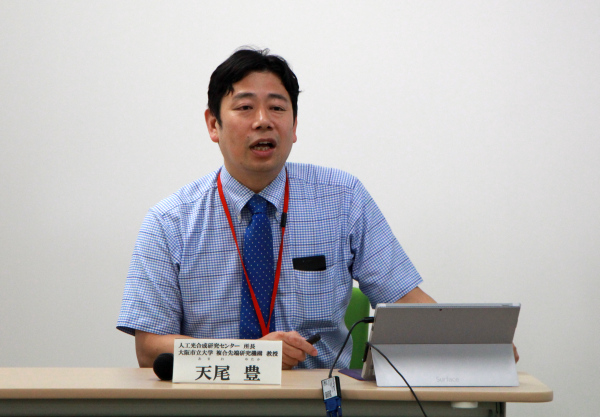
Prof. Amao explaining his research findings
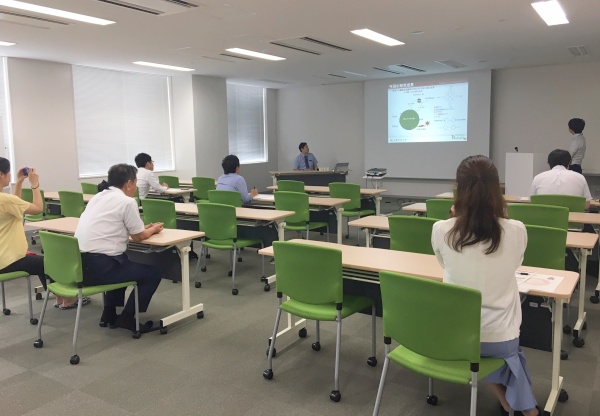
Scene from the press conference
Research Overview
Development of an effective catalyst is one of the crucial key technologies for creating artificial photosynthesis systems that utilize solar energy to convert carbon dioxide into organic molecules. Our research group has previously synthesized a novel molecule (DAV in the figure), featuring two amino groups (-NH2) introduced into the chemical structure of viologen. By utilizing this molecule as an artificial coenzyme, we successfully accelerated the activity of formate dehydrogenase—a catalyst that promotes the conversion of carbon dioxide into formic acid (used as a fuel, chemical product, and energy storage medium)—achieving a 560-fold increase in activity compared to the previous maximum achieved with natural coenzymes.
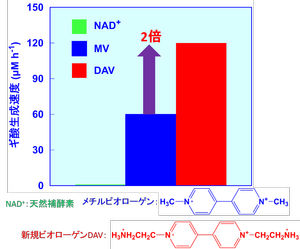
In this study, we applied this artificial coenzyme to a photoredox system composed of a dye molecule (water-soluble porphyrin) and formate dehydrogenase to convert carbon dioxide into formic acid. As a result, after one hour of visible light irradiation, the formic acid production rate increased by up to two times compared to the conventionally used artificial coenzyme methyl viologen, achieving the highest value reported to date.
This discovery is expected to significantly contribute to the design and development of catalysts for creating future artificial photosynthesis systems that convert carbon dioxide into organic molecules. Currently, we are examining reaction conditions and other factors with the aim of further improving formic acid production efficiency.
Publication Information
| Journal: | Sustainable Energy & Fuels |
|---|---|
| Title: | A novel electron carrier molecule based on viologen derivative for visible light-driven CO2 reduction to formic acid with the system of zinc porphyrin and formate dehydrogenase |
| Author: | Shusaku Ikeyama, Yutaka Amao |
| URL: | https://doi.org/10.1039/C7SE00255F |