TOPICS
Jul 8, 2015
- MEDIA
- Joint Research Paper
- Press Release
- Paper / PressRelease
- Joint research results
Press Release Issued on Joint Research Results by Mazda Technical Research Center and Prof. Yutaka Amao et al., Featured in Mass Media
Successful Production of Ethanol Fuel Using Solar Energy
This research has been featured in the following media outlets:
*(Evening) denotes evening edition; * denotes Web edition
- July 10:NHK (Japan Broadcasting Corporation)"News Hot Kansai"
- July 11: The Nikkei Shimbun, The Asahi Shimbun, The Mainichi Newspapers, The Sankei Shimbun
- July 13: Smart Japan (Web Media)*, ASCII.jp*, Kankyo Business Online*
- July 14: The Chugoku Shimbun
- July 15: The Nikkan Kogyo Shimbun, Response.*
- July 17: The Denki Shimbun*
- July 18: Zaikei Shimbun*
- August 19: The Yomiuri Shimbun (Evening edition)
In addition, the research has been featured in numerous other local newspapers and media outlets.
Summary
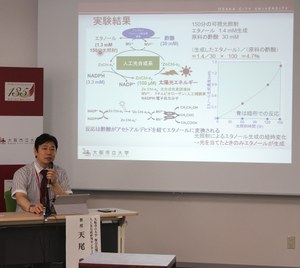
A research group led by Professor Yutaka Amao (Director of the Research Center for Artificial Photosynthesis (ReCAP), Advanced Research Institute for Natural Science and Technology, Osaka City University) has successfully developed a new artificial photosynthesis technology in joint research with the Technical Research Center of Mazda Motor Corporation. This technology enables the production of ethanol, which is gaining attention as a low-carbon fuel for automobiles, using solar energy.
This research was published on the online page of the following specialized journal on July 2, 2015 (Netherlands Time). Additionally, these research results are scheduled to be presented at the Nagoya Meeting of the Japan Petroleum Institute (the 45th Petroleum-Petrochemical Symposium), which will be held at WINC AICHI from November 5 to 6.
Research Background
It is imperative to promptly address the serious issues that have emerged alongside the advancement of science and technology, such as global environmental pollution caused by greenhouse gases, the disposal of vast amounts of industrial waste, and the depletion of fossil fuels like petroleum and coal, for the benefit of future generations.
In particular, establishing low-environmental-impact energy circulation systems and developing energy conversion systems that effectively utilize greenhouse gases, notably carbon dioxide, are essential initiatives for this century. Regarding carbon dioxide, for which global reduction targets have been established, while regulating emissions is one approach, developing methods to proactively utilize it as a raw material and convert it into useful substances is also a crucial challenge.
Under these circumstances, artificial photosynthesis technology, which utilizes solar energy to convert carbon dioxide into new fuels, is garnering significant attention. The ability to produce ethanol—which is highlighted as a next-generation low-carbon fuel for automobiles—would represent a transformative application for new artificial photosynthesis systems.
While artificial photosynthesis systems capable of converting carbon dioxide into methanol (a single-carbon molecule) have been reported, the technology to produce ethanol, which requires the addition of a second carbon atom, had not yet been achieved.
Research Details
If a technology can be established to molecularly convert carbon dioxide into methanol or ethanol using solar energy, it will enable the capture of carbon dioxide into useful resources by utilizing solar energy—a representative form of renewable energy.
We focused on constructing a reaction system to produce ethanol using artificial photosynthesis technology, with carbon dioxide as the starting material. As shown in the diagram below, we devised a process to produce acetic acid from carbon dioxide and methane (or methanol as an alternative to methane) and then synthesize ethanol from that acetic acid using artificial photosynthesis. Our experimental results confirmed the success of this approach.
There have been no previous reports of successful artificial photosynthesis technology capable of synthesizing ethanol from acetic acid; this is a completely new achievement realized by our group. With this technology, approximately 5% of acetic acid is converted into ethanol upon exposure to 150 minutes of sunlight.
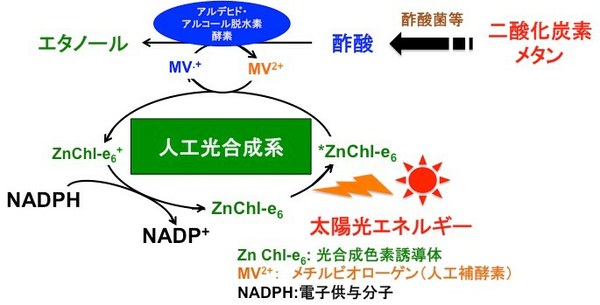
Artificial photosynthesis technology for ethanol production using carbon dioxide as a starting material
Expected Impact
Until now, artificial photosynthesis technology for the molecular conversion of carbon dioxide has been limited to products with a single carbon atom, such as carbon monoxide, formic acid, and methanol. If the technology shown in the diagram above can be fully realized, it will become possible to produce ethanol—which has higher expectations for practical use as a fuel—from sunlight and carbon dioxide. This is expected to emerge as a groundbreaking new technology comparable to existing bioethanol production methods derived from food crops and other biomass.
Future Development
We plan to work on expanding this research into a new artificial photosynthesis technology capable of producing ethanol fuel from sunlight and carbon dioxide. This will be achieved by incorporating techniques to synthesize acetic acid from methane (a natural gas) and carbon dioxide, through the utilization of acetogenic bacteria and other biological systems.
About This Research
This research is the result of a joint collaboration between the Research Center for Artificial Photosynthesis (ReCAP) at our university and the Technical Research Center of Mazda Motor Corporation.
Publication Information
| Journal: | Applied Catalysis B: Environmental, issued by Elsevier |
|---|---|
| Paper Title: | Ethanol synthesis based on the photoredox system consisting of photosensitizer and dehydrogenases |
| Authors: | Yutaka Amao (Osaka City University) Naho Shuto (Oita University) Hideharu Iwakuni (Mazda Motor Corporation) |
| URL: | https://www.sciencedirect.com/science/article/pii/S0926337315300096 |