Functional liposomes
Liposomes are phospholipid-based vesicles having a particle size of several tens to several hundred nanometers. Liposomes have been considered ideal drug carriers because they are highly safe, their size can be easily controlled, and various drug molecules can be encapsulated. In fact, many liposome drugs have already been put into practical use and are used in a clinic. 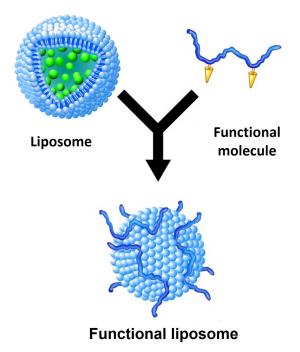
Another feature of liposomes is that by combining with functional molecules and materials, "functional liposomes" that reflect the functions of the combined materials can be obtained. A variety of functional liposomes have been developed to date to realize the basic concept of drug delivery systems (DDS), which is to maximize the effectiveness of medicines and reduce adverse effects. In order to precisely control drug distribution at the tissue, cellular, and organelle levels, functional molecules and materials to be combined into liposomes must be designed and synthesized based on advanced chemistry. Furthermore, in order to accurately evaluate the performance of liposomes modified with functional molecules and materials, advanced bioassay technology is also required.
Our laboratory focuses on acidic pH environments inside tumor tissues and cells and develops functional polymers and lipids that change their properties responding to such acidic environments, to obtain “pH-responsive liposomes” and apply them to cancer treatment. For example, when liposomes are combined with polycarboxylic acids that change their properties from hydrophilic to hydrophobic when protonated in acidic environments, they can destabilize the liposomal membrane in an acidic environment or fuse with another lipid membrane. When such functional liposomes are taken up by the cells through endocytosis, they can be used as DDS materials to fuse with endosomes, which have an acidic environment, and introduce drugs into cells.
Papers on this theme
- E. Yuba, “Development of functional liposomes by modification of stimuli-responsive materials and their biomedical applications”, J. Mater. Chem. B, 8, 1093-1107 (2020). (Review) DOI:10.1039/C9TB02470K
- M. Miyazaki, E. Yuba, H. Hayashi, A. Harada, K. Kono, “Hyaluronic acid-based pH-sensitive polymer-modified liposomes for cell-specific intracellular drug delivery systems”, Bioconjugate Chem., 29, 44-55 (2018). DOI: 10.1021/acs.bioconjchem.7b00551.
- E. Yuba, T. Osaki, M. Ono, S. Park, A. Harada, M. Yamashita, K. Azuma, T. Tsuka, N. Ito, T. Imagawa, Y. Okamoto, “Bleomycin-loaded pH-sensitive polymer-lipid-incorporated liposomes for cancer chemotherapy”, Polymers, 10, 74 (2018). DOI: 10.3390/polym10010074.
- N. Yamazaki, S. Yamakawa, T. Sugimoto, Y. Yoshizaki, R. Teranishi, T. Hayashi, A. Kotaka, C. Shinde, T. Kumei, Y. Sumida, T. Shimizu, Y. Ohashi, E. Yuba, A. Harada, K. Kono, “Carboxylated phytosterol derivative-introduced liposomes for skin environment-responsive transdermal drug delivery system”, J. Liposome Res., 28, 275-284 (2018). DOI: 10.1080/08982104.2017.1369995.
- K. Kono, T. Kaiden, E. Yuba, Y. Sakanishi, A. Harada, "Synthesis of oligoethylene glycol-modified hyperbranched polyglycidols for dual sensitization of liposomes to pH and temperature", J. Taiwan Institute of Chemical Engineers, 45, 3054-3061 (2014). DOI:10.1016/j.jtice.2014.06.011.
- E. Yuba, A. Harada, Y. Sakanishi, K. Kono, "Carboxylated hyperbranched poly(glycidol)s for preparation of pH-sensitive liposomes", J. Control. Release, 149, 72-80 (2011).