Curricula
Program Outline
The five-year integrated curriculum is organized to achieve the learning outcomes (Diploma Policy) of the System-inspired Leaders in Multidisciplinary Science degree program. To cultivate professionals in five years who create new value through interdisciplinary thinking in diverse fields, from basic science to social systems, the program offers a multidisciplinary curriculum with industry-academia-government collaboration that integrates different fields, as shown below.
- Literacy courses are designed to provide students with the basic knowledge they need as researchers and to teach them broadly about social issues and value creation, not just particular academic disciplines.
- Interdisciplinary courses deepen students’ interest in various academic fields and develops a foundation in multidisciplinary research skills through interaction with researchers in different fields.
- Ideation courses, the core of the degree program, are organized to provide practical instruction in “systems thinking,” which takes a bird's-eye view of mono (material things) and koto (systems) made up of diverse and complex academic and social elements, “design thinking,” which combines diverse elements to create new mono and koto, and “management skills” to realize these through multidisciplinary thinking.
- Global courses develop the ability to identify and solve problems in various fields that arise in the globalized industrial world through lectures, research, and seminars held in collaboration with researchers in different fields, people from diverse industries, and foreigners with different cultural backgrounds.
- Entrepreneurship courses provide opportunities to learn and practice ways to connect research results and new ideas to the creation of industrial innovation by fully applying the knowledge acquired in 1 to 4 above.
Course
The program’s coursework is designed in a way that students think for themselves about strengthening their knowledge and work continuously toward strengthening that knowledge on their own. The following diagram shows the relationship between the curriculum and the knowledge they develop.
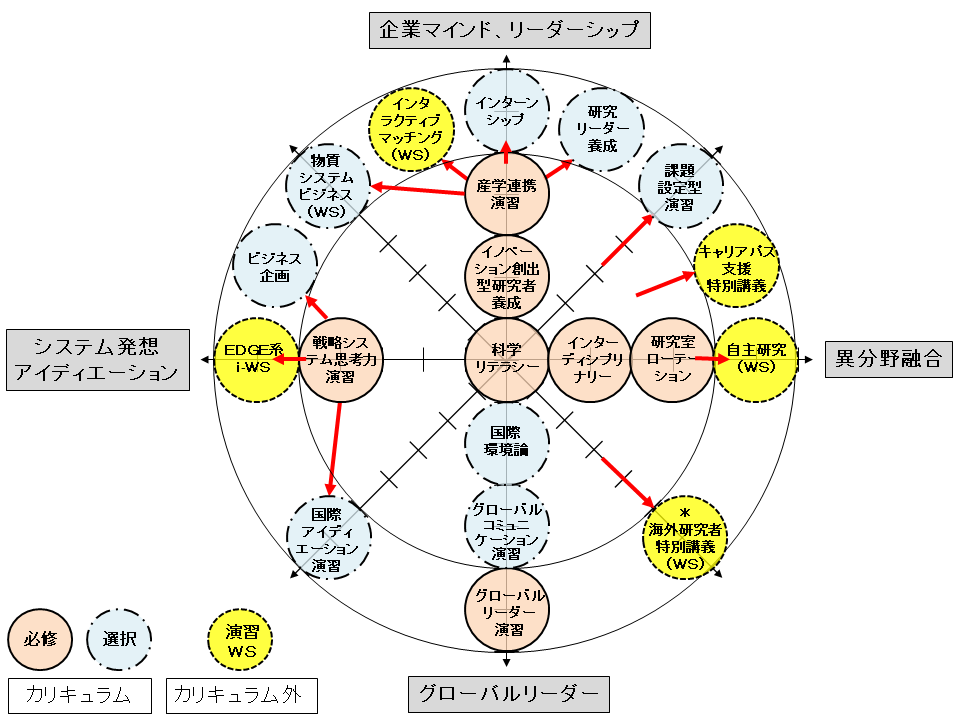
Curricula and Accreditation
* For the standard curriculum for current students, please see the “Course Registration Guidance” page.
| Courses |
Subject Title | Number of Credits (Circled numbers are compulsory) |
Academic Year |
Number of credits for designated subjects, etc. |
|
|---|---|---|---|---|---|
|
Literacy |
Scientific Literacy* |
② |
1-2 |
4 credits or more |
|
|
Studies on International Environmental Issues |
2 |
1-2 |
|||
|
Special Seminar for Scenario Task Oriented Planning |
2 |
1-2 |
|||
|
Introduction to Innovation* |
② |
1-2 |
|||
|
Interdisciplinary |
Special communication seminar based on multidisciplinary sciences |
2 |
1-2 |
2 credits or more |
|
|
SiMS Special Research (Laboratory Rotation) * |
② |
3-5 |
|||
|
Ideation |
Special Seminar for Strategic Reasoning and Thinking1* |
② |
1-2 |
4 credits or more |
|
|
Special Seminar for Strategic Reasoning and Thinking2* |
② |
1-2 |
|||
|
The Ideation and Globalization Workshop |
2 |
3-5 |
|||
|
Global |
Special Seminar for Global Communication |
2 |
1-2 |
2 credits or more |
|
|
Global Leader Workshop* |
② |
3-5 |
|||
|
Entrepreneurship
|
Global Collaboration |
UNM-ASM Special Lecture A |
3 |
1-2 |
4 credits or more including 2 subjects (2 credits) from 8 subjects marked with (*). |
|
UNM-ASM Special Lecture B |
3 |
1-2 |
|||
|
Lecture on Corporate Finance |
2 |
1-2 |
|||
|
Advanced |
Case Studies in Startup and Business Strategy* |
1 |
3-5 |
||
|
Commercialization Consulting Seminar* |
1 |
3-5 |
|||
|
Intellectual Property Rights Strategy* |
1 |
3-5 |
|||
|
Idea Generation Workshop* |
1 |
3-5 |
|||
|
Management and Marketing Workshop* |
1 |
3-5 |
|||
|
Marketing and Management for Innovative Products/Services* |
1 |
3-5 |
|||
|
Venture Business and Entrepreneurship Basics* |
1 |
3-5 |
|||
|
Leadership and Team Management Workshop* |
1 |
3-5 |
|||
|
Practical |
Business Planning Workshop |
2 |
3-5 |
||
|
Research Internship |
2 |
3-5 |
|||
|
Collaborative Research Leaders Internship |
2 |
3-5 |
|||
|
|
Total |
16 credits or more (including 12 required credits) |
|||
Double Degree / Curricula
| Courses |
Subject Title | Number of Credits (Circled numbers are compulsory) |
Academic Year |
Number of credits for designated subjects, etc. |
|
|---|---|---|---|---|---|
|
Literacy |
Scientific Literacy* |
② |
1-2 |
4 credits or more |
|
|
Studies on International Environmental Issues |
2 |
1-2 |
|||
|
Special Seminar for Scenario Task Oriented Planning |
2 |
1-2 |
|||
|
Introduction to Innovation* |
② |
1-2 |
|||
|
Interdisciplinary |
Special communication seminar based on multidisciplinary sciences |
2 |
1-2 |
2 credits or more |
|
|
SiMS Special Research (Laboratory Rotation) * |
② |
3-5 |
|||
|
Ideation |
Special Seminar for Strategic Reasoning and Thinking1* |
② |
1-2 |
4 credits or more |
|
|
Special Seminar for Strategic Reasoning and Thinking2* |
② |
1-2 |
|||
|
The Ideation and Globalization Workshop |
2 |
3-5 |
|||
|
Global |
Special Seminar for Global Communication |
2 |
1-2 |
2 credits or more |
|
|
Global Leader Workshop* |
② |
3-5 |
|||
|
Entrepreneurship
|
Global Collaboration |
UNM-ASM Special Lecture A |
3 |
1-2 |
4 credits or more including 2 subjects (2 credits) from 8 subjects marked with (*). |
|
UNM-ASM Special Lecture B |
3 |
1-2 |
|||
|
Lecture on Corporate Finance |
2 |
1-2 |
|||
|
Lecture on Corporate Finance Advanced Seminar |
1 |
1-2 |
|||
|
Advanced |
Case Studies in Startup and Business Strategy* |
1 |
3-5 |
||
|
Commercialization Consulting Seminar* |
1 |
3-5 |
|||
|
Intellectual Property Rights Strategy* |
1 |
3-5 |
|||
|
Idea Generation Workshop* |
1 |
3-5 |
|||
|
Management and Marketing Workshop* |
1 |
3-5 |
|||
|
Marketing and Management for Innovative Products/Services* |
1 |
3-5 |
|||
|
Venture Business and Entrepreneurship Basics* |
1 |
3-5 |
|||
|
Leadership and Team Management Workshop* |
1 |
3-5 |
|||
|
Practical |
Business Planning Workshop |
2 |
3-5 |
||
|
Research Internship |
2 |
3-5 |
|||
|
Collaborative Research Leaders Internship |
2 |
3-5 |
|||
|
|
Total |
16 credits or more (including 12 required credits) |
|||
Double Degree (Anderson School of Management, University of New Mexico)
Overview - the Double Degree Curricula of SiMS Program
Course Registration Guide
Anderson School of Management, UNM
SiMS Program
SiMS overview
SiMS pamphlet
Future Innovators Development Program
FiND overview
FiND pamphlet