Research Results
Feb 10, 2026
- Press Release
- Joint research results
- Paper / PressRelease
- Joint research results
Joint Research Results by Iida Group Holdings and Osaka Metropolitan University Published as World's First Integrated Artificial Photosynthesis System Verification for Residential Energy Decarbonization
Iida Group Holdings Co., Ltd. (Headquarters: Musashino, Tokyo; President: Hiroshi Nishino) has successfully developed a residential energy system apparatus using artificial photosynthesis technology through joint research with Osaka Metropolitan University (Joto-ku, Osaka; Chairperson: Shinichi Fukushima). We are pleased to announce that we have successfully conducted the world's first verification experiment at the Expo 2025 Osaka, Kansai, Japan, demonstrating a series of "carbon-recirculating" operations ranging from solar-driven formic acid generation to power generation using the formic acid, and the recovery and utilization of carbon dioxide from exhaust gas. Our company and the Research Center for Artificial Photosynthesis at Osaka Metropolitan University have been conducting joint research and development since 2015 toward the realization of the "IG Perfect Eco House" utilizing artificial photosynthesis technology.
What is Artificial Photosynthesis Technology?
Modeled after plant photosynthesis, this technology generates organic substances from sunlight, carbon dioxide, and water. We are researching the generation of formic acid, which serves as an organic substance and a hydrogen carrier. In our IG Perfect Eco House research, we are developing a mechanism that stores energy as formic acid—which is easier to store than hydrogen—and safely generates energy by chemically converting formic acid into hydrogen when needed.
Formic acid is a type of organic compound synthesized from hydrogen and carbon dioxide. While it is classified as a hazardous material under the Fire Service Act, aqueous solutions of 78wt% or less are exempt. Because it remains a liquid at standard temperature and pressure, it is easier to handle than low-density flammable hydrogen gas itself, attracting significant attention as a storage medium for hydrogen energy. For instance, the 10wt% formic acid aqueous solution produced in this verification experiment contains the equivalent of approximately 1,000 L of hydrogen in a 20 L volume. This corresponds to approximately 3 kWh of energy, which represents one-fifth of the daily energy required by an average Japanese household. For this reason, formic acid is considered an extremely beneficial organic substance capable of safely storing and transporting hydrogen energy.
What is the IG Perfect Eco House?
Conventionally, sunlight has been utilized as a primary form of renewable energy. However, it is heavily dependent on weather conditions and time, presenting a major challenge for residential use where electricity is required during hours when sufficient solar energy cannot be obtained. To solve this issue, the joint research team from our company and Osaka Metropolitan University is developing a system that stores energy using artificial photosynthesis technology and utilizes it at any given timing. This system is a "carbon-recirculating" mechanism primarily composed of the following three processes:
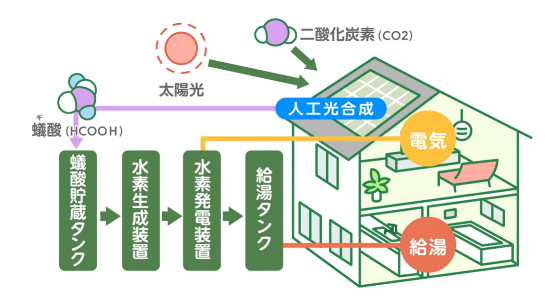
Schematic diagram of the IG Perfect Eco House
- Generation: Formic acid, an energy carrier, is generated from solar energy, water, and carbon dioxide through artificial photosynthesis.
- Hydrogen Generation: When energy is required, formic acid is decomposed through a chemical reaction to obtain a gas mixture of hydrogen and carbon dioxide.
- Power Generation and Recirculation: Power is generated using the obtained gas mixture, supplying electrical energy and thermal energy from power generation to the residence.
Furthermore, high-concentration carbon dioxide contained in the exhaust gas during power generation is recovered and reused for the formic acid generation in step 1. In this manner, unlike methods that obtain energy by burning fossil fuels, residential energy use does not increase carbon dioxide in the atmosphere. Moreover, carbon dioxide is trapped within the IG Perfect Eco House system in the form of formic acid and exhaust gas, allowing for the effective utilization of carbon resources.
Verification Experiment at the Expo 2025 Osaka, Kansai, Japan
In the verification experiment at the Expo 2025 Osaka, Kansai, Japan, the following three prototype devices were fabricated to verify the series of operations as a system designed for a residential home:
- Artificial Photosynthesis Apparatus: Composed of a solar concentrating panel and a formic acid generation cell, it synthesizes formic acid from carbon dioxide.
- Formic Acid Decomposition Apparatus: Decomposes the synthesized formic acid to extract hydrogen.
- Hydrogen Power Generator: Generates electricity using the extracted hydrogen.
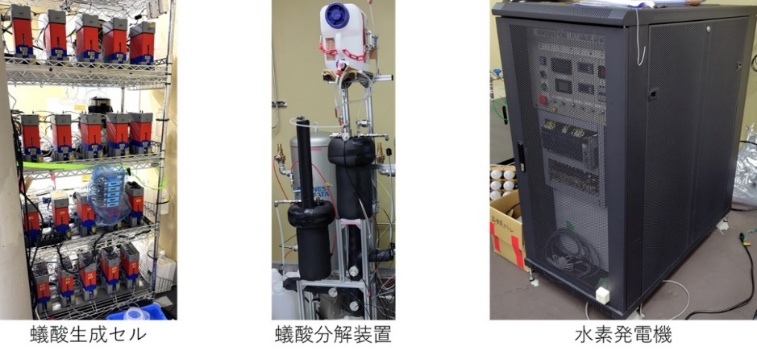
Photograph of the apparatus used in the verification experiment
(From left) Formic acid generation cell, formic acid decomposition apparatus, and hydrogen power generator
In this experiment, these apparatuses were operated in coordination, successfully demonstrating "carbon recirculation" by recovering the exhaust gas (carbon dioxide) generated during power generation and reusing it for formic acid synthesis in the first apparatus.
Thus, we have successfully conducted the world's first verification experiment for a series of operations in a residential-targeted system, encompassing not only artificial photosynthesis but also power generation and carbon recirculation through exhaust gas utilization. The electrical power obtained during the verification experiment was utilized for a model of the IG Perfect Eco House inside our pavilion. Moving forward toward practical application, we plan to utilize the data obtained from this verification experiment to work on further efficiency enhancements and downsizing.
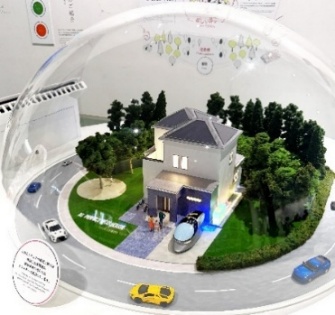
Model illuminated by electricity derived from the verification experiment
⇒All Press Release (PDF: 729.6KB)
SDGs


Published on: Osaka Metropolitan University Website