Research Results
May 13, 2026
- Press Release
- Joint research results
- Paper / PressRelease
- Joint research results
Press Release Issued on Joint Research Results by Iida Group Holdings Co., Ltd. and Professor Yutaka Amao, Associate Professor Yasuo Matsubara (OMU) et al., Published in EES Solar Issued by RSC
Advancement in Automated Operation of Artificial Photosynthesis System: Highly Efficient Production of Formic Acid Using Sunlight
Presenters
- Yasuo Matsubara (Associate Professor, Research Center for Artificial Photosynthesis, Osaka Metropolitan University)
- Yutaka Amao (Professor, Research Center for Artificial Photosynthesis, Osaka Metropolitan University)
- Hinako Kawakami (Researcher, Next-Generation Technology Development Office, Iida Group Holdings Co., Ltd.)
- Yasuhito Kajita (Researcher, Next-Generation Technology Development Office, Iida Group Holdings Co., Ltd.)
Summary
Formic acid is an important substance that can simultaneously achieve carbon dioxide reduction and energy storage. A Maximum Power Point Tracking (MPPT) system, which combines solar cells with an electrolyzer to produce formic acid while controlling the solar cells to always generate power efficiently, is a promising technology for realizing autonomous artificial photosynthesis devices that automatically produce fuel using sunlight as an energy source. However, conventional MPPT systems faced the challenge of requiring expensive batteries to stabilize output according to the intensity of sunlight.
This research group theoretically modeled and improved the electrolyzer, establishing the foundation of artificial photosynthesis technology for automated operation that continues to produce formic acid at a constant concentration under specific conditions, regardless of the intensity of sunlight.
These research results were published online in the international academic journal EES Solar on March 20, 2026.
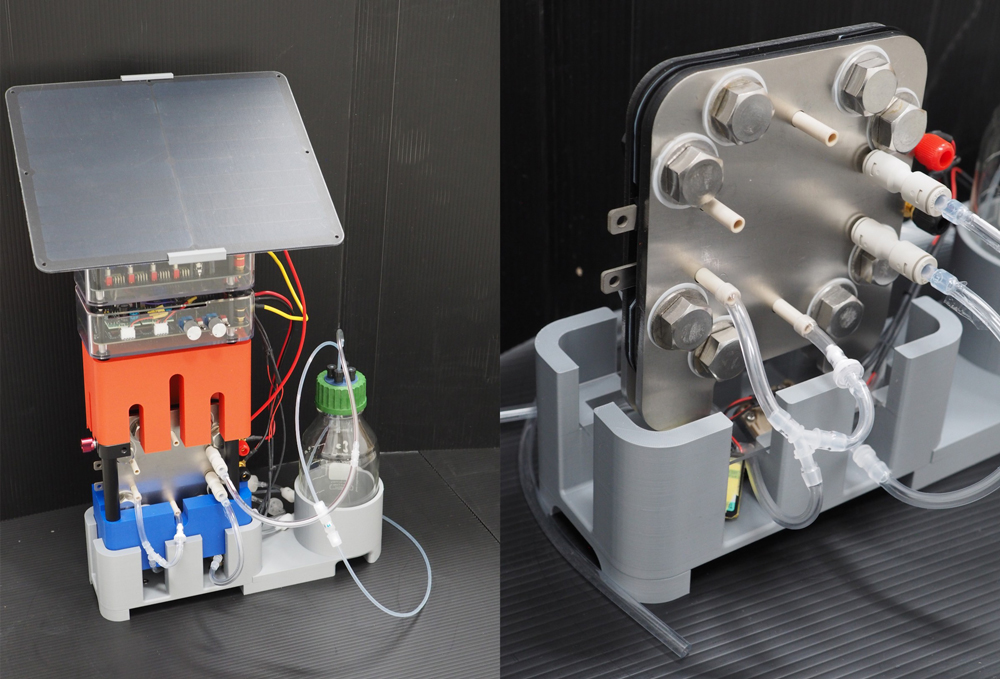
Figure 1: Artificial photosynthesis system generating formic acid from carbon dioxide and water
Key Points
- The electrolyzer for generating formic acid was theoretically modeled and improved from thermal and electrical perspectives.
- By controlling the supply of gas and water according to the intensity of sunlight, pure formic acid of a constant concentration can now be consistently obtained.
- Under specific conditions, the foundation of artificial photosynthesis technology for automated operation was established, enabling the tracking of the maximum power point of solar cells.
- As an automated artificial photosynthesis operation system, it has achieved the world's highest level of energy efficiency at present.
Researcher's Comment
"Currently, technological developments to achieve net-zero greenhouse gas emissions are being conducted worldwide. The Research Center for Artificial Photosynthesis researches, develops, and supports science and technology for this purpose. We are proud that this research has presented a new methodology as an intermediate technology bridging the gap toward the social implementation of such core technologies."

Associate Professor Yasuo Matsubara
Research Background
Artificial photosynthesis is a promising technology that uses solar energy as a driving force to synthesize fuel from carbon dioxide. This research group has been conducting research aimed at establishing artificial photosynthesis technology to generate formic acid, which can serve as fuel, from water and carbon dioxide using solar energy. Connecting solar cells with an electrolyzer and controlling operation with a Maximum Power Point Tracking (MPPT) system is one of the promising approaches to realizing autonomous artificial photosynthesis devices that produce fuel driven by solar energy. However, although the goal is low-cost fuel production through artificial photosynthesis, conventional MPPT systems rely on expensive components, such as batteries, which has been a major challenge for the entire system.
Research Details
In this study, the electrolyzer was theoretically modeled and improved from thermal and electrical viewpoints. As a result, the foundation of an automated artificial photosynthesis technology was established, which can track the maximum power point of solar cells under specific conditions and produce formic acid at a constant concentration regardless of the intensity of sunlight.
In the artificial photosynthesis technology developed in this study, pure formic acid with a constant concentration is always obtained by controlling the gas and water supply according to the intensity of sunlight. It was demonstrated that a device incorporating this technology can actually generate formic acid stably from water and carbon dioxide using sunlight with varying intensity.
Specifically, instead of using a conventional electronic MPPT system, when the model devised in this study was applied to an electrolyzer (Figure 2) connected to a commercially available monocrystalline silicon solar panel, the power generated by the solar cells could be utilized with high efficiency (85% on average). With a solar-to-formic acid energy conversion efficiency of 2%, the system succeeded in producing 0.1 kg of formic acid from pure water and carbon dioxide. This energy efficiency includes the energy required to operate the device, achieving the world's highest level of efficiency for an automated operation system at present.
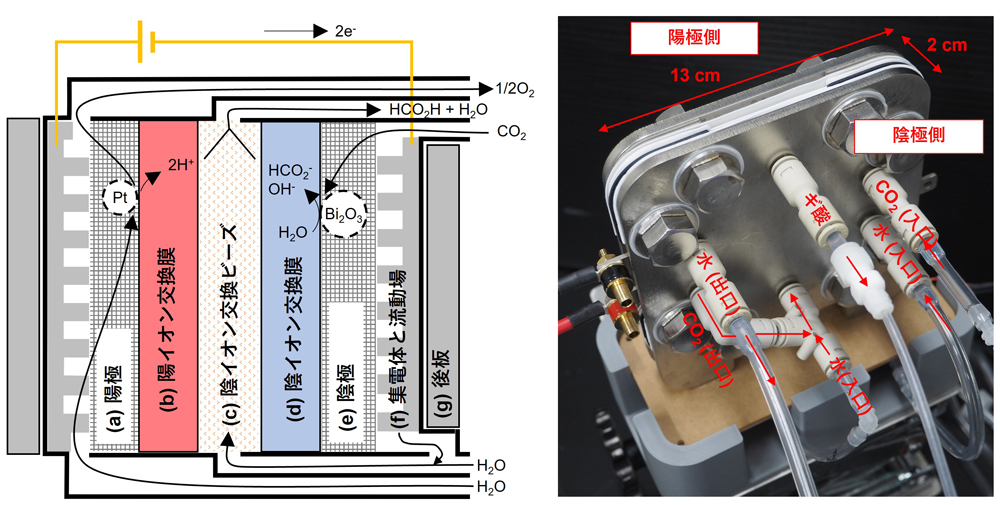
Figure 2: Structure and external view of the electrolyzer for generating formic acid from water and carbon dioxide
Expected Effects and Future Prospects
This research underwent demonstration testing at the "Iida Group x Osaka Metropolitan University Joint Pavilion" during the Expo 2025 Osaka, Kansai, Japan, which opened in April 2025. The generated formic acid was utilized to supply power to a mini-diorama inside the pavilion. In the future, we aim to further increase the yield of formic acid and expand this artificial photosynthesis technology for installation in residential homes.
Funding Information
This study was conducted as a joint research project with Iida Group Holdings Co., Ltd.
Journal Information
| Journal: | EES Solar* |
|---|---|
| Title: | Chemical Maximum-Power-Point Tracking System for Stabilized Liquid Solar-Fuel Production |
| Authors: | Yasuo Matsubara, Hinako Kawakami, Yasuhito Kajita, Yutaka Amao |
| URL: | https://doi.org/10.1039/D5EL00177C |
*EES Solar (Energy and Environmental Science Solar) is a premier international academic journal published by the Royal Society of Chemistry (RSC), a British academic institution, focusing on solar energy and photovoltaics. The journal publishes a wide range of research and analytical papers advancing solar energy fields, spanning chemistry, physics, materials science, engineering, theory, policy, and techno-economic analysis. In particular, it actively features research aiming for high performance with minimal environmental impact using eco-friendly materials and sustainable methods.
Research Inquiries
Research Center for Artificial Photosynthesis, Osaka Metropolitan University
Professor Yutaka Amao
E-mail: amao[at]omu.ac.jp (Please replace [at] with @)
Media Inquiries
Public Relations Department, Osaka Metropolitan University
TEL: +81-6-6605-3411
E-mail: koho-list[at]ml.omu.ac.jp (Please replace [at] with @)
SDGs


Published on: Osaka Metropolitan University Website