TOPICS
Aug 26, 2025
- NEWS
- Lecture / Seminar
- Lecture / Seminar
2nd Lecture Meeting of FY2025 Held by Research Center for Artificial Photosynthesis
- Lecture Title:
"Natural and Biomimetic Light-Harvesting Nanotubes in the Light of Single-Molecule Spectroscopy." - Speaker:
Professor Jürgen Köhler (University of Bayreuth, Germany) - Date & Time:
Tuesday, August 26, 2025, 16:00-17:00 Venue: Cultural Exchange Room, 1F, Academic Information Ce - Venue: Cultural Exchange Room, 1F, Media Center, Sugimoto Campus, Osaka Metropolitan University
(Due to a maintenance period, the main entrance is closed. Please enter through the side entrance on the Faculty of Engineering side.) - Participation fee:Free (No prior registration required. Please come directly to the venue.)
- Co-host:
Joint Usage/Research Center for Catalysis (JURCC)
Research Group on Carbon Dioxide Conversion Catalysts, the Catalysis Society of Japan
Research Group on Bio-related Catalysts, the Catalysis Society of Japan
Clean Energy (CN) Coalition Promotion Office, Innovation Working Group
⇒Flyer for the Research Center for Artificial Photosynthesis Lecture
We organized a lecture by Professor Jürgen Köhler, a leading expert in single-molecule spectroscopic measurements for photosynthetic light-harvesting systems. Since this is a special occasion where he will present his work in an easy-to-understand manner tailored for chemists, we cordially invite everyone to attend.
Organizer: Ritsuko Fujii (Res. Center for Artificial Photosynthesis / Dept. of Chemistry, Faculty of Science (Concurrent Appointment))
Contact: ritsuko[at]omu.ac.jp (Please change [at] to @) / Extension: 3624
Lecture Abstract
How do photosynthetic antennas efficiently utilize sunlight? Chlorosomes are the light-harvesting systems of green sulfur bacteria and consist of a large number of bacteriochlorophyll (BChl) molecules. It is believed that the heterogeneity in BChl numbers and aggregate structures in individual chlorosomes leads to efficient light-harvesting functions. Single-molecule spectroscopy is particularly suited to approach this issue, as it can detect specific and characteristic spectral features of individual molecules that cannot be observed in ensemble-averaged spectra. In this lecture, the above topics will be discussed using natural chlorosomes and biomimetic light-harvesting nanotubes as examples.
(Reference: Jansen et al., Chem. Phys. Rev. 5 (2024), 041305)
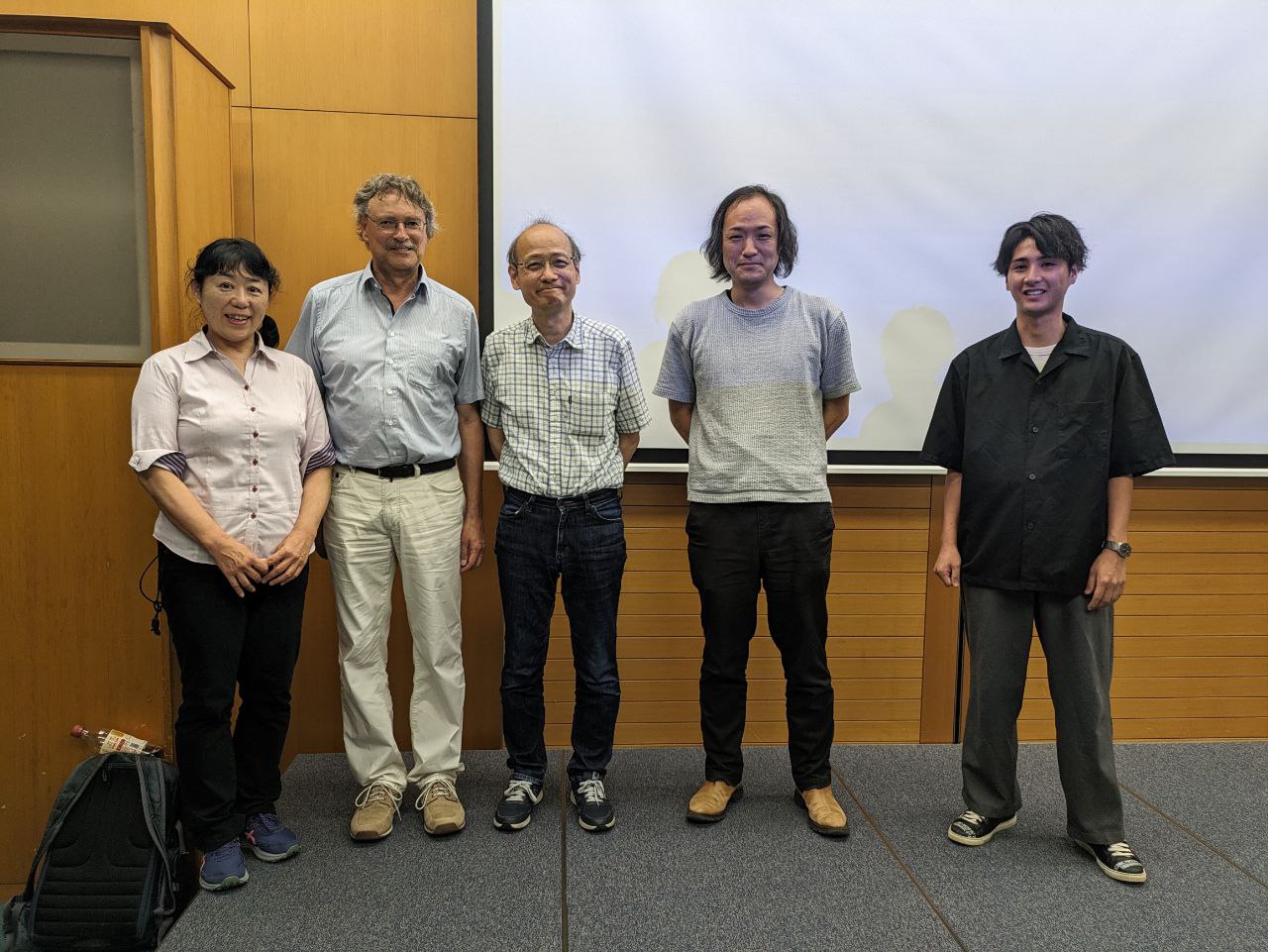
Although the main entrance was locked due to the closure of the Media Center and Library used as the venue, approximately 20 people participated, including online attendees.
In the lecture, "single-molecule spectroscopy," a method capable of observing the behavior of individual particles that can only be captured as a statistical average in conventional spectroscopy, was introduced. Because this method sensitively reflects structural changes within molecular aggregates, it is possible to estimate characteristic structures within the aggregates through comparison with calculations based on structural models.
This time, the latest research applying this method to "photosynthetic light-harvesting complexes," which are composed of aggregates of numerous dye molecules, was introduced. The correlation between individual photoresponses and the assembled structures of dye molecules was explained in detail, suggesting that these characteristic assembled structures might be caused by slight differences in the chemical structures of the dyes.
After the lecture, a lively Q&A session took place, reflecting the high level of interest among the participants. We would like to express our sincere gratitude to everyone who attended.