Research Topics
Research Topics
Materials whose color changes with the direction of light: Electronic states behind pleochroism
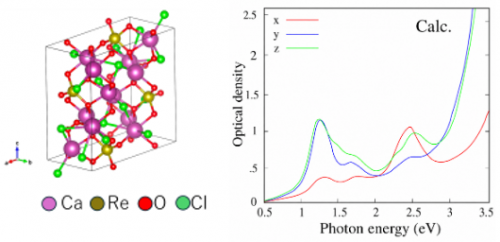
The same material can sometimes appear in different colors depending on the direction from which it is viewed or illuminated. This phenomenon, known as pleochroism, reflects the directional nature of electronic states in a crystal. We study the 5d transition-metal compound Ca3ReO5Cl2, which exhibits strong pleochroism, using first-principles calculations. By taking into account the localized character of Re-5d electrons, we qualitatively reproduce the polarization-dependent optical absorption spectra. Our analysis shows that the pleochroism arises from hybridization between anisotropic Re-d and O-p orbitals.
Controlling Magnetism by Mechanical Strain: Microscopic Origin of Piezomagnetism
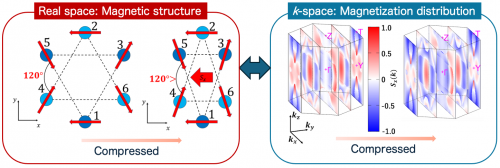
Applying mechanical strain such as compression or tension can modify the magnetic properties of materials. Such strain-induced control of magnetism has attracted attention as a possible route toward low-power spintronic functionalities. In our group, we investigate the noncollinear antiferromagnet Mn3Sn using first-principles calculations to understand how strain induces magnetization at the electronic-structure level. In particular, by combining real-space spin analysis with wave-number space (k-space) electronic structure analysis, we aim to clarify the microscopic origin of the piezomagnetic effect.
Layer-Dependent Properties of Two-Dimensional Layered Materials
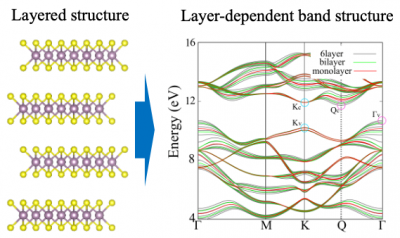
In layered materials such as MoS2, the electronic and optical properties can change significantly depending on whether the material consists of a single layer or multiple stacked layers. We study the transition from a direct to an indirect band gap in MoS2 as the number of layers increases, using Wannier-function-based analysis. By clarifying how interactions between electronic orbitals change through layer stacking, we aim to build a fundamental understanding of the electronic states of layered materials and their layer-dependent properties.
Hall Effects Driven by Topology and Quantum Geometry
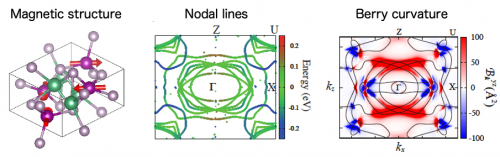
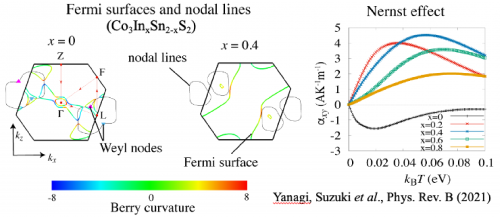
Magnetic materials can exhibit the anomalous Hall effect, in which a voltage appears perpendicular to an applied electric field even without an external magnetic field. Recent studies have revealed that this phenomenon is closely related to the topology of electronic states and the quantum geometric properties of electronic wave functions. We investigate how special band degeneracies called nodal lines enhance anomalous and nonlinear Hall effects through the Berry curvature in the antiferromagnetic material NbMnP. By understanding the relationship between electronic structure and transport phenomena, we aim to clarify the origin of novel quantum transport phenomena.
Functionality of Magnetic Materials and Magnetic Properties
In addition to ferromagnetic materials, which have macroscopic magnetization and exhibit magnetic properties, there are various other types of magnetic materials, such as ferrimagnetism, chiral magnetism, and alternating magnetism, depending on the microscopic magnetization distribution inside the material, which cause various physical phenomena that differ from those of ferromagnetic materials. Under what conditions do these phenomena occur? How can we bring out more powerful phenomena? We investigate the properties of magnetic materials from various angles using theory and simulation, studying the relationship with functionality as a material and the possibility of new phenomena.
Symmetry breaking and electronic states brought about by spin-orbit coupling
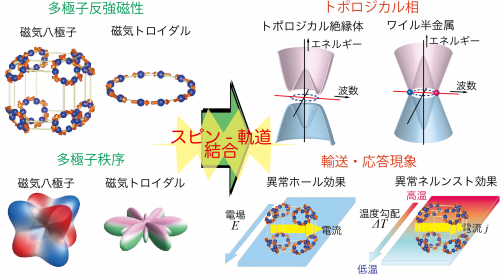
Spin-orbit coupling, which is introduced into quantum mechanics as a relativistic correction for electron motion, causes a symmetry lowering in the electronic states of materials by coupling real space and spin space, which obey different symmetry rules, and is the origin of various physical phenomena. However, it is difficult to obtain a clear physical picture of the physical properties brought about by the coupling of spin, a resident of the quantum mechanical world, with real space, and in particular, the relationship with electric and magnetic ordering, including magnetism and superconductivity, is still a field of research where many mysteries remain. Our research group is studying the physical phenomena induced by spin-orbit coupling by making full use of mathematical science and first-principles calculations.
Understanding Experimental Observations through First-Principles Calculations
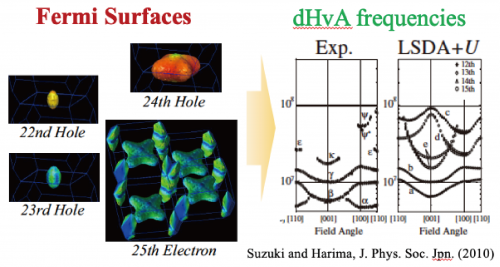
The properties of a material are determined by the states of the electrons and atomic nuclei, which are its fundamental building blocks, within the material. Understanding the electronic state of material is essential to understanding the origin of macroscopic measurements such as electrical conduction, specific heat, and magnetization measurements, as well as experimental observations such as photoemission spectroscopy, nuclear magnetic resonance (NMR), and quantum osciration. The properties of electronic states can be investigated from many angles by analyzing band structures, density of states, Fermi surfaces, Berry phases, etc. Information on single-electron states obtained from first-principles calculations can also be used to calculate many physical quantities observed in experiments. Through collaborations with various experimental groups, our research group is working to understand unknown physical phenomena obtained experimentally.
- Hisashi Kotegawa, Akira Nakamura, Vu Thi Ngoc Huyen, Yuki Arai, Hideki Tou, Hitoshi Sugawara, Junichi Hayashi, Keiki Takeda, Chihiro Tabata, Koji Kaneko, Katsuaki Kodama, Michi-To Suzuki, Phys. Rev. B 110, 214417/1-8 (2024)
- Hisashi Kotegawa, Yoshiki Kuwata, Vu Thi Ngoc Huyen, Yuki Arai, Hideki Tou, Masaaki Matsuda, Keiki Takeda, Hitoshi Sugawara, Michi-To Suzuki, npj Quantum Mater. 8, 56/1-7 (2023)
- Michi-To SUZUKI and Hisatomo HARIMA, J. Phys. Soc. Jpn. 79 (2010) 024705/1-5.
Exploration of antiferromagnetic properties by magnetic structure screening
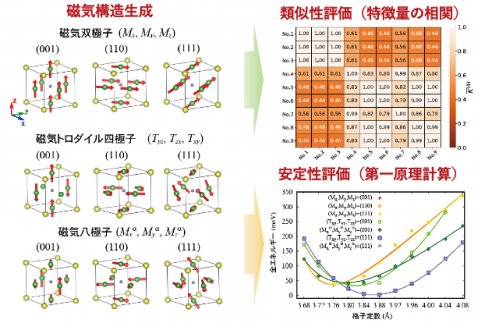
In many antiferromagnets, a highly symmetric magnetic structure is realized. In our research, we have shown that highly symmetric magnetic structures can be automatically generated for a given crystal structure by utilizing the multipole theory and group theory. We have shown that these theories can be combined with first-principles calculations to predict stable magnetic structures without the use of experimental information, and we are now working on the prediction of physical properties through simulations of magnetic structures. We are also engaged in research on physical properties using machine learning, a statistical analysis method that is the basis of artificial intelligence, and have proposed theoretical methods for converting magnetic structures into machine learning features.
- Takuya Nomoto, Susumu Minami, Yuki Yanagi, Michi-To Suzuki, Takashi Koretsune, and Ryotaro Arita, Phys. Rev. B 109, 094435/1-12 (2024)
- Michi-To Suzuki, Takuya Nomoto, Eiaki V. Morooka, Yuki Yanagi, and Hiroaki Kusunose, Phys. Rev. B 108, 014403/1-11 (2023)
- M.-T. Huebsch, T. Nomoto, M.-T. Suzuki, and R. Arita, Phys. Rev. X 11, 011031/1-25 (2021)
First-principles calculations of rare-earth and actinide material
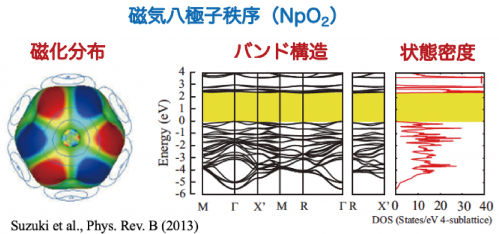
Rare-earth and actinide compounds that contain f-electron systems are called heavy-electron systems. It is known that the prediction accuracy of electronic states by first-principles calculations is significantly reduced for the f-electron system. In addition, some heavy fermion systems form multipole orders by using large orbital degrees of freedom of f-electrons, and it is important to understand the electronic states under complex electric/magnetic order formation by first-principles calculations. Our research group is studying electronic states in strongly correlated electron systems through the development of first-principles calculation methods and analytical theory.