Lab News
2026年4月14日
- 研究
【研究論文】ACS Omega
当研究室 (Tran Thi Minh Ngoc博士ら) とベトナム国家大学ホーチミン市校との共同研究による研究成果が、ACS Omega誌にアクセプトされました。
A reserach paper entitled "Hardwood burning as a dominant source of fine particulate matter from biomass burning in Ho Chi Minh City, Vietnam" has been published in ACS Omega (First Author: Dr. Tran Thi Minh Ngoc, a visiting researcher in our laboratory). Congratulations!
 Cite: ACS Omega (https://doi.org/10.1021/acsomega.5c13491)
Summary
An international research group—comprising Dr. Ngoc Tran (Visiting Researcher), Associate Prof. Yusuke Fujii, and Prof. Norimichi Takenaka from the Graduate School of Sustainable System Sciences at Osaka Metropolitan University, along with Associate Prof. To Thi Hien from Vietnam National University Ho Chi Minh City—has investigated the characteristics of biomass burning derived components in PM2.5 within Ho Chi Minh City, Vietnam's largest city.
While levoglucosan is widely used as a tracer for biomass burning, it is known to decrease in concentration due to chemical degradation and volatilization in the atmosphere. However, quantitative assessments of this degradation in tropical regions have remained insufficient. In this study, the team analyzed PM2.5 samples collected from the rainy to the dry season in 2021, performing source apportionment and correction calculations that account for the degradation of levoglucosan.
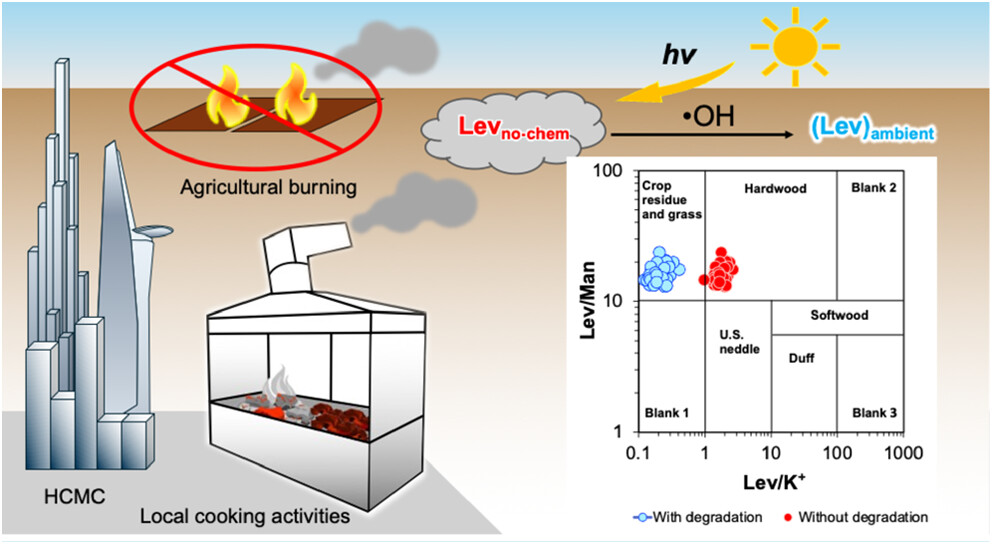
The results revealed that while conventional analysis (which does not account for tracer degradation) suggested "agricultural residue burning" as the primary source, the degradation-corrected analysis indicated that "hardwood and hardwood charcoal combustion" is the more dominant factor. These findings demonstrate the critical importance of considering the transformation of tracer components to accurately identify air pollution sources and implement effective mitigation strategies in Southeast Asia.
Key Points
- Estimated an approximately 88% loss of levoglucosan, a tracer for biomass burning in Ho Chi Minh City’s PM2.5, due to atmospheric degradation and volatilization.
- Identified hardwood and hardwood charcoal combustion (primarily from cooking activities) as the likely dominant biomass burning source, rather than agricultural residue, after correcting for the loss of the tracer component.
- Confirmed that biomass burning sources are predominantly associated with local urban activities within Ho Chi Minh City, rather than long-range transport from surrounding areas.
Comments from Dr. Tran Thi Minh Ngoc
Our detailed data analysis has revealed that everyday activities, such as cooking commonly seen on the streets of Ho Chi Minh City, are actually deeply connected to the city's air quality. We believe this study successfully provides scientific evidence for the need to look beyond agricultural burning—previously considered the primary cause—and focus on localized emission sources within the urban area. I look forward to continuing our work on high-precision analysis tailored to regional characteristics, contributing to the resolution of environmental challenges across Southeast Asian countries.
Research Background
- Urgent Need for Accurate Evaluation of "Biomass Burning"
In Southeast Asia, biomass burning—including forest fires, agricultural burning, and the use of wood or charcoal for cooking—is a major source of PM2.5. In Vietnam, where pollution is particularly severe, characterizing the specific contributions of these sources is critical for developing effective mitigation strategies.
-
Potential Risks of "Errors" in Conventional Analysis
Levoglucosan, a key tracer for biomass burning, is prone to atmospheric loss due to chemical reactions and volatilization in tropical environments. Conventional analysis without accounting for this loss risks misidentifying emission sources. In Ho Chi Minh City, precise data was essential to scientifically distinguish whether urban activities or long-range transport from suburban areas were the dominant influence.
Research Details
-
Re-evaluation Accounting for Tracer "Loss"
In tropical environments, it was estimated that approximately 88% of levoglucosan, a tracer for biomass burning, was lost in the atmosphere. Conventional analysis based on raw data tended to bias identified sources toward "agricultural residue burning." To address this, the team applied a method to correct concentrations based on the estimated loss rate, allowing for a re-evaluation of the true emission sources.
-
"Hardwood Combustion" and "Local Activities" Identified as Primary Drivers
The corrected analysis revealed that the primary driver of biomass burning-derived PM2.5 in Ho Chi Minh City was not agricultural residue, but rather the combustion of hardwood and charcoal used for cooking. Furthermore, backward trajectory analysis strongly suggested that these emissions originated from local activities within the city and its vicinity, rather than long-range transport from distant areas.
Expected Impacts and Future Prospects
-
Improving the Accuracy of Source Apportionment in Tropical Regions
The effectiveness of the analysis accounting for the transformation of tracer components demonstrated in this study is expected to provide important guidance for future air pollution research in tropical and subtropical regions. By optimally integrating existing methodologies to suit local environmental conditions, this work demonstrates a more accurate evaluation of specific biomass burning types that were previously difficult to distinguish, contributing to enhanced precision in urban PM2.5 source apportionment worldwide.
-
Scientific Basis for Effective Air Pollution Mitigation
Data demonstrated that the primary causes of PM2.5 derived from biomass burning in Ho Chi Minh City stem not only from suburban agricultural burning, as previously assumed, but also from urban cooking activities (utilizing hardwood and charcoal). This finding serves as a crucial scientific basis for authorities to consider effective pollution control measures tailored to the actual emission sources, such as promoting fuel switching or improving exhaust systems.
-
Expansion Across Southeast Asia
The research group plans to apply this approach to other major Southeast Asian cities and investigate varying seasonal conditions. By further elucidating the types of biomass burning and their atmospheric transformation processes, we aim to deepen the understanding of regional air pollution challenges and contribute to discussions focused on future environmental improvements.
Funding
The research group plans to apply this approach to other major Southeast Asian cities and investigate varying seasonal conditions. By further elucidating the types of biomass burning and their atmospheric transformation processes, we aim to deepen the understanding of regional air pollution challenges and contribute to discussions focused on future environmental improvements.
Inquiries Regarding This Research
Dr. Ngoc Tran (Visiting Researcher)
Graduate School of Modern System Sciences, Osaka Metropolitan University
Email: k22402v[at]omu.ac.jp
*Please replace [at] with @.