Clinical Training Report
Clinical Training Report
Thomy Duong
- Country / Regions
- Vietnam
- School
- Vin University
- Elective period
- 6 October 2025 to 17 October 2025
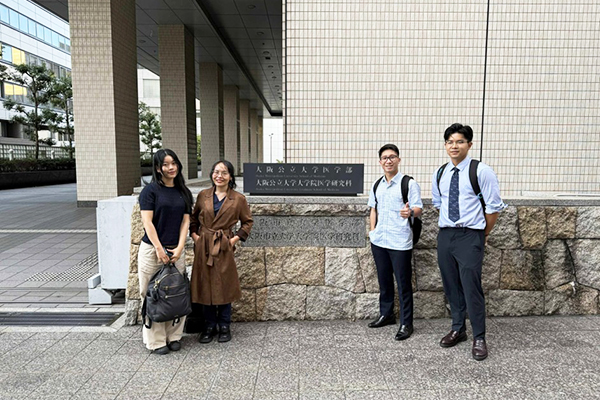
Osaka Metropolitan University Hospital (大阪公立大学病院) is centrally located in Osaka and houses many specialties that combine modern medical technology with an emphasis on academic training. As expected for Japanese culture, it is organized, clean and well managed.
Doctors, staff, medical students and nursing students work in tandem and can be seen dressed in their uniquely assigned gowns. In contrast to Vietnam, many patients were either elderly or young children. The elderly were also often very self-reliant and visiting on their own. The atmosphere was often quiet; the volume levels similar to a night shift in Vietnam. I was very impressed with the efficiency of the hospital and the patients seemed very satisfied with the quality and speed of care

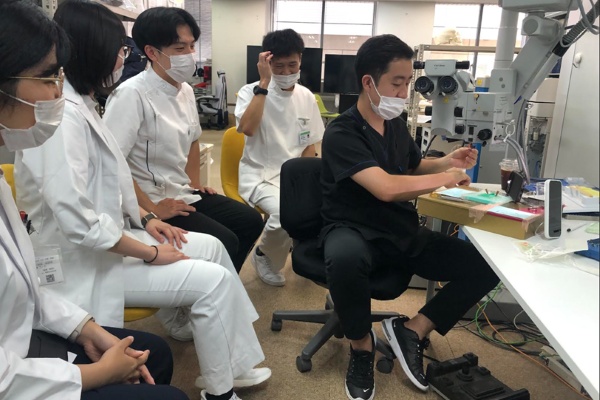
I was very lucky to have had the opportunity to learn from Dr. Hamada both with the group of students and independently in the office (top picture) and Dr. Atsushi (In the bottom picture) showing how to use the microscope for micro suturing of an anastomoses of a blood vessel. Both were very helpful in explaining medical procedures as I saw them in the surgery room. Dr. Atsushi was also very friendly and even suggested good places to eat Udon in Osaka. I am also very thankful to Dr. Amamoto for showing me around the first days – I think there is a good chance that I saw her operations the most often. I also thank Prof. Motomura who greeted me the first day and always brought positive energy into the operating room. His research poster that hangs in the office is also a great inspiration for me, showing the importance of continuing to build a greater body of research. I also thank Dr. Fujikawa, Dr. Fujii, Dr. Morotomi (who often greeted me in German) and Dr. Kojima for their guidance during this rotation. Thank you to Dr. Murikawa for always trying to help me understand what is going on during procedures.
The students were very helpful, showing me the canteen, study area, the computers and patient documents. I got to learn about how they studied, their programs, their OSCE they were preparing for (which was very different from ours) and wrote the case report on a surgery with them following their format. One big difference is that students from Vietnam have much more clinical experience as they are allowed to engage patients more earlier and more often. Outside of academics, they also showed me places to eat, visit and shop.

Most of my days were scheduled around the surgeries. From which I got to see many:
I also got to see inpatient procedures: malignant melanoma with 3 site reconstruction after-care, orbital reconstruction after-care, epidermal cyst removal, glomus tumor removal, diabetic foot ulcer, myelitis ulcer
In surgery I saw: Breast reconstruction with abdominal graft, ptosis eyelid lift, nevus removal, cleft-lip operation, palate surgery,
I also saw; laser treatment for Mongolian spots and haemangioma.
During my rotation at Osaka Metropolitan University Hospital’s Plastic Surgery Department, I observed both the technical precision and humanistic depth of reconstructive work. A memorable case involved a facial basal cell carcinoma, where the surgical team demonstrated both meticulous skill and empathetic patient-centered care. Despite language barriers, I learned to navigate cultural nuances—recognizing Japan’s hierarchy, indirect communication, and deep respect for not burdening others. These moments taught me the importance of cultural sensitivity, preemptive communication, and understanding the psychological impact of facial deformities. Beyond surgical knowledge, this experience deepened my appreciation for the balance between technical mastery, compassion, and adaptability in patient care.
I got to observe a palatoplasty procedure after a cleft-lip repair that started at 8:30 AM and ran until 4 PM. It was very long, and the doctors were very hardworking. During the procedure, Dr. Maeda showed us the above picture to help us visualize how the procedure was going to look and told us why it was being done.

I also got to see the department take part in conferences: trying new technologies and discussing the cases they had for that week. It was very insightful to see the department adapting to new technology and how they discussed each patient – checking up on the details, asking why a procedure was done a certain way. I am most impressed by the fact that on my first day Dr. Murikawa said he loved his job – that is something we hear very rarely in Vietnam since the job is so demanding and working hours are long. It tells me that at OMU, the working conditions, passion and personal development continue to be top class.
Overall, I got to learn a lot of about Japanese culture and also learned to introduce myself in Japanese. When I could just speak a few sentences, I felt that people immediately warmed up to make more conversation. I noticed the pre-emptive and strategic ways doctors engaged their patients. I have also seen and been inspired by their craftsmanship.