Research News
Dec 25, 2025
- Veterinary Science
Escherichia albertii: The still unfolding journey of a misdiagnosed pathogen
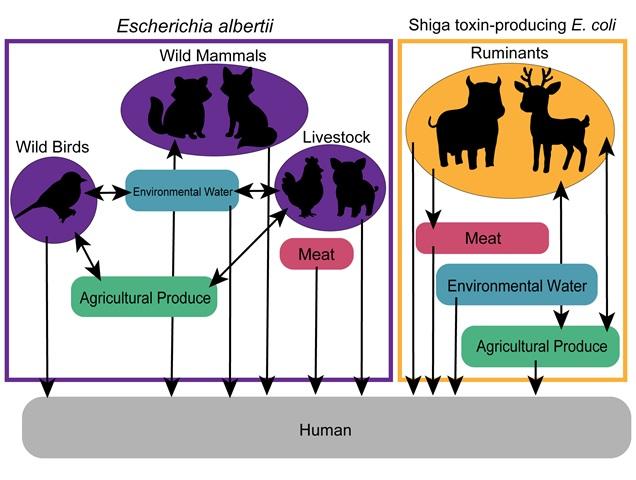
Animal to human bacteria pathways
Escherichia albertii is primarily found in mammals and birds, suggesting it is a novel zoonotic pathogen.
Credit: Osaka Metropolitan University
Escherichia albertii, initially identified as Hafnia alvei, by the commercial identification biochemical strip, API 20E, was isolated from an infant with diarrhea in Bangladesh in 1989. However, this bacterium was later renamed as a novel species, E. albertii because of its similarities in biochemical and genetic properties to the genus Escherichia, but different from those of any known species in the genus. E. albertii possesses many pathogenic attributes including a key one, which is the ability to produce attaching and effacing (A/E) lesions in the intestinal mucosa mediated by genes on a 35-kb pathogenicity island called the locus of enterocyte effacement. Therefore, it is a member of the family of A/E pathogens.
However, there are still many unknowns that exist regarding this bacterium. To fill the knowledge gap, an Osaka Metropolitan University-led research team conducted a review which described what is known about some key facets of this bacterium and provided directions for future research. For instance, the researchers discussed some of the initially reported cases of enteropathogenic Escherichia coli (EPEC), enterohemorrhagic E. coli (EHEC), Shigella boydii O13, and cytolethal distending toxin II-producing E. coli (CTEC-II), which were later confirmed as E. albertii. E. albertii caused sporadic cases of diarrhea and diarrheal outbreaks, and rarely extraintestinal infections. E. albertii was also associated with death of birds in Scottland, UK, and Alaska in the USA. Not only birds, including chickens, but also mammals, including raccoons, seem to be major reservoirs of E. albertii suggesting that E. albertii is an emerging zoonotic pathogen.
Further, specific detection methods and selective and differential media for E. albertii have been developed for diagnosis. Several E. albertii isolates have been sequenced revealing key characteristics of the organism, but there are still many more miles to travel before a better understanding of this pathogen can be realized.
Paper information
Journal: Microbiology and Molecular Biology Reviews
Title: Escherichia albertii: the still unfolding journey of a misdiagnosed pathogen that became a new species and a new member of the family of attaching and effacing enteric bacterial pathogens
DOI: 10.1128/mmbr.00088-23
Authors: Shinji Yamasaki, Atsushi Hinenoya, Dieter Bulach, M. John Albert
Published: 10 December 2025
URL: https://doi.org/10.1128/mmbr.00088-23
Contact
Shinji Yamasaki
Graduate School of Veterinary Science
Osaka International Research Center for Infectious Diseases
Email: yshinji[at]omu.ac.jp
*Please change [at] to @.
SDGs

