Research News
Jan 27, 2026
- Human Life and Ecology
Balancing comfort and sustainability with climate-tailored housing
Region-specific residential buildings solution optimizes energy-efficiency and thermal comfort
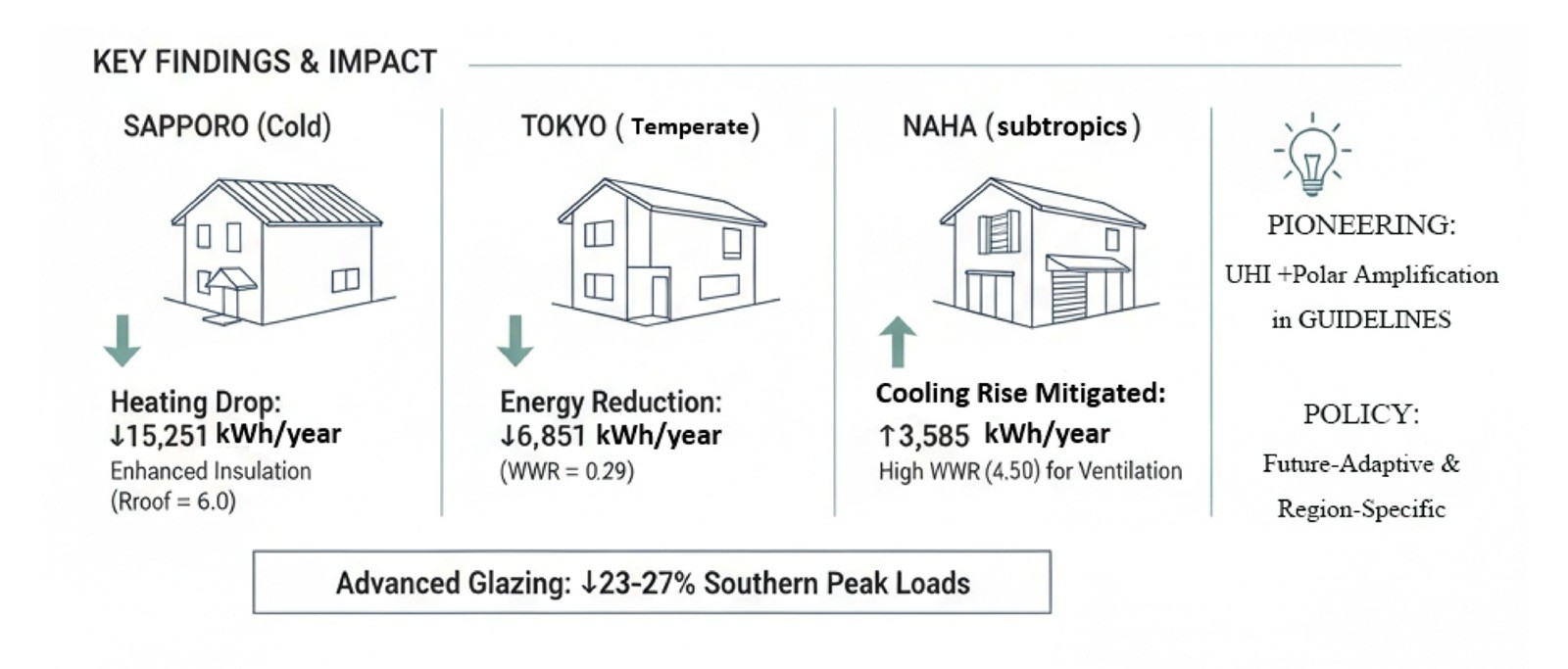
Optimized housing designs
Energy-saving housing designs taking into account regional climate and rising temperatures.
Credit: Osaka Metropolitan University
From subarctic to subtropical, Japan’s varied climates present a challenge for energy-saving housing design. Adding the projected effects of climate change, with temperatures estimated to rise from 1.5 to 3.5°C by the close of the century, there currently is not a standard, one-size-fits-all solution. Therefore, climate-based building design solutions that consider regional differences, thermal comfort, and net-zero carbon goals are urgently needed.
In search for efficient designs, a research group led by Associate Professor Jihui Yuan from Osaka Metropolitan University’s Graduate School of Human Life and Ecology conducted energy simulations for 10 cities across all climate regions in Japan, comparing current and future scenarios using a 120.08 m² two-story three-dimensional residential model. Using weather data and a Genetic Algorithm, they then optimized window-to-wall ratio (WWR) and the thermal resistance performance of the roof, exterior walls, and windows.
As a result, it was found that in cold regions like Sapporo, Hokkaido, strengthening home insulation can reduce the energy used for heating by approximately 15,000 kWh per year. In moderate regions like Tokyo, setting WWR to 0.29 saved approximately 6,800 kWh of energy annually. Meanwhile, in subtropical Naha, Okinawa, setting the WWR to 0.45 can improve ventilation and reduce air conditioning energy consumption by approximately 3,600 kWh. Additionally, it was found that using high-performance windows can reduce the cooling load during the hottest times in south-facing rooms by 23 to 27%.
“This research provides optimal housing design guidelines tailored to each region, contributing to the promotion of net-zero energy housing, the regional optimization of energy efficiency standards, and local governments' climate adaptation policies. Going forward, we plan to work toward “building-city integrated optimization” that combines renewable energy adoption, variable factors in resident behavior, and city-scale environmental measures,” stated Professor Yuan.
The findings were published in Energy Nexus.
Funding
This work was supported by JSPS KAKENHI (Grant Number: JP24K05546; Grant Number: JP24K01053), and JST SPRING (Grant Number: JPMJSP2139).
Paper Information
Journal: Energy Nexus
Title: Optimization of energy-efficient residential building design in Japan: A climate-responsive approach under current and future scenarios
DOI: 10.1016/j.nexus.2025.100605
Author: Xiong Xiao, Jihui Yuan, Zhichao Jiao, Zhengsong Lin, Kazuo Emura, Craig Farnham, Jiale Chai, Xiangfei Kong, Yan Ding, Xiaochen Yang, Zhe Tian
Published: 20 November 2025
URL: https://doi.org/10.1016/j.nexus.2025.100605
Contact
Jihui Yuan
Graduate School of Human Life and Ecology
Email: yuan[at]omu.ac.jp
*Please change [at] to @.
SDGs


