Research News
Feb 4, 2026
- Agriculture
Stacking the genetic deck: How some plant hybrids beat the odds
When cultivated tobacco is crossed with a wild relative it erases lethal genes, allowing normally fatal hybrids to survive
Researchers discovered hybrid combinations capable of overcoming hybrid lethality and producing numerous offspring using tobacco as an experimental plant
(Left) Viable hybrid; (Right) Lethal hybrid
Credit: Osaka Metropolitan University
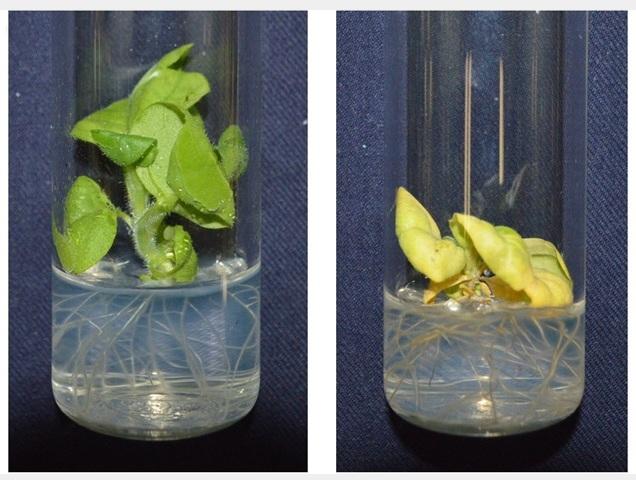
In the plant world, when two different species mate, their offspring often don’t survive. The reason lies in their DNA: incompatible genes often mix in their offspring, triggering a fatal breakdown known as hybrid lethality that acts as a reproductive barrier to keep species separate.
Using tobacco plants and their wild relatives, a research group led by graduate student Shota Nagai and Associate Professor Takahiro Tezuka at the Graduate School of Agriculture, Osaka Metropolitan University, explored what happens when two species with a long evolutionary history attempt to hybridize. As expected, many of the resulting seedlings died shortly after sprouting, turning brown and collapsing from hybrid lethality. However, a larger-than-expected number of hybrids survived and grew normally.
By carefully cross-pollinating cultivated tobacco (Nicotiana tabacum) with a wild species (Nicotiana amplexicaulis), the researchers tracked which seedlings lived and which died. They then examined the plants’ DNA, focusing on two genes known to trigger hybrid lethality when they interact; one from each parent species.
They found that in many of the surviving hybrids, one of the lethal genes had vanished. This disappearance appeared to be the result of a gene reshuffling process known as genome shock. When two very different genomes suddenly merge, the resulting instability can cause large-scale genetic changes such as rearrangements, silencing, or even deletion of entire gene regions. In this case, this reshuffling had erased the genetic trigger that would normally kill the hybrid.
“This finding challenges the long-held assumption that hybrid incompatibilities are fixed,” Professor Tezuka said. “Instead, the very act of hybridization can dismantle the genetic barriers meant to prevent it.”
There are practical implications for the research, as plant breeders often struggle to combine useful traits, such as disease resistance or drought tolerance, from different species. Understanding how genome shock removes genetic roadblocks could open new paths for crop improvement by breaking the reproductive barrier that normally stops different species from mixing. When they are broken, plants can mix genes across species, and this can eventually lead to the creation of new species.
“This research is expected to provide a starting point for overcoming reproductive isolation and achieving hybrid breeding,” Professor Tezuka said. “In plant breeding, hybrid breeding—the process of crossing genetically distinct plants to exchange genes—is widely practiced as a fundamental method. In hybrid breeding, interspecific crosses are performed not only between different strains of the same species but also to utilize more diverse variations. These results suggest how this could be done safely.”
Hybridization plays a major role in the evolution of wildflowers and crops. If genome shock neutralizes lethal gene combinations, it may help explain how new plant species arise rapidly, especially when previously isolated species come into contact with each other.
The findings were published in Frontiers in Plant Science.
Funding
This study was partly supported by JSPS KAKENHI Grant Numbers JP20880024, JP25870627, JP17K15224, JP20K05988, and JP25K09063 from the Japan Society for the Promotion of Science to TT.
Paper information
Journal: Frontiers in Plant Science
Title: Genome-shock deletion of a hybrid lethality gene breaks a reproductive barrier and facilitates speciation in Nicotiana
DOI: 10.3389/fpls.2025.1690873
Authors: Shota Nagai, Kenji Kawaguchi, Hiroki Itakura, Kaho Matsumoto, Takahiro Iizuka, Kosaku Kobayashi, Kouki Nakata, Tetsuya Yamada, Wataru Marubashi, Masanori Yanase, Toshinobu Morikawa, Shuji Yokoi, Takahiro Tezuka
Published: 19 November 2025
URL: https://doi.org/10.3389/fpls.2025.1690873
Contact
Takahiro Tezuka
Graduate School of Agriculture
Email: tezuka[at]omu.ac.jp
*Please change [at] to @.
SDGs
