Research News
Feb 9, 2026
- Engineering
Particle-in-cell study of electron beam propagation through ionospheric plasma
ADR system in action
Theoretical use of an e-beam in the ionosphere to disperse debris.
Credit: Osaka Metropolitan University
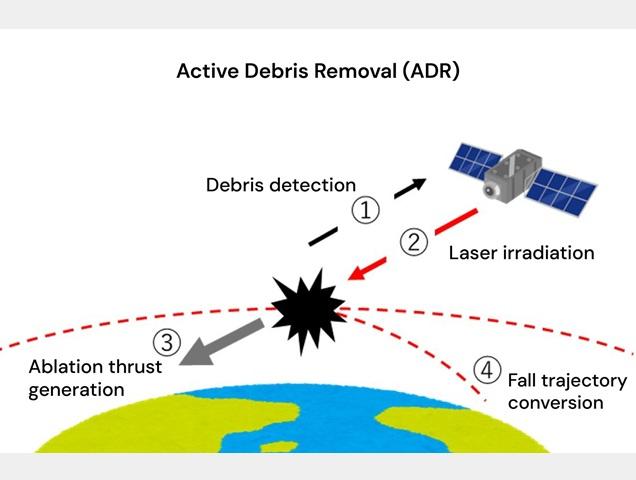
A possible alternative to the active debris removal (ADR) by laser is the ablative propulsion by a remotely transmitted electron beam (e-beam). The e-beam ablation has been widely used in industries, and it might provide higher overall energy efficiency of an ADR system and a higher momentum-coupling coefficient than the laser ablation. However, transmitting an e-beam efficiently through the ionosphere plasma over a long distance (10 m–100 km) and focusing it to enhance its intensity above the ablation threshold of debris materials are new technical challenges that require novel methods of external actions to support the beam transmission.
Therefore, Osaka Metropolitan University researchers conducted a preliminary study of the relevant challenges, divergence, and instabilities of an e-beam in an ionospheric atmosphere, and identified them quantitatively through numerical simulations. Particle-in-cell simulations were performed systematically to clarify the divergence and the instability of an e-beam in an ionospheric plasma. The major phenomena, divergence and instability, depended on the densities of the e-beam and the atmosphere. The e-beam density was set slightly different from the density of ionospheric plasma in the range from 1010 to 1012 m−3. The e-beam velocity was changed from 106 to 108 m∕s, in a nonrelativistic range.
Results revealed that nonrelativistic e-beams of density from 1010 to 1012 m−3 emitted in ionospheric plasmas of density from 1010 to 1012 m−3 experience the laminar-to-turbulent transition. The turbulence should originate from the beam electron/ion two-stream instability because the transition length can be approximated by the theoretical formula of the two-stream instability. In the laminar region, the lateral expansion of the electron beam was suppressed in the plasma. The beam compression factor was quantified for the first time. These results indicate that for the use of e-beams for ADR applications, the laminar region with suppressed divergence can be beneficial for efficient focusing and ablation, but the turbulence due to plasma instabilities needs to be considered in ADR system design.
Paper information
Journal: Journal of Thermophysics and Heat Transfer
Title: Particle-In-Cell Study of Electron Beam Propagation Through Ionospheric Plasma
DOI: 10.2514/1.T7221
Authors: Keita Nishio and Koichi Mori
Published: 4 December 2025
URL: https://doi.org/10.2514/1.T7221
Contact
Koichi Mori
Graduate School of Engineering
Email: koichimori [at] st.omu.ac.jp
*Please change [at] to @.
SDGs
