Research News
Feb 27, 2026
- Human Life and Ecology
Predicting extreme rainfall through novel spatial modeling
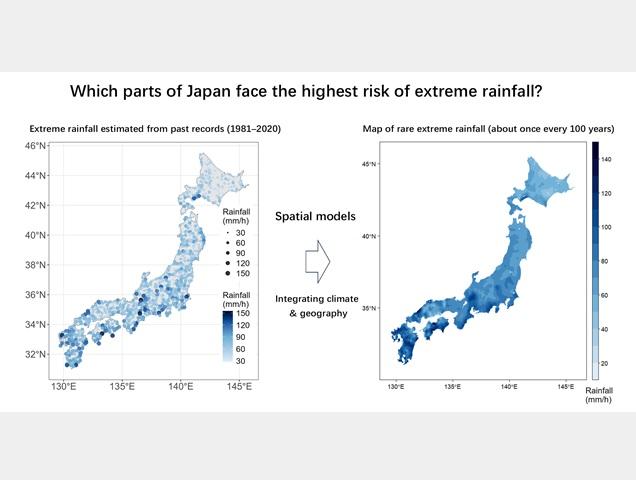
Estimating extreme rainfall
Using weather data from 1981–2020, statistical methods analyzed data to predict extreme rainfall in the next hundred years.
Credit: Osaka Metropolitan University
Japan is an archipelago with diverse climate zones and complex topography that is prone to heavy rain and flooding. Add the growing effects of global warming, these disaster risks are heightened with an increased frequency and intensity of extreme precipitation events. Thus, predicting when and where these events might strike is crucial for future-proofing vulnerable infrastructure, especially in rural areas.
However, current systems for tracking comprehensive weather data are primarily stationed around urban areas, presenting a significant statistical gap across large swathes of Japan. Proper data analysis methods to overcome this and provide accurate predictions to assist in future disaster preparedness further pose a challenge. In related fields, there is debate regarding the traditional kriging method used for spatial predictions, as it causes the underestimation of extreme values, and the high computational load of Bayesian hierarchical models based on the Markov Chain Monte Carlo (MCMC) method. As a plausible alternative, the Integrated Nested Laplace Approximation - Stochastic Partial Differential Equation (INLA-SPDE) method is positioned as an efficient alternative that overcomes these shortcomings and is widely used in environmental and climate research. However, its application to spatiotemporal analysis in complex topographies like Japan is limited.
To determine the most effective approach, Associate Professor Jihui Yuan, Emeritus Professor Kazuo Emura, and Professor Craig Farnham from Osaka Metropolitan University’s Graduate School of Human Life and Ecology, and Visiting Researcher Zhichao Jiao from Yantai University’s Architecture School conducted a study to predict the increasing risk of extreme precipitation across the four main islands of Japan. The researchers divided Japan into four areas based on climate and used hourly precipitation data obtained from 752 meteorological observation stations across Japan from 1981 to 2020. They estimated the Generalized Extreme Value distribution (GEV) at each station using the MCMC method and calculated return value levels for 2-year, 5-year, 10-year, 25-year, 50-year, and 100-year events. The researchers then applied the INLA-SPDE method and kriging methods, ordinary kriging (OK) and kriging with external drift (KED), for spatial prediction, forecasting extreme precipitation in unobserved regions using annual precipitation, distance from the coast, and population as covariates. The Leave-One-Out Cross-Validation (LOOCV) was used to evaluate the model’s performance.
The results showed that the INLA-SPDE method, particularly the SPDE1 model with annual precipitation as a covariate, exhibited higher prediction stability than the kriging method. With a smaller standard deviation during long return periods, spatial variability increased, revealing an expansion of the high-risk zone from south to north.
“This study is significant in that it contributes to improving the quality of disaster prevention plans by identifying the limitations of conventional hazard maps and presenting a framework for scientifically assessing flood risks under climate change,” stated Professor Yuan. “Going forward, we will incorporate dynamic meteorological factors such as typhoon paths into the model and work on expanding it to spatio-temporal models. By resolving these challenges, it will be possible to capture the development process of extreme rainfall more realistically, paving the way for high-resolution forecasting.”
The findings were published in the Journal of Hydrology: Regional Studies.
Funding
This work was supported by JSPS KAKENHI, Grant Numbers 23KJ1840 and JP22K02098.
Paper information
Journal: Journal of Hydrology: Regional Studies
Title: Assessing the risk of extreme precipitation in Japan through GEV distribution and spatial modeling
DOI: 10.1016/j.ejrh.2026.103107
Authors: Zhichao Jiao, Jihui Yuan, Craig Farnham, Kazuo Emura
Published: 6 January 2026
URL: https://doi.org/10.1016/j.ejrh.2026.103107
Contact
Jihui Yuan
Graduate School of Human Life and Ecology
Email: yuan[at]omu.ac.jp
*Please change [at] to @.
SDGs

