Research News
Mar 11, 2026
- Agriculture
Low testosterone, high fructose: A recipe for liver disaster
Changes in male hormones and excessive sugar intake work together in progressing liver damage
Mouse model in Castration/Fructose group
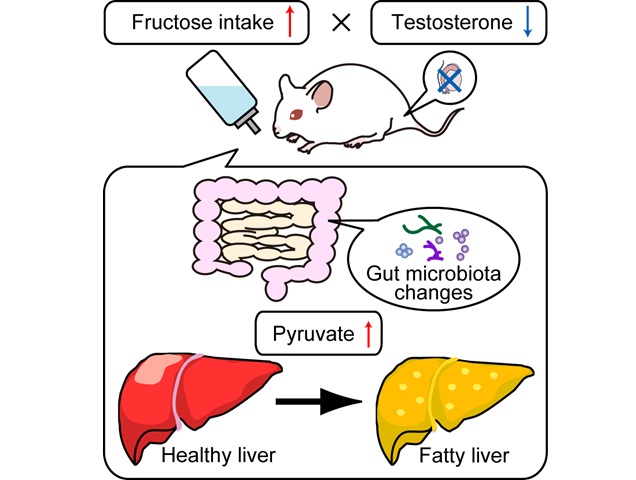
The combination of low testosterone and high fructose intake revealed changes in gut microbiota and increased fat on the liver.
Credit: Osaka Metropolitan University
Low testosterone in itself can cause a variety of health problems, but the addition of a poor diet can exacerbate certain conditions. Metabolic dysfunction-associated steatotic liver disease (MASLD) is one example that approximately 40% of adult men worldwide currently suffer from and has become a global problem. Fatty liver, the initial stage of MASLD, is associated with risk factors such as obesity, type 2 diabetes, decreased testosterone, and high fructose intake from beverages and processed foods. However, the relationship and combined effects of these on the liver have yet to be fully understood.
Focusing on the two distinct factors, decreased testosterone and high fructose intake, a Graduate School of Agriculture research group led by graduate student Hiroki Takahashi and Associate Professor Naoki Harada conducted a study to observe their effects on the liver. Eight-week-old male mice were castrated or sham-operated and divided into six groups, Sham/Control, Sham/ Fructose, Sham/Fructose + Antibiotics, Castration/Control, Castration/Fructose, and Castration/Fructose + Antibiotics. Analyses of liver cells, tissue, plasma, cecal organic acids, and gut microbiota samples were conducted to evaluate the effects and differences between each group.
Results revealed that liver weight increased in castrated mice with fructose intake but lessened in those treated with antibiotics. Each factor alone caused a slight change in liver triglyceride levels, but when the two factors combined, they synergistically contributed to fat accumulation on the liver and worsened fatty liver. Further, the castration and fructose intake group showed signs of altered gut microbiota composition, liver gene expression, and increased levels of cecal pyruvate.
“Upon examining this mechanism, we found that changes in the gut microbiota led to increased levels of pyruvate within the intestine. Furthermore, experiments using mouse-derived primary hepatocytes revealed that pyruvate acts synergistically with fructose to promote neutral lipid accumulation in hepatocytes,” explained Takahashi.
“Going forward, we hope to clarify the mechanism by which pyruvate promotes triglyceride accumulation to pioneer the development of therapeutic drugs and establishment of preventive methods through dietary interventions,” added Professor Harada.
The study was published in American Journal of Physiology-Endocrinology and Metabolism.
Funding
This work was supported by the Japan Society for the Promotion of Science KAKENHI (Grant Nos. 22H02289 and 25K01971 to N.H.) and Thomas J. Beatson Jr. Foundation Grant (No. 2022-006 to E.Y.), National Institute of Diabetes and Digestive and Kidney Diseases (Grant No. R01DK136888 to E.Y.), and Juvenile Diabetes Research Foundation (JDRF) (Grant No. 5-CDA-2022-1178-A-N to E.Y.).
Paper information
Journal: American Journal of Physiology-Endocrinology and Metabolism
Title: Testosterone deficiency synergistically exacerbates fructose-induced hepatic steatosis through gut microbiota and pyruvate in mice
DOI: 10.1152/ajpendo.00518.2025
Authors: Hiroki Takahashi, Naoki Harada, Yohei Hayamizu, Erdenetsogt Dungubat, Masami Nakazawa, Tomoya Kitakaze, Keiichiro Sugimoto, Hiroshi Inui, Eiji Yoshihara, Yoshihisa Takahashi, and Ryoichi Yamaji
Published: 7 January 2026
URL: https://doi.org/10.1152/ajpendo.00518.2025
Contact
Naoki Harada
Graduate School of Agriculture
Email: naoki.harada[at]omu.ac.jp
*Please change [at] to @.
SDGs
