Research News
Mar 13, 2026
- Science
- Research Centers
How an alga makes the most of dim light
A freshwater alga captures far-red light for photosynthesis by rearranging ordinary chlorophyll
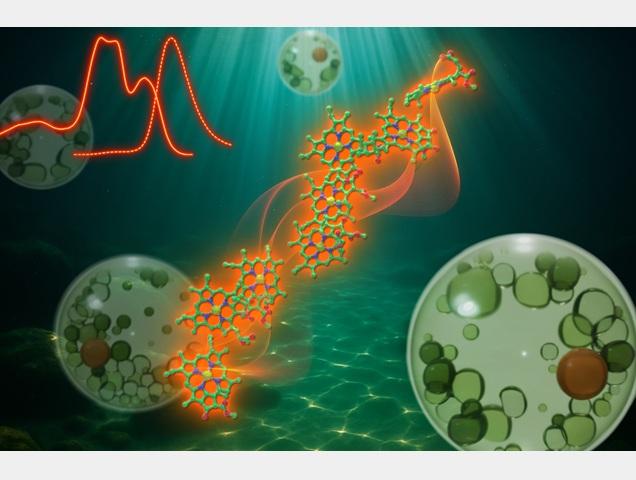
Freshwater alga Trachydiscus minutus has a unique chlorophyll structure to capture far-red light
This single-celled alga harvests far-red light by organizing chlorophyll molecules into large, cooperative clusters within its photosynthetic antenna.
Credit: Yuki Isaji, Soichiro Seki
To survive in areas where it is difficult to photosynthesize, some organisms adopt unique strategies. Osaka Metropolitan University researchers have found that a freshwater alga captures far-red light as an additional energy source by arranging ordinary chlorophyll in an extraordinary way.
Far-red light lies beyond the optimal range for photosynthesis for many organisms. Yet in shaded forests and murky waters, where this light dominates, plants and algae still pull off photosynthesis, making something out of almost nothing.
“Whilst certain cyanobacteria use specialized chlorophylls to absorb far-red light, many plants and algae achieve the same effect by reorganizing ordinary chlorophyll a into cooperative assemblies within their photosynthetic antennas,” said Ritsuko Fujii, lead author and associate professor at the Graduate School of Science and Research Center for Artificial Photosynthesis at Osaka Metropolitan University.
Chlorophyll a is a pigment that cannot absorb far-red light on its own. So, how exactly do these organisms achieve photosynthesis?
The team looked for an answer in the freshwater eustigmatophyte alga, Trachydiscus minutus, an organism that accumulates large amounts of a light-harvesting protein that can utilize far-red light. Although the alga can perform photosynthesis under normal light conditions, the high levels of the light-harvesting protein are especially useful for surviving in low-light conditions.
“The organism produces a specialized photosynthetic antenna called a red-shifted violaxanthin–chlorophyll protein (rVCP), which absorbs far-red light even though it contains only chlorophyll a,” Fujii said.
Using cryo-electron microscopy, the researchers determined the structure of rVCP at a high resolution of 2.4 Å. They found that the protein forms a previously unreported architecture: a tetramer composed of two different heterodimers. This unique assembly brings chlorophyll a molecules into close proximity, allowing them to form unusually large pigment clusters.
To understand how this structure affects light absorption, the team combined the structural data with multiscale quantum chemical calculations.
“Our analysis showed that three chlorophyll clusters within each heterodimer play a major role in absorbing far-red light,” Fujii said. “Importantly, this absorption arises purely from energy delocalization across multiple chlorophyll molecules, independently of the charge-transfer effects that are thought to drive similar red-shifted systems.”
These findings reveal a fundamentally different mechanism for tuning the color of absorbed light, one in which the protein scaffold precisely controls interactions between identical chlorophyll molecules, without chemically modifying the pigment. This explains the resilience of these organisms in tough environments.
The discovery also has practical implications. Some eustigmatophytes are known for their ability to store oils, making them promising candidates for sustainable bioenergy production. Harnessing organisms that can photosynthesize efficiently under far-red light could enable oil production in conventionally unsuitable environments.
The unusual tetrameric structure of rVCP may also offer a new blueprint for protein design. Because pigment arrangement is dictated by protein sequence, this framework could help guide the engineering of artificial or enhanced photosynthetic systems.
“As interest grows in expanding photosynthesis into the far-red region to boost overall photosynthetic productivity on Earth, our next goal is to reveal how this complex delivers captures energy to the photosystem and how that mechanism could be optimized,” Fujii said.
The findings were published in the Journal of the American Chemistry Society.
Funding
- JSPS KAKENHI Grant Numbers 24H02091 and 23H04958
- Grant-in-aid for JSPS Fellowships Grant Number K23KJ1834
- JST CREST Grant Number JPMJCR20E
- Platform Project for Supporting Drug Discovery and Life Science Research (BINDS) from AMED under Grant Number JP23ama121001 and JP23ama121003
- JEOL YOKOGUSHI Research Alliance Laboratories of Osaka University
- OP JAK project Photomachines reg. no. CZ.02.01.01/00/22_008/0004624 875
- Institutional support RVO: 60077344
Paper information
Journal: Journal of the American Chemistry Society
Title: Exciton Delocalization Promotes Far-Red Absorption in a Tetrameric Chlorophyll a Light-Harvesting Complex from Trachydiscus minutus
DOI: 10.1021/jacs.5c17299
Authors: Soichiro Seki, Lorenzo Cupellini, David Bína, Elena Betti, Petra Urajová, Hideaki Tanaka, Tomoko Miyata, Keiichi Namba, Genji Kurisu, Tomás Polívka, Radek Litvín, Ritsuko Fujii
Published: 13 December 2025
URL: https://doi.org/10.1021/jacs.5c17299
Contact
Ritsuko Fujii
Graduate School of Science
Research Center for Artificial Photosynthesis
Email: ritsuko[at]omu.ac.jp
*Please change [at] to @.
SDGs

