Research News
Mar 24, 2026
- Agriculture
- Science
Stolen chloroplasts maintained by host-made proteins offer clues to plant cell origins
The single-celled predator Rapaza viridis temporarily retains chloroplasts from prey algae and imports its own proteins into them
Host-made proteins help maintain the stolen chloroplast in Rapaza viridis
The arrow indicates a chloroplast stolen from algal prey (a kleptoplast) inside an R. viridis cell. The study shows that proteins made by the host are transported into this kleptoplast, where they help keep key chloroplast machinery working.
Credit: Osaka Metropolitan University
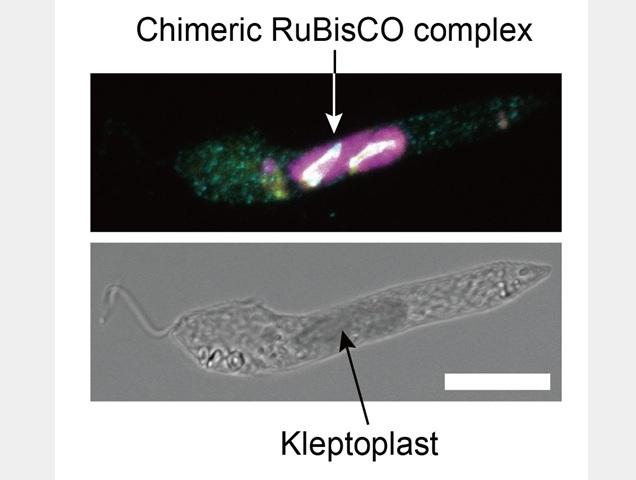
A protein made by Rapaza viridis is imported into a stolen chloroplast and functions there as part of a protein complex
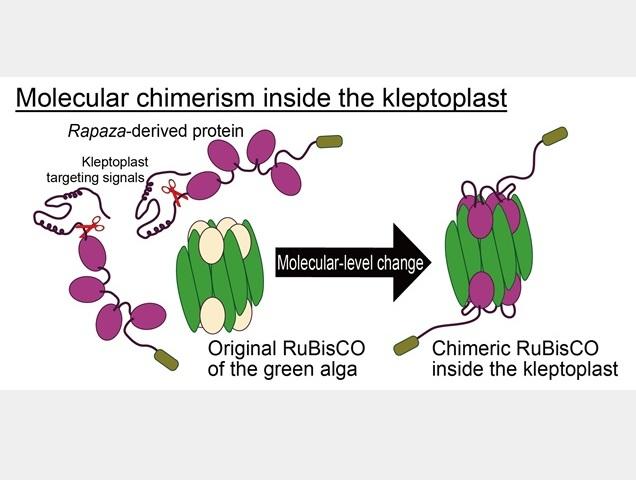
A protein made by R. viridis carries a targeting signal that directs it into a chloroplast stolen from a green alga, where it functions as part of a protein complex.
Credit: Osaka Metropolitan University
Every plant cell is the product of a biological merger billions of years ago. Chloroplasts are key structures in plants and algae that capture sunlight, but originally they were free-living bacteria that took up residence inside another cell. Over time, these partners became more closely integrated by sharing genes, proteins, and roles.
To understand how this process happened, scientists look for organisms that display similar processes. A tiny predator named Rapaza viridis may offer a glimpse of some of the early steps involved in that ancient transformation.
R. viridis is a single-celled organism that performs photosynthesis using chloroplasts stolen from the green alga it consumes. This process is called kleptoplasty—from the Greek word for thief.
Even after the algal nucleus and much of the cytoplasm are lost, the prey-derived chloroplasts remain inside R. viridis. Temporarily, structures from two different organisms coexist within a single cell, which can be described as structural-level chimerism.
Using genetic engineering and biochemical approaches, research led by Masami Nakazawa, a lecturer at the Graduate School of Agriculture, Osaka Metropolitan University, and Professor Yuichiro Kashiyama at the Faculty of Environmental Studies, Fukui University of Technology, has found that the kleptoplasts in R. viridis also exhibit chimerism at the molecular level. This suggests a more advanced form of kleptoplasty than structural-level chimerism alone.
The group identified host-made proteins that are transported into the stolen chloroplast, where they help keep key chloroplast machinery working. When the researchers disrupted the genes encoding these proteins, the stolen chloroplasts functioned less effectively.
Their findings suggest that by producing proteins that function within the stolen chloroplast, R. viridis goes beyond simple prey retention and offers a valuable model for studying how deeper host–organelle integration can arise.
“This makes R. viridis the first organism in which proteins encoded in the host’s nucleus have been biochemically shown to function inside a stolen organelle from another species,” Professor Kashiyama said. “These findings show that even temporary chloroplast retention can involve a deeper level of host–organelle integration than previously recognized.”
Dr. Nakazawa believes that experiments like these can help researchers understand what happened when the first plant cells emerged. “By revealing mechanisms at work when eukaryotic cells use foreign organelles, going beyond what we typically see in model organisms, this study provides clues to the evolutionary processes that gave rise to plant cells,” she said.
Funding
Japan Society for the Promotion of Science KAKENHI: 18H03743, 21H02273, 24K09042, 21K19240, 23K17996, 24K02048, and 24H00579.
Paper information
Journal: Nature Communications
Title: Transient molecular chimerism for exploiting xenogeneic organelles
DOI: 10.1038/s41467-026-70516-x
Authors: Yuichiro Kashiyama, Moe Maruyama, Masami Nakazawa, Tsuyoshi Kagamoto, Hiroki Imanishi, Sayaka Yamamoto, Mio Inoue, Ryo Onuma, Goro Tanifuji, Hiroki Ashida, Noriko Inada, Koichiro Awai, Shin-ya Miyagishima
Published: 24 March 2026
URL: https://doi.org/10.1038/s41467-026-70516-x
Contact
Masami Nakazawa
Graduate School of Agriculture
Email: mami[at]omu.ac.jp
*Please change [at] to @.
SDGs
