Research News
Mar 31, 2026
- Science
Two organs, one brain area: How fish orientate themselves in the water
A brain region integrates input from the eyes and the ‘third eye’ in fish to help them orientate themselves
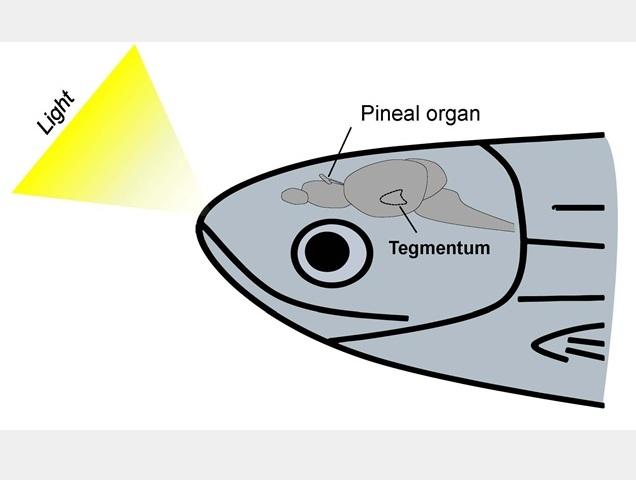
The brain regions involved in pineal ‘color’ detection
Light is detected by both the eye and the pineal organ. The light-sensitive opsin PP1 in the pineal cells senses the balance of ultraviolet and visible light and converts it into neural signals. These signals are processed in the tegmentum, where they regulate the fish’s up and down swimming behavior.
Credit: Osaka Metropolitan University
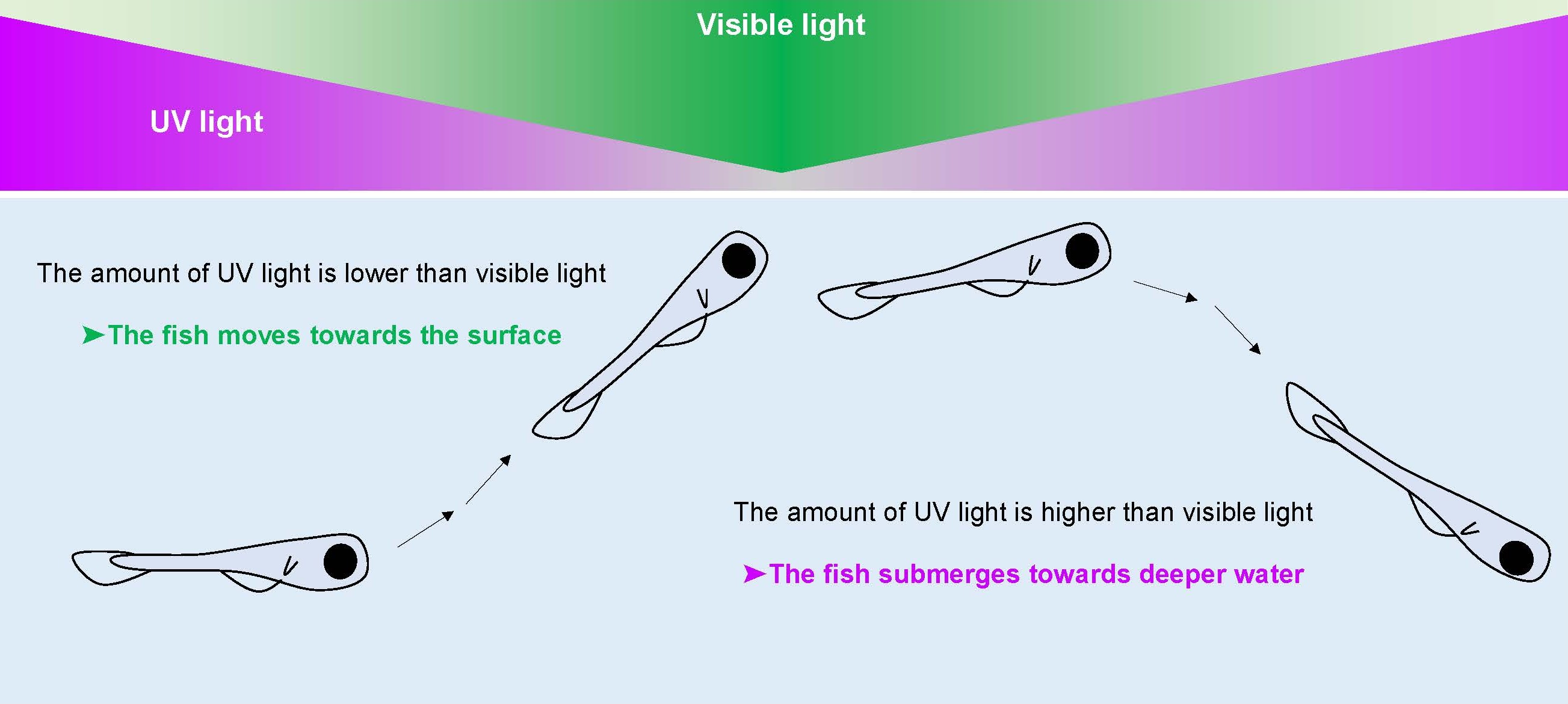
How different light cues influence fish behavior
Fish change their swimming direction in response to differences in the wavelength of light: when ultraviolet light is weak, they swim toward the surface, whereas when it is strong, they swim downward.
Credit: Osaka Metropolitan University
Using zebrafish, researchers from Osaka Metropolitan University (OMU) have identified the tegmentum region in the fish midbrain as the area where light input from both the fish’s eyes and the pineal organ—the ‘third eye’—is integrated. Their findings suggest that fish use the integrated light signals in this region to swim up or down in response to differences in the wavelength of light.
In the aquatic world, light changes depending on depth, water conditions, and differences such as sunlight and shade. Differences in the levels of visible and UV light enable fish to infer these factors, which they may use to make survival decisions.
To understand the related processes taking place in the brain, an OMU research team led by Professors Akihisa Terakita and Mitsumasa Koyanagi with Dr. Seiji Wada of the Graduate School of Science looked at the opsin parapinopsin 1 (PP1). Opsins are specialized proteins that respond to light. They are typically found in the eyes, but in some species, opsins like PP1 are also found in the pineal organ. Using calcium imaging, the team investigated how color-detection signals produced by PP1 in the pineal photoreceptor cells are passed to the brain by nerve cells.
“We decided to study zebrafish, as their larvae are transparent,” Professor Koyanagi said. “This transparency means that changes in calcium levels within nerve cells can be observed as changes in the fluorescence intensity of the calcium indicator, allowing us to measure the strength of neural activity.”
PP1 exhibits opposite responses to UV and visible light. Using calcium imaging, the group traced these responses to light from the pineal organ to the tegmentum via ganglion cells.
“Our study showed that the tegmentum integrates visual information from the eyes that is combined with color information detected by the pineal organ. These integrated signals then contribute to the fish’s up and down swimming behavior,” Dr. Wada, the first author of the paper, said.
When they raised fish without the PP1 gene, they did not show the typical responses to changes in the wavelength of light.
“These findings shed light on how animals process visual information, advance the analysis of neural circuits using light, and expand research into behavioral control,” Professor Terakita said. “In the future, these findings may contribute to applications in neuroscience and biomedicine, such as the identification of neural circuits using PP1-based optogenetics.”
Funding
Japan Society for the Promotion of Sciences Grants-in-Aid for Scientific Research (JSPS KAKENHI) JP15H05777 and JP23H02516 (to A.T.), JP18H02482 and JP22H02663 (to M.K.), JP18K14751, JP20K15844, and JP22K06321 (to S.W.)
Japan Science and Technology Agency Core Research for Evolutional Science and Technology (JST CREST) JPMJCR1753 (to A.T.).
Paper information
Journal: Proceedings of the National Academy of Sciences of the United States of America
Title: Neural circuits for decision making based on pineal photoreception in zebrafish
DOI: 10.1073/pnas.2520290123
Authors: Seiji Wada, Yuki Yamamoto, Tomoka Saito, Masahiko Hibi, Mitsumasa Koyanagi, and Akihisa Terakita
Published: March 31 2026
URL: https://doi.org/10.1073/pnas.2520290123
Contact
Akihisa Terakita
Graduate School of Science
Email: terakita [at]omu.ac.jp
*Please change [at] to @.
SDGs
