Research News
Apr 2, 2026
- Informatics
Fair decisions, clear reasons: Creating Fuzzy AI with fairness built in from the start
Fuzzy AI developed that handles complex real-world situations fairly
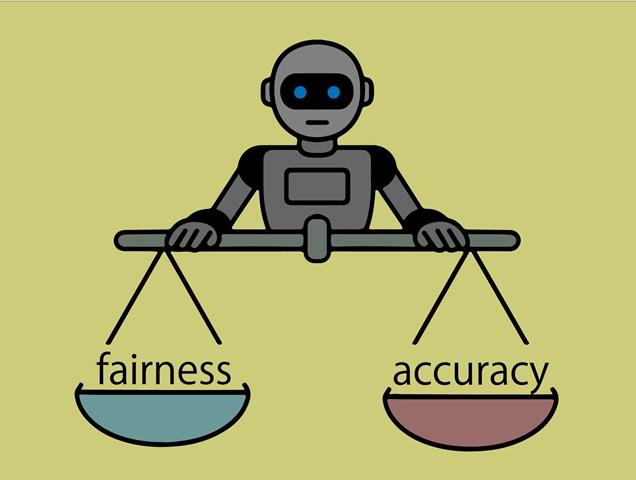
Fuzzy AI systems balance fairness and accuracy for complicated real-world situations
By balancing fairness and accuracy, Osaka Metropolitan University evolved fuzzy AI systems that could be used with real-world datasets to make fair decisions even in situations that are typically prone to bias.
Credit: Osaka Metropolitan University
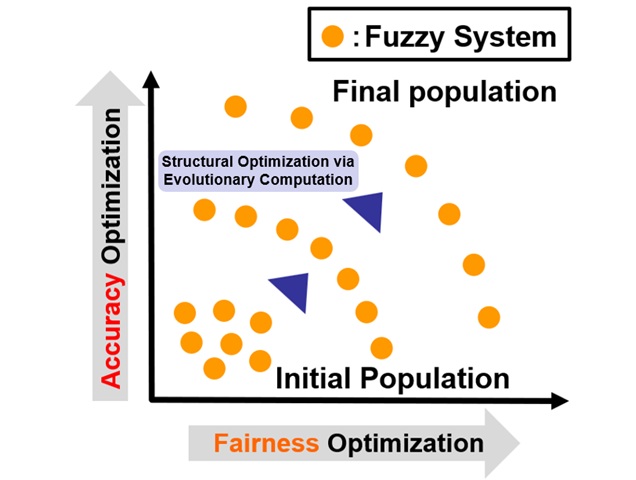
Conceptual diagram of fuzzy system design
Fuzzy systems were created with various degrees of fairness and accuracy. The dots show the evolved systems and how they scored for both factors.
Credit: Osaka Metropolitan University
Although AI is not intentionally biased, it can inherit biases from the data fed into it, learning and repeating them until the system becomes inherently unfair. This is complicated by the problem of identifying where the AI system introduced the bias, as most AI systems display their final decision without showing the steps that made it. Unfair patterns may go unnoticed simply because they are hard to identify.
To solve these problems, a computational intelligence research group led by Professor Yusuke Nojima at the Graduate School of Informatics, Osaka Metropolitan University, evolved numerous ‘fuzzy’ systems that balance the trade-off between accuracy and fairness.
A fuzzy system is a type of AI that makes decisions using rules that resemble human reasoning. Unlike strict yes/no rules, fuzzy systems allow degrees (agreement can be somewhat high, very high, etc.) allowing it to cope with the grey areas encountered in the real world.
The researchers used a method called “multiobjective fuzzy genetics-based machine learning.” This learning system evolves many candidate models that are designed to make decisions fairly. Unlike earlier studies that focused mainly on prediction accuracy and evaluated fairness only after the model was trained, their study included fairness directly in the training process.
Each evolved model was judged based on accuracy and fairness, with the algorithm searching for optimal trade-offs that balanced the two.
To evaluate their method, they used four commonly used fairness benchmark datasets that are especially prone to making decisions biased by factors such as sex and race: whether a person earns more than $50,000 per year, has good credit risk, will make a bank deposit after seeing a marketing campaign, and whether a defendant will reoffend within two years using real-world datasets.
“The designed models achieved accuracy and fairness that exceeded other models,” first author Takeru Konishi, a graduate student, said.
By seeing the factors that made the decision and the tradeoffs that the AI balanced, analysis of the internal mechanisms will contribute to understanding the mechanism by which a trade-off between accuracy and fairness is formed during the optimization process. Based on the research, the group intends to build increasingly accurate and fair AI systems in the future.
“The findings from this research will promote AI development that prioritizes both transparency and fairness in addition to accuracy,” Professor Nojima said. “We hope this kind of research will lead to the realization of a society where AI can be trusted and used with confidence to make nuanced decisions.”
The study was published in IEEE Transactions on Fuzzy Systems.
Funding
- JST BOOST (Grant Number: JPMJBS2401)
- Applied Research Projects of the University of Granada Research and Transfer Plan 2023
- Andalusia ERDF Operational Program (Grant Number: C-ING-206-UGR23)
- Knowledge Generation Projects
- Spanish Ministry of Science, Innovation
- Universities of Spain (Grant Number: PID2023-150070NB-I00)
Paper information
Journal: IEEE Transactions on Fuzzy Systems (vol. 34, no. 2, pp. 650-664, February 2026)
Title: Fairness via Fuzzy Systems: Analysis of Accuracy-Fairness Trade-off by Multi-objective Fuzzy Genetics-based Machine Learning
DOI: 10.1109/TFUZZ.2025.3646867
Authors: Takeru Konishi, Naoki Masuyama, Jorge Casillas, and Yusuke Nojima
Published:22 December 2025
URL: https://doi.org/10.1109/TFUZZ.2025.3646867
Contact
Yusuke Nojima
Graduate School of Informatics
Email: nojima[at]omu.ac.jp
*Please change [at] to @.
SDGs
