Research News
Apr 6, 2026
- Research Centers
- Science
Review summarizes photocatalyst and biocatalyst for artificial photosynthesis
Schematic Diagram of Semiartificial Photosynthesis
A semiartificial photosynthesis system composed of photocatalysts (purple), electron mediators (red), and biocatalysts (green) works together to convert carbon dioxide into useful substances using sunlight.
Credit: Osaka Metropolitan University
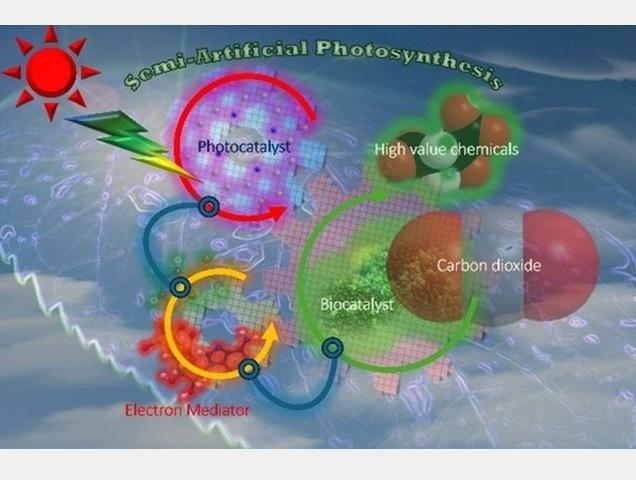
A new review from Osaka Metropolitan University (OMU) summarizes the biocatalysts involved in semiartificial photosynthesis, an exciting research field that combines natural photosynthesis with artificial technology to efficiently generate fuels and useful substances from sunlight.
In nature, photosynthesis, the process by which plants convert solar energy into sugar, is not particularly efficient, with only about 1 to 2% of light being successfully converted. Semiartificial photosynthesis overcomes these limitations by combining synthetic photosensitizers and biocatalysts to construct reaction systems with unique properties.
A new review paper by Professor Yutaka Amao of the Research Center for Artificial Photosynthesis at OMU introduces the fundamentals of natural and artificial photosynthesis, using these as a basis for discussing semiartificial photosynthesis that utilizes biocatalysts and photocatalysts as part of Carbon Dioxide Capture, Utilization, and Storage (CCUS) technology.
“Semiartificial photosynthesis is expected to lead to technologies that achieve higher energy conversion efficiency than natural photosynthesis,” Professor Amao said. “This is accomplished through the absorption of a broad spectrum of sunlight using artificial pigments, combined with catalysts specialized for producing fuels and value-added substances.”
Furthermore, Professor Amao explains the current state of semiartificial photosynthesis, including research from his own group. “Semiartificial photosynthesis is expected to increase in value as a CCUS technology in the future,” he said. “It is expected that this technology will evolve into a method for long-term fixation of carbon dioxide into organic molecules, enabling its utilization as a valuable substance.”
Funding
- Grant-in-Aid for Specially Promoted Research (23H05404)
- Scientific Research (B): (25K01584), (23K23140), (22H01872), and (22H01871)
Paper information
Journal: Chemical Reviews
Title: Photo/Biohybrid Catalytic System for Application in Semiartificial Photosynthesis of CO2 to Chemicals
DOI: 10.1021/acs.chemrev.5c00754
Authors: Yutaka Amao
Published: January 8, 2026
URL: https://doi.org/10.1021/acs.chemrev.5c00754
Reference
Improving fumaric acid production efficiency through a ‘more haste, less speed’ strategy
Advanced artificial photosynthesis catalyst uses CO2 more efficiently to create biodegradable plastics
Contact
Yutaka Amao
Graduate School of Science
Research Center for Artificial Photosynthesis
Email: amao[at]omu.ac.jp
*Please change [at] to @.
SDGs
