Research News
Apr 9, 2026
- Science
Seeing red: Dragonflies and humans share the same red-light detection mechanism
Dragonflies’ visual protein has intriguing similarities and differences to ours
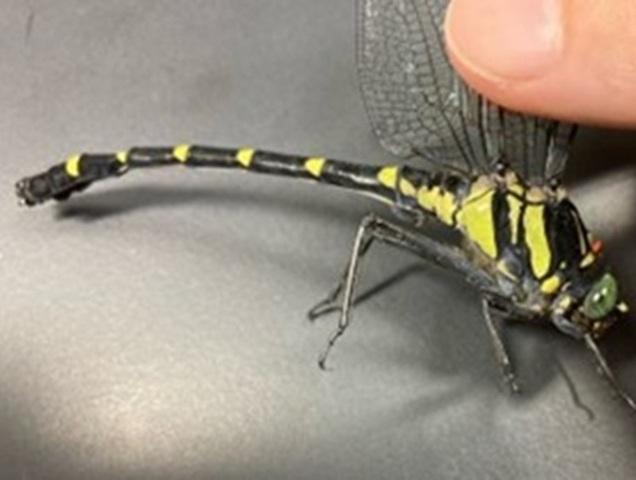
The reflective yellow parts of dragonflies that enable others to identify their sex
The way that light is reflected off the yellow parts helps dragonflies differentiate between males and females, making finding a mate more efficient.
Credit: Osaka Metropolitan University
Sometimes different organisms can evolve the same ability independently, a process called parallel evolution. A new study from Osaka Metropolitan University (OMU) has found that dragonflies sense red light similarly to mammals, including us. As many medical devices also rely on red light, their findings could be important not just in zoology but also in medical fields that rely on red light-sensing.
Humans perceive the colors of light through a protein called opsin in the eye. In humans, three types of opsins—corresponding to blue, green, and red light—are responsible for color vision.
Among insects, dragonflies have unusually strong red vision. The team led by Professors Mitsumasa Koyanagi and Akihisa Terakita at OMU’s Graduate School of Science identified a dragonfly opsin that detects light at around 720 nm, which is outside of the deepest red end of our visible spectrum.
“This is one of the most red-sensitive visual pigments ever found,” Professor Terakita said. “Dragonflies can likely see deeper into red light than most insects.”
The researchers hypothesized that this would help dragonflies identify suitable mates. To test this idea, they measured reflectance. Reflectance is the amount of light a surface reflects, and in dragonflies this reflected light influences how they appear to each other. The researchers found significant differences between males and females in red to near-infrared reflectance, suggesting that detecting these wavelengths helps males quickly distinguish members of the opposite sex during flight.
“Surprisingly, the mechanism by which dragonfly red opsin detects red light is identical to that of red opsin in mammals, including humans. This is an unexpected result, suggesting that the same evolutionary process occurred independently in distantly related lineages,” first author Ryu Sato, a graduate student, said.
Their study also revealed an important insight that could help turn this discovery into real-world applications. They pinpointed a single key position in the protein that controls its sensitivity to light. When they tweaked this, it pushed this sensitivity even further, allowing the protein to respond to light close to the infrared range. They engineered a version of the protein that reacts to even longer wavelengths and showed that cells equipped with it can be activated by near-infrared light.
These findings could be useful in the field of optogenetics, which uses light-sensitive proteins that are activated with light to investigate medical conditions. As the dragonfly opsin responds to light with longer wavelengths, it could work better inside deeper tissues.
“In this study, we succeeded in shifting the sensitivity of a modified near-infrared opsin from Gomphidae dragonflies even further toward longer wavelengths and confirmed that the modified near-infrared opsin can induce cellular responses in response to near-infrared light,” Professor Koyanagi said. “These findings demonstrate this opsin as a promising optogenetic tool capable of detecting light even deep within living organisms.”
The findings were published in Cellular and Molecular Life Sciences.
Funding
- Ministry of Education, Culture, Sports, Science and Technology (MEXT) KAKENHI Grant Numbers JP22H02663 (to M.K.), JP23H02516 (to A.T.), and JP23KJ1845 (to R.S.)
- Ohsumi Frontier Science Foundation (to M.K.)
- Japan Science and Technology Agency (JST) Precursory Research for Embryonic Science and Technology (PRESTO) grant JPMJPR13A2 (to M.K.). and Core Research for Evolutional Science and Technology (CREST) grant JPMJCR25B5 (to M.K.)
- Grant-in-Aid for JSPS Fellows (R.S.).
Paper information
Journal: Cellular and Molecular Life Sciences
Title: Dragonfly red opsins share a common tuning mechanism with mammalian red opsins and further enhancement of near-infrared sensitivity
DOI: 10.1007/s00018-025-06017-9
Authors: Ryu Sato, Akihisa Terakita, Mitsumasa Koyanagi
Published: 20 January 2026
URL: https://doi.org/10.1007/s00018-025-06017-9
Contact
Mitsumasa Koyanagi
Graduate School of Science
Email: koyanagi[at]omu.ac.jp
*Please change [at] to @.
SDGs
