Research News
Apr 13, 2026
- Science
A new mechanism for light-controlled plant growth
Light enhances adhesion between epidermal and inner tissues in plant stems
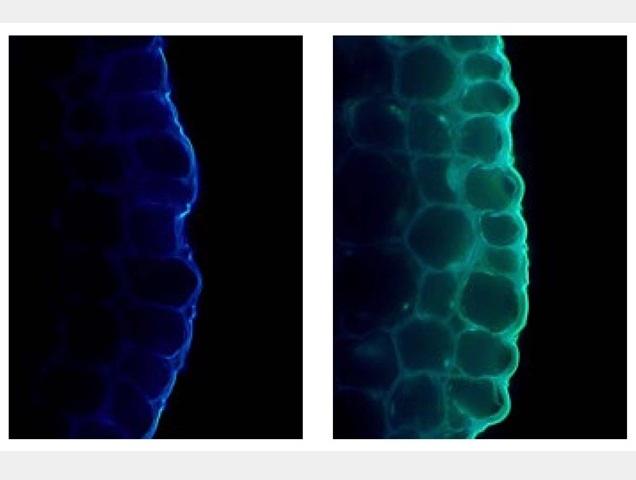
Changes in cell wall fluorescence
Cells exposed to light showed a different fluorescence pattern, consistent with the accumulation of large amounts of p-coumaric acid, a compound that strengthens cell walls.
Credit: Osaka Metropolitan University
Light has long been known to regulate plant growth. New research from Osaka Metropolitan University has discovered a new mechanism behind this regulation.
A team led by Professor Kouichi Soga of the Graduate School of Science used a unique method to measure adhesion between the epidermal (the outermost layer) and inner tissues in young pea stems. They found that those grown in light exhibit enhanced adhesion.
“Compared with plants grown in the dark, the epidermal and inner tissues of plants grown in the light are more tightly bound together,” Professor Soga said. “This phenomenon has never been reported before, making it a particularly interesting finding.”
When they observed the cells under a fluorescence microscope, they found that stems exposed to light showed fluorescence consistent with high levels of a phenolic acid called p-coumaric acid. This compound is used by plants to strengthen their cell walls, thereby enhancing adhesion.
“This provided strong evidence that the accumulation of p-coumaric acid was a key factor in strengthening the adhesion between the epidermal and the inner tissues,” Yuma Shimizu, a graduate student and first author of the study, explained.
Their results suggest that this mechanism regulates growth and can put the brakes on it too. When adhesion between the epidermal and inner tissues is enhanced, it limits the expansion of the inner tissue, restricting overall growth.
“By measuring the adhesion between the epidermal and the inner tissues as stem growth changes in response to various factors, we expect to determine whether growth regulation mediated by changes in adhesion is a universal mechanism,” Professor Soga concluded. “These findings could be highly significant for plant cultivation. If we can control adhesion, it may be possible to breed plants with improved tolerance to environmental stress.”
The findings were published in Physiologia Plantarum.
Funding
This work was supported by the Sasakawa Scientific Research Grant from The Japan Science Society (no. 2025-4004) and JST SPRING (JPMJSP2139) to Y.S.
Paper information
Journal: Physiologia Plantarum
Title: White light enhances adhesive strength between epidermal and inner tissues of pea epicotyls via accumulation of cell wall-bound p-coumaric acid
DOI: 10.1111/ppl.70755
Authors: Yuma Shimizu, Kazuyuki Wakabayashi, Kensuke Miyamoto, Kouichi Soga
Published: 25 January 2026
URL: https://doi.org/10.1111/ppl.70755
Contact
Kouichi Soga
Graduate School of Science
Email: soga[at]omu.ac.jp
*Please change [at] to @.
SDGs
