Research News
Apr 15, 2026
- Engineering
Smarter than slithering only: AI boosts snakebot movement efficiency
Scientists make a movement innovation that could extend robot missions
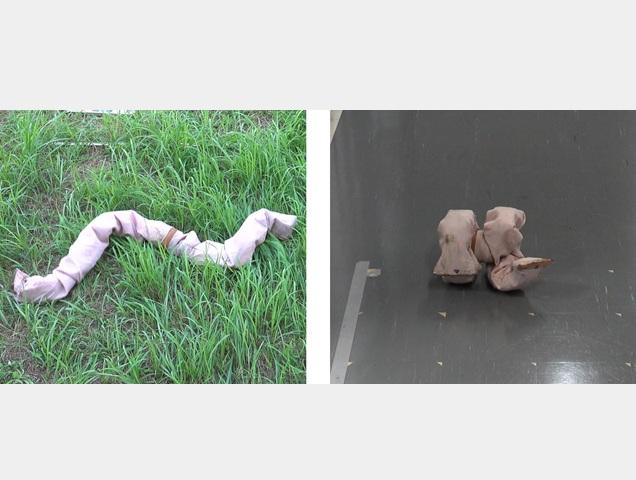
Undulating motion and rolling motion of a snake-like robot
The snake robot mixes undulating movements like a snake (left), with rolling motions that take advantage of gravity (right).
Credit: Osaka Metropolitan University
Snakebot rolling movement
The snakebot rolls up like a wheel and uses gravity to move more efficiently.
Credit: Osaka Metropolitan University
The snakebot changes from rolling to a slithering motion
The snake changes movement patterns from rolling to slithering depending on terrain to maximize efficiency.
Credit: Osaka Metropolitan University
Snake-like robots represent the future of rescue. Their slender bodies allow them to navigate narrow spaces, uneven terrain, and water surfaces, entering places that would be hazardous for humans. This could potentially save lives in earthquake-prone areas, like Japan.
However, the robots may suffer from being too ‘snake-like.’ Their undulating, slithering motion requires multiple motors coordinating with each other, causing rapid battery depletion, limiting their usefulness in extended missions.
A research group led by Dr. Akio Yamano at the Graduate School of Engineering, Osaka Metropolitan University, has developed a snake-like robot artificial intelligence that optimizes its rolling movement using deep reinforcement learning. This movement is aided by a unique “observation buffer” that uses data from the robot’s sensors to analyze angular velocity, acceleration, and body state information, which stabilize the rolling motion, ensuring precise straight-line travel.
They found that a rolling motion, where the robot’s head and tail reshape into a circular structure and the snakebot rolls by shifting its center of gravity, was more efficient in certain situations, as it allowed it to use gravity rather than constant motor power.
“We found that on level ground, the rolling motion achieved approximately twice the travel speed per unit of power consumption compared with the undulating motion,” Dr. Yamano said.
The most efficient motion was using an “undulating motion” on uneven terrain and switching to a “rolling motion” on flat surfaces. Mixing rolling and undulating movements could extend mission time in disaster zones and for planetary exploration.
In the future, Dr. Yamano hopes to expand these capabilities to design robots that can compute the ideal movement, instead of simply performing pre-programmed gaits. “Our group is developing various interesting capabilities,” he said. “We aim to create robots that autonomously assess the situation and use precise navigation technologies to carry out useful tasks.”
The study was published in Robotics and Autonomous Systems.
Funding
This study was supported by the Mazda Foundation, Japan
Grant-in-Aid for Scientific Research (C), Japan, no. 25K07667.
Paper information
Journal: Robotics and Autonomous Systems
Title: Deep reinforcement learning-based design with observation buffer of rolling motion for snake-like robots
DOI: 10.1016/j.robot.2026.105370
Authors: Akio Yamano, Satomi Suzuki, Tsuyoshi Kimoto, and Takashi Iwasa
Published: 29 January 2026
URL: https://doi.org/10.1016/j.robot.2026.105370
Contact
Akio Yamano
Graduate School of Engineering
Email: yamano_aero[at]omu.ac.jp
*Please change [at] to @.
SDGs
