Research News
Apr 22, 2026
- Informatics
Geometry-aware human noise removal from TLS point clouds via 2D segmentation projection
Automatic recognition of 3D point clouds of people
AI framework detects “human noise” in TLS point clouds taken around Osaka.
Credit: Osaka Metropolitan University
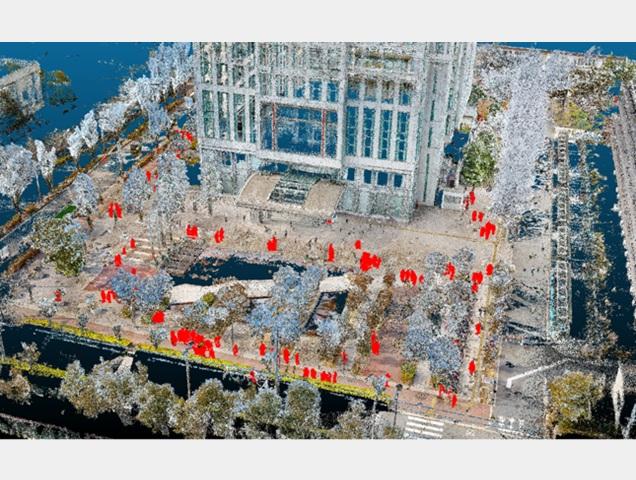
Large-scale terrestrial laser scanning (TLS) point clouds are increasingly used for applications such as digital twins and cultural heritage documentation. However, removing unwanted human points captured during acquisition remains a largely manual and time-consuming process. In this study, Osaka Metropolitan University researchers proposed a geometry-aware framework for automatically removing human noise from TLS point clouds by projecting 2D instance segmentation masks (obtained using You Only Look Once (YOLO) v8 with an instance segmentation head) into 3D space and validating candidates through multi-stage geometric filtering.
To suppress false positives induced by reprojection misalignment and planar background structures (e.g., walls and ground), the researchers introduced projection-followed geometric validation (or “geometric gating”) using Density-Based Spatial Clustering of Applications with Noise (DBSCAN) and principal component analysis (PCA)-based planarity analysis, followed by cluster-level plausibility checks. Experiments were conducted on two real-world outdoor TLS datasets—(i) Osaka Metropolitan University Sugimoto Campus (OMU) (82 scenes) and (ii) Jinaimachi historic district in Tondabayashi (JM) (68 scenes).
The results demonstrate that the proposed method achieves high noise removal accuracy, obtaining precision/recall/intersection over union (IoU) of 0.9502/0.9014/0.8607 on OMU and 0.8912/0.9028/0.8132 on JM. Additional experiments on mobile mapping system (MMS) data from the Waymo Open Dataset demonstrate stable performance without parameter recalibration.
Furthermore, quantitative and qualitative comparisons with representative time-series geometric dynamic object removal methods, including DUFOMap and BeautyMap, show that the proposed approach maintains competitive recall under a human-only ground-truth definition while reducing over-removal of static structures in TLS scenes, particularly when humans are observed in only one or a few scans due to limited revisit frequency. The end-to-end processing time with YOLOv8 was 935.62 s for 82 scenes (11.4 s/scene) on OMU and 571.58 s for 68 scenes (8.4 s/scene) on JM, supporting practical efficiency on high-resolution TLS imagery.
Ablation studies further clarify the role of each stage and indicate stable performance under the observed reprojection errors. The annotated human point cloud dataset used in this study has been publicly released to facilitate reproducibility and further research on human noise removal in large-scale TLS scenes.
Paper information
Journal: Sensors
Title: Geometry-Aware Human Noise Removal from TLS Point Clouds via 2D Segmentation Projection
DOI: 10.3390/s26041237
Authors: Fuga Komura, Daisuke Yoshida, and Ryosei Ueda
Published: 13 February 2026
URL: https://doi.org/10.3390/s26041237
Contact
Daisuke Yoshida
Graduate School of Informatics
Email: daisuke[at]omu.ac.jp
*Please change [at] to @.
SDGs
