Research News
Apr 21, 2026
- Informatics
Creating a wireless tissue-aware medical device network in the human body
Swallowable medical device performance enhanced by ultra-wideband technology
Swallowable medical devices work together to send signals during endoscopy
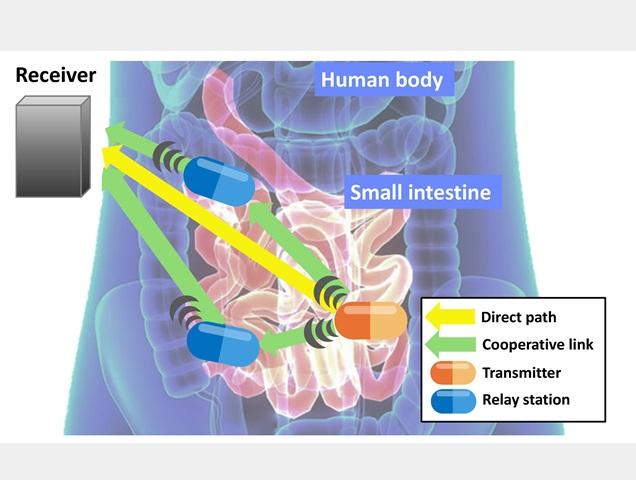
The swallowed transmitter and relay stations cooperate to improve clearer wireless communication to the external receiver.
Credit: Osaka Metropolitan University
Diagnostic tests for stomach conditions are tough for patients, as many of the most accurate ones involve minor surgical procedures or invasive techniques.
Swallowable medical devices have emerged as a possible solution. Complex procedures like endoscopy are replaced by a pill-sized camera, which is swallowed and transmits data about the patient’s health as it travels through the body.
However, the use of swallowable devices is complicated by the makeup of the human body. Wireless signals are made up of many frequencies, each of which gets absorbed, scattered, and distorted differently depending on whether it passes through muscle, fat, or bone. As a result, many arrive misaligned or uneven in strength.
A research group led by Associate Professor Takumi Kobayashi and Professor Daisuke Anzai at the Graduate School of Informatics, Osaka Metropolitan University, focused on optimizing signal transmission separately for each frequency, allowing multiple implants to coordinate their signals using ultra-wideband (UWB) communication.
Rather than treating the wireless signal as a single uniform beam, the swallowed transmitter and relay devices adjust each frequency component so that all signals arrive aligned at the external receiver, where they combine into a stronger, clearer signal.
“For each frequency, we calibrated the timing so the signals arrived aligned, and adjusted the strength to compensate for any loss,” Professor Kobayashi explained.
When they tested their approach using realistic simulations of implantable medical applications like capsule endoscopy, the results showed marked improvement over existing techniques, with signals arriving at the receiver more clearly and with greater strength.
“These results show that it is possible to achieve simple yet high-quality wireless communication using swallowable medical devices,” Professor Anzai concluded. “We expect this to accelerate their practical implementation and lead to widespread adoption as well as opening the door to more advanced medical and healthcare applications.”
The findings were published in Scientific Reports.
Funding
- JST Moonshot R&D Grant Number JPMJMS2214-06
- JSPS KAKENHI Grant Number 24K00885
- MIC/FORWARD Grant Number JPMI250830001
Paper information
Journal: Scientific Reports
Title: Weight optimization of MIMO-UWB distributed beamforming for implant communications
DOI: 10.1038/s41598-026-36694-w
Authors: Takumi Kobayashi, Jaakko Hyry, Manato Fujimoto, Daisuke Anzai
Published: 21 January 2026
URL: https://doi.org/10.1038/s41598-026-36694-w
Contact
Takumi Kobayashi
Graduate School of Informatics
Email: kobayashi.takumi[at]omu.ac.jp
*Please change [at] to @.
SDGs

