Research News
May 11, 2026
- Medicine
Testing cefiderocol and levofloxacin against hemorrhagic pneumonia
Drug resistance of Stenotrophomonas maltophilia prompts need for effective alternative treatments
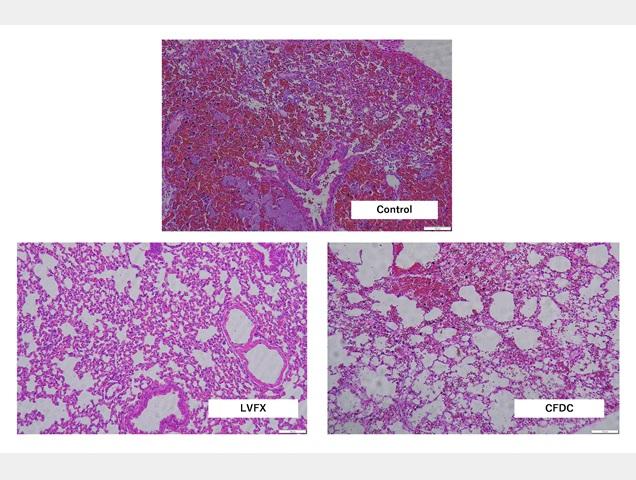
Hemorrhagic pneumonia in treatment groups
Compared to the control, LVFX and CFDC administered groups showed decreased lung damage.
Credit: Osaka Metropolitan University
Stenotrophomonas maltophilia (S. maltophilia) is a multidrug-resistant bacterium that can cause severe and life-threatening hemorrhagic pneumonia in individuals with weakened immune systems. Despite this, there are limited treatment options for this bacterium and the infections it causes are extremely difficult to treat. The commonly used antibiotic, levofloxacin (LVFX), currently stands as one of the most effective, but reported evidence of S. maltophilia resistance has been increasing. Alternatively, cefiderocol (CFDC), a new antimicrobial agent, has shown effectiveness against S. maltophilia in experimental studies. However, its efficacy against hemorrhagic pneumonia remains unclear.
Therefore, a research group led by Dr. Waki Imoto at Osaka Metropolitan University’s Graduate School of Medicine examined the effectiveness of CFDC and LVFX using a mouse model. After separating the mice into control, CFDC, and LVFX groups, the team administered the drugs to mice with severe hemorrhagic pneumonia caused by S. maltophilia and evaluated the effects of each treatment.
As a result, both antimicrobial treatments improved survival rates and reduced bacterial burdens in the heart and lungs. In addition, microscopic examination of lung tissue revealed reduced hemorrhage, indicating decreased lung damage. However, instances of hemorrhage differed between the LVFX and CFDC groups. In mice treated with LVFX, hemorrhage was rarely observed, whereas the CFDC group had slight occurrences.
“The effects observed in this study were more pronounced with LVFX. One possible reason is that it more readily reaches the lungs, which are the primary organs infected by the bacteria,” said Dr. Imoto. “On the other hand, because the emergence of LVFX-resistant strains has been reported, it is important to select appropriate therapeutic agents depending on the clinical situation while taking antimicrobial resistance into account and using CFDC as an alternative treatment for S. maltophilia.”
The study was published in Antimicrobial Agents and Chemotherapy.
The authors thank Shionogi & Co., Ltd., for providing CFDC and experimental advice.
Funding
This research was supported by the Japanese Society for Chemotherapy 70th Anniversary Research Support Program, JSPS KAKENHI (grant number 24K11659), Medical Research Grants from the Takeda Science Foundation (grant number 2024047731), and the Morinomiyako Medical Research Foundation (grant number 2021-01-02).
Paper information
Journal: Antimicrobial Agents and Chemotherapy
Title: Efficacy of cefiderocol and levofloxacin against Stenotrophomonas maltophilia in a hemorrhagic pneumonia mouse model
DOI: 10.1128/aac.00944-25
Authors: Waki Imoto, Junko Abe, Norihiro Sakurai, Kengo Kawamoto, Koichi Yamada, Yukihiro Kaneko, Hiroshi Kakeya
Published: 30 January 2026
URL: https://doi.org/10.1128/aac.00944-25
Contact
Waki Imoto
Graduate School of Medicine
Email: wakiimoto[at]omu.ac.jp
*Please change [at] to @.
SDGs
