Research News
May 15, 2026
- Medicine
Paraprobiotic counteracts damage to male fertility from BPA in plastic
A possible link between gut health and reproductive function
FK-23 increases sperm number and motility
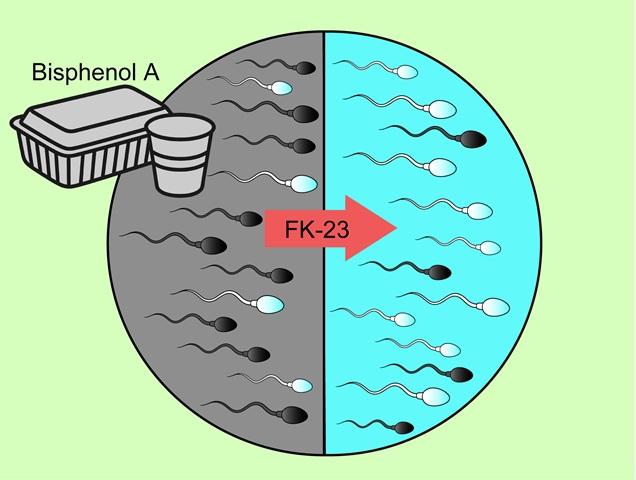
Bisphenol A, a chemical found in plastics, harms sperm by reducing their number and movement. After treatment with FK-23, sperm numbers and activity improved. Light-colored sperm represent normal sperm; dark-colored sperm represent dysfunctional sperm.
Credit: Osaka Metropolitan University
Bisphenol A (BPA) is widely used in the production of plastic materials. However, there have recently been concerns about its toxicity in humans, leading to the European Union banning its use in food containers.
BPA has been shown to impair sperm function, in part through increased generation of reactive oxygen species—highly reactive molecules that can damage cellular components. As this charged oxygen can be counteracted with antioxidants, researchers at Osaka Metropolitan University (OMU) have been investigating specific compounds that counteract oxidative stress.
A promising source is paraprobiotics, a new class of supplements that are based on heat-treated bacterial cells. The heat makes the bacteria unable to reproduce but doesn’t destroy the cell structures that stimulate the immune system and gut, making them biologically active yet safe to consume.
A research team led by Visiting Professor Yukiko Minamiyama of the Graduate School of Medicine at OMU investigated whether a paraprobiotic material derived from the lactic acid bacterium Enterococcus faecalis (known as FK‑23) protects against the sperm toxicity caused by BPA. FK-23 primarily acts in the gut, influencing the gut–immune system axis, which in turn affects whole-body conditions like oxidative stress.
Her team confirmed the risks of BPA in rats: the rodents exposed to the substance showed a significant reduction in sperm motility and an increase in markers suggestive of oxidative stress. When the rats received FK‑23, they showed improved sperm motility despite BPA exposure, and the expression of the markers was markedly reduced.
“These findings suggest that components derived from lactic acid bacteria exert protective effects against reproductive toxicity caused by environmental chemicals,” Professor Minamiyama said. “Future studies aimed at elucidating the underlying mechanisms mediated by the gut environment, as well as validating these effects in humans, are expected to pave the way for the application of food-derived components in maintaining reproductive health.”
The findings were published in Journal of Functional Foods.
Funding
JSPS KAKENHI (21K05426) (Japan)
Grants-in-Aid from Nichinichi Pharmaceutical Co. Industry, Ltd. (Mie, Japan)
Paper information
Journal: Journal of Functional Foods
Title: Preventive effect of paraprobiotic Enterococcus faecalis FK-23 on bisphenol A-induced sperm toxicity
DOI: 10.1016/j.jff.2026.107205
Authors: Yukiko Minamiyama, Shigekazu Takemura, Kanako Nakagawa, Hiroshi Ichikawa, Takeaki Ishizawa, Toshikazu Yoshikawa
Published: 18 February 2026
URL: https://doi.org/10.1016/j.jff.2026.107205
Contact
Yukiko Minamiyama
Graduate School of Medicine
Email: yukiko[at]omu.ac.jp
*Please change [at] to @.
SDGs
