Research News
Jun 11, 2026
- Science
Newly synthesized fullerene material remains metallic even under low temperatures
Molecular systems based on all-carbon fullerides mirror established electronic behavior of transition metal materials
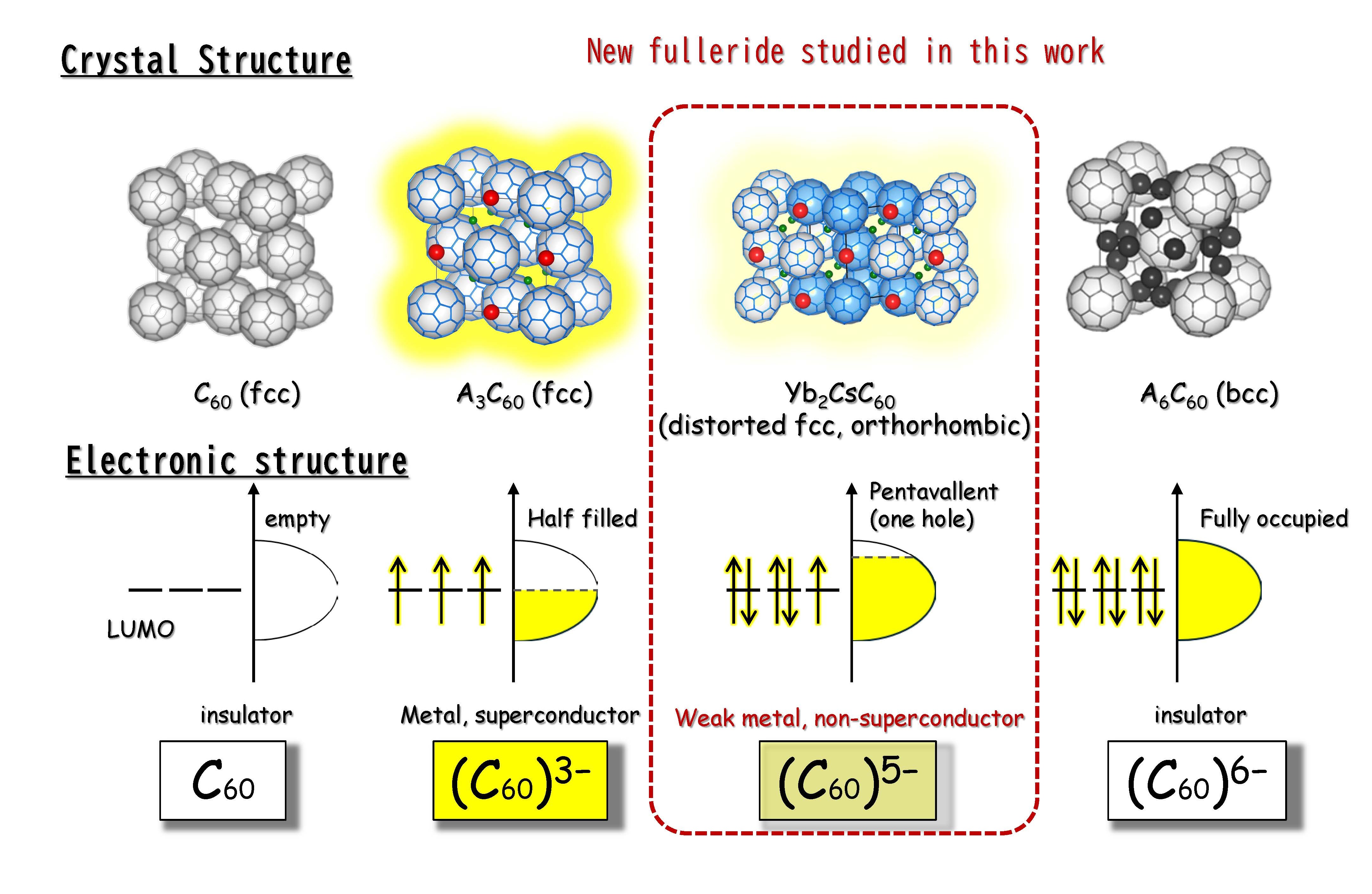
Evolution of the structural and electronic properties of molecular fullerides with change in valence state
Despite the presence of strong correlations, the newly synthesized fulleride (box) continues to behave like a weak metal, by passing the transition to an insulating state and continuing to conduct electrons, even when reduced to cryogenic temperatures. Other materials are shown for comparison.
Credit: Osaka Metropolitan University
An international team whose research was coordinated by Osaka Metropolitan University (OMU) has reported the survival of metallic behavior in the strongly correlated molecular material, ytterbium cesium fulleride (Yb₂CsC₆₀). The electrons in the newly synthesized material remained mobile and continued to conduct electricity even at the lowest temperatures studied, despite strong electron interactions that would normally be expected to drive the material into an insulating state.
In materials, such as metals, electrons move freely, allowing them to conduct electricity. However, as interactions between electrons become stronger, freedom of motion can be suppressed. Under these conditions, materials undergo a phenomenon known as a Mott metal-insulator transition, where they change from a conducting metal into an insulating state in which electrons become effectively immobile.
However, the group’s newly synthesized Yb₂CsC₆₀ compound was special, as the localizing electron interactions were overcome, making the material maintain its metallic state.
“The synthesis and availability of the new fulleride material was key,” Keisuke Matsui of the Graduate School of Engineering at OMU said.
To make this discovery, an international team including the Institute Jozef Stefan (IJS) in Slovenia, the National Institute of Science and Technology (NIST) in the USA, and the Aristotle University of Thessaloniki (AUT) in Greece investigated the structural and electronic properties of the new compound. In their material, C₆₀ had a valency of 5-, an uncommon feature that implied the existence of a single hole in the occupation of the triply degenerate lowest unoccupied molecular orbitals.
In many strongly correlated materials, strong interactions between electrons normally trap the electrons in place and turn the material into an insulator. This effect is often strengthened by a quantum effect known as Hund’s coupling when the electronic bands are half full. According to Hund’s law, the electrons spread out across different orbitals with aligned spins before pairing up.
However, in the newly synthesized fulleride, the electronic bands are almost completely filled except for a single missing electron, or ‘hole.’ In this case, Hund’s coupling instead helped the electrons remain mobile, allowing the material to retain its metallic behavior despite strong electron interactions.
This phenomenon has been well documented in transition metal compounds where the active electrons reside in d-orbitals. But it has remained virtually unexplored for ‘light-element’ molecular systems, which include fullerides, in which the electrons occupy p-orbitals.
The team discovered that the properties of their synthesized p-orbital fulleride material mirrored those of its d-orbital counterparts.
“We were all excited to see that our predictions were proved correct,” Professor Yoshiki Kubota of the Graduate School of Science at OMU said. “The Mott transition was suppressed and the robust metallic state survived even when the compound was exposed to cryogenic temperatures.”
“These findings were due to the new material, which allowed us to pursue an exhaustive series of experimental measurements combined with theoretical calculations,” Kosmas Prassides, a Professor at IJS and a visiting researcher at OMU, said. “This allowed us to assert that electronic correlations and the competition with Hund’s coupling follow the behavior seen in the well-studied transition-metal compounds.”
The group believe their research into strongly correlated materials could aid transformative technologies. Previous fundamental discoveries in quantum mechanics eventually enabled semiconductors and computers, whereas superconductivity research contributed to technologies such as MRI systems.
They hope that follow-up research to understand how electrons collectively behave in molecular materials like Yb₂CsC₆₀ will ultimately influence future electronics, energy systems, and quantum technologies.
“In this experimental work, we found unexpected similarities between two major classes of quantum materials: specifically correlated molecular p-electron systems and transition-metal d-electron materials,” Professor Denis Arcon from IJS explained. “This provides new insights into fundamental concepts such as Hund-coupling and strongly correlated quantum matter.”
“The newly synthesized orthorhombic fulleride may also open pathways toward discovering unconventional superconductivity in related molecular systems,” he added.
The findings were published in Nature Communications.
Funding
This work was financially supported by Grants-in-Aid for Scientific Research (JSPS KAKENHI Grant Numbers JP21H01907, JP22K18693, and JP23KJ1843), JST SPRING (Grant Number JPMJSP2139), the Slovenian Research Agency (Grant Numbers P1-0125 and J1-3007), and NIST (CMB in whole, and partial support for RAK).
Paper Information
Journal: Nature Communications
Title: Survival of the metallic state in a single-hole multiband p-orbital molecular system
DOI: 10.1038/s41467-026-73095-z
Author: Keisuke Matsui, Ryan A. Klein, Naoya Yoshikane, John Arvanitidis, Matjaž Gomilšek, Urh Klopčič, Shogo Kawaguchi, Hitoshi Yamaoka, Nozomu Hiraoka, Hirofumi Ishii, Qiang Zhang, Shigeo Mori, Hiroki Ishibashi, Yoshiki Kubota, Craig M. Brown, Denis Arčon, Kosmas Prassides
Published: 26 May 2026
URL: https://doi.org/10.1038/s41467-026-73095-z
Contact
Yoshiki Kubota
Graduate School of Science
Email: kubuotayoshiki[at]omu.ac.jp
*Please change [at] to @.
SDGs
