Research News
Jun 16, 2026
- Science
Argon adsorption on MCM-48 mesoporous crystal studied by in situ synchrotron powder X-ray diffraction
Gyroid structure and pore structure of silica mesoporous material MCM-48
Lower figures are the electron density distribution analyzed in this study, where the filling process of Ar gas into the pores of MCM-48 is observed as a change in electron density.
Credit: Osaka Metropolitan University
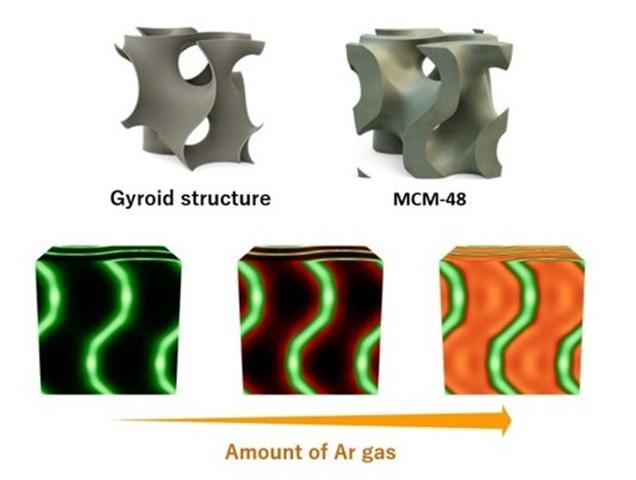
An Osaka Metropolitan University-led research team studied the structure of the silica mesoporous crystal MCM-48 and the argon adsorption process by in situ synchrotron powder X-ray diffraction (XRD). The diffraction intensity data were analyzed using the maximum entropy method (MEM). The Ar adsorption process within the mesopores was directly monitored through changes in the electron density distribution in the sample.
The diffraction patterns clearly reflected different stages of adsorption as the gas pressure increased: gradual formation of an adsorbed film on the pore walls at low pressures, followed by stepwise pore filling due to capillary condensation. The real-space imaging of diffraction data presented in this paper is a robust and promising approach for improving our understanding of gas–solid interactions during adsorption and for characterizing the pore structures of mesoporous crystals.
Paper information
Journal: The Journal of Physical Chemistry C
Title: Argon Adsorption on MCM-48 Mesoporous Crystal Studied by In Situ Synchrotron Powder X-ray Diffraction
DOI: 10.1021/acs.jpcc.6c00603
Authors: Norihiro Muroyama, Arisa Yoshimura, Yoshiki Kubota, Keiichi Miyasaka, Peter I. Ravikovitch, Alexander V. Neimark, Ryotaro Matsuda, Masakazu Higuchi, Susumu Kitagawa, Masaki Takata, and Osamu Terasaki
Published: 15 April 2026
URL: https://doi.org/10.1021/acs.jpcc.6c00603
Contact
Yoshiki Kubota
Graduate School of Science
Email: kubotayoshiki[at]omu.ac.jp
*Please change [at] to @.
SDGs
