Research News
Jun 30, 2026
- Science
How cricket mothers control the developmental timing of their offspring
A combination of transcription factors, epigenetic regulation, and metabolic processes underlies arrested development
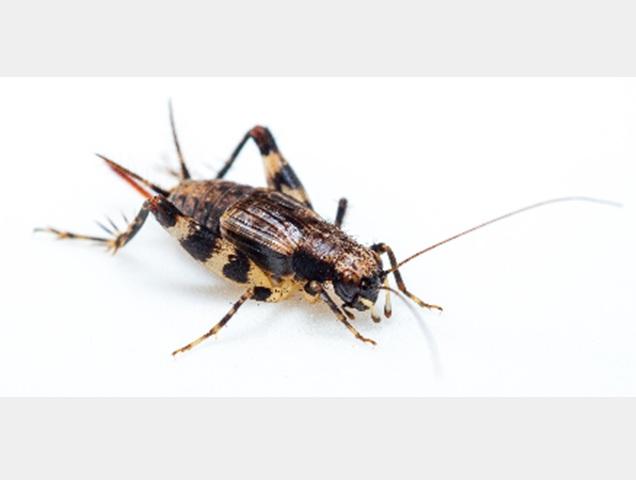
A band-legged ground cricket mother
Band-legged ground cricket mothers use environmental cues to determine whether their offspring enter diapause.
Credit: Osaka Metropolitan University
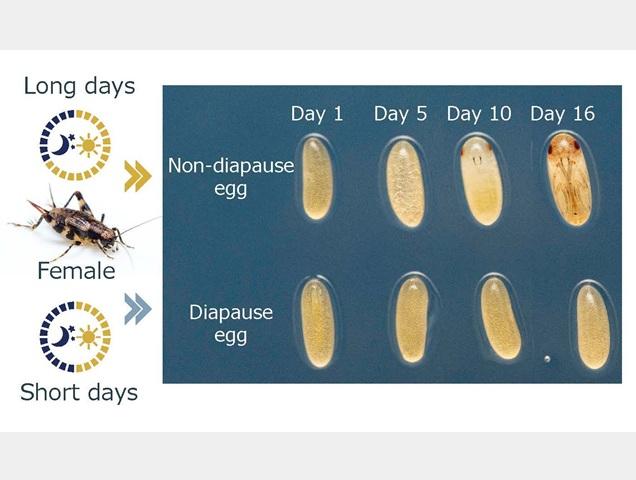
Differences in growth between diapause and non-diapause cricket eggs
At 16 days, the non-diapause eggs are developed and almost ready to hatch. On the other hand, the diapause eggs are in a similar state to day 1.
Credit: Osaka Metropolitan University
Diapause is a fascinating form of biological dormancy that is employed by a broad array of animals as a survival strategy to endure adverse environmental conditions. To overcome the problems associated with seasons that are unsuitable for reproduction and/or development, many temperate insects enter diapause.
Some insect species exhibit maternal diapause induction, in which environmental cues are perceived by the mother and determine the developmental fate of the offspring. Although maternal diapause induction is found in many species, its underlying molecular physiological mechanisms remain largely unknown.
A research group led by Professor Shin Goto and Dr. Yuta Shimizu at the Graduate School of Science, Osaka Metropolitan University, focused on the band-legged ground cricket Dianemobius nigrofasciatus, which produces non-diapause eggs that develop without interruption in summer and diapause eggs that undergo developmental arrest in autumn. To elucidate the molecular and physiological events occurring before and after the onset of diapause, the researchers comprehensively analyzed changes in gene expression across these stages.
In the diapause eggs, they found that the expression of genes involved in chromatin remodeling increased 24 hours after egg laying. Chromatin structure is associated with the activation and silencing of gene expression.
The researchers identified reduced chromatin accessibility of genes involved in neural development and the cell cycle in the diapause eggs. This suggests that preparatory processes for growth arrest are already underway prior to the onset of diapause.
“In diapause eggs, many genes involved in amino acid and carbohydrate metabolism were expressed,” Dr. Shimizu said. “This suggests that diapause eggs generate energy to sustain long-term survival.”
These findings deepen our understanding of insect diapause. Because ectothermic animals, such as insects, are particularly vulnerable to cold, diapause represents an important survival strategy.
Although the band-legged ground cricket is not an agricultural pest, similar processes are likely to occur in many pest species that damage crops. “Understanding the genes and mechanisms that regulate diapause may lead to the development of novel insecticides and new pest management strategies, such as delaying pest emergence until after crop harvest,” Professor Goto explained.
Funding
- Cooperative Research Grant of the Genome Research for BioResource (NODAI Genome Research Center, Tokyo University of Agriculture)
- Cross ministerial Moonshot Agriculture, Forestry and Fisheries Research and Development Program, "Technologies for Smart Bio-industry and Agriculture" (Bio-oriented Technology Research Advancement Institution, BRAIN) [Grant Number: JPJ009237]
- JSPS KAKENHI Grant-in-Aid for Scientific Research (B) and (C) [Grant Number: JP26K02062/21K05614], and Grant-in-Aid for JSPS Fellows [Grant Number: 21J23478/22KJ2609]
Paper information
Journal: Communications Biology
Title: Temporal orchestration of transcriptional and epigenomic programming underlying maternal embryonic diapause in a cricket model
DOI: 10.1038/s42003-026-10402-w
Authors: Kosuke Kataoka, Yuta Shimizu, Ryuto Sanno, Yuichi Koshiishi, Ken Naito, Kei Yura, Toru Asahi, Shin G. Goto
Published: 30 June 2026
URL: https://doi.org/10.1038/s42003-026-10402-w
https://www.nature.com/articles/s42003-026-10402-w
Contact
Shin Goto
Graduate School of Science
Email: shingoto[at]omu.ac.jp
*Please change [at] to @.
SDGs
