Research News
Jul 7, 2026
- Engineering
Making heat behave like data
Researchers break a fundamental rule to create a new concept: heat that can be directed and “programmed”
New device enables flexible control of heat
Heat is absorbed from the right, heating the structure, where it is radiated to the left, cooling the structure.
Credit: Osaka Metropolitan University
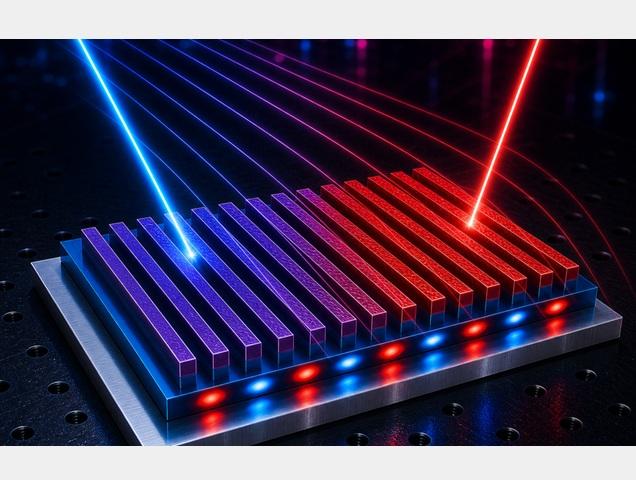
Normally, a material absorbs and emits heat in a linked way: a surface that absorbs heat well at a certain wavelength and direction will also emit heat in the same ways. This fundamental relationship, known as reciprocity, limits our ability to independently control heat absorption and heat emission.
But if absorption and emission could be separated, engineers could design devices that absorb heat from one direction while emitting it in another. By ‘steering’ thermal energy, they could create more efficient thermal management, energy conversion, infrared sensing, and thermal communication technologies.
To create a material that behaves differently for incoming and outgoing radiation, an international research team led by Professor Koichi Okamoto and Dr. Shunsuke Murai from Osaka Metropolitan University’s Graduate School of Engineering turned to magneto-optical materials. In these materials, the interaction with light can be altered using a magnetic field.
By combining a magneto-optical material with a special phase-change material called GST, the team created a device that can not only control the direction of heat radiation but also switch this effect on and off and remember its state even when the power is removed, allowing heat to be programmed like data in a microchip.
“We made heat radiation behave in a ‘smarter’ way,” Dr. Murai explained. “Achieving these capabilities in a working model could enable a new generation of efficient infrared emitters, thermal-energy devices, sensors, and photonic memory technologies.”
They found that their device exhibited different responses depending on light direction, even when light arrived almost straight on. This marked a huge improvement compared with previous devices that required light to arrive at very large angles, at which the absorption and radiation efficiencies dropped compared to those at normal incidence. In addition, the “on and off switch” effect of the previous devices was highly variable, and the memory was lost when the power was removed, limiting reconfiguration.
“Our ultimate goal is to develop compact devices that can actively control heat radiation, much like electronic circuits control the flow of electricity,” Professor Okamoto said. “Such devices could be used in smarter infrared sensors, more efficient energy systems, and new types of photonic memory that store information using light and heat instead of electrical charges.”
Funding
This work was supported by the National Natural Science Foundation of China (62305173), the Japan Society for the Promotion of Science (JSPS) Postdoctoral Fellowships for Research in Japan (P25357) and KAKENHI (25K01501, 25K21709, 25KF0265), the Youth Talent Support Program of the Jiangsu Association for Science and Technology (JSTJ-2024-390), Agency for Science, Technology and Research (A*STAR) under its Japan-Singapore Joint Call for Quantum 2025 (R25J4IR112), and the National Research Foundation (NRF), Singapore (NRF-CRP30-2023-0003).
Paper information
Journal: Laser & Photonics Reviews
Title: Reconfigurable Giant Nonreciprocity at Near‐Normal Incidence via Phase‐Change Magneto‐Optical Metagratings
DOI: 10.1002/lpor.71438
Authors: Ye Ming Qing, Yi Shen, Jun Wu, Shunsuke Murai, Zhaogang Dong, and Koichi Okamoto
Published: 25 June 2026
URL: https://doi.org/10.1002/lpor.71438
Contact
Shunsuke Murai
Graduate School of Engineering
Email: murai[at]omu.ac.jp
*Please change [at] to @.
SDGs
