Research News
Jul 20, 2026
- Veterinary Science
Generating red blood cell-like cells from canine iPSCs
Foundational steps made towards artificial cell production for blood bank reserves
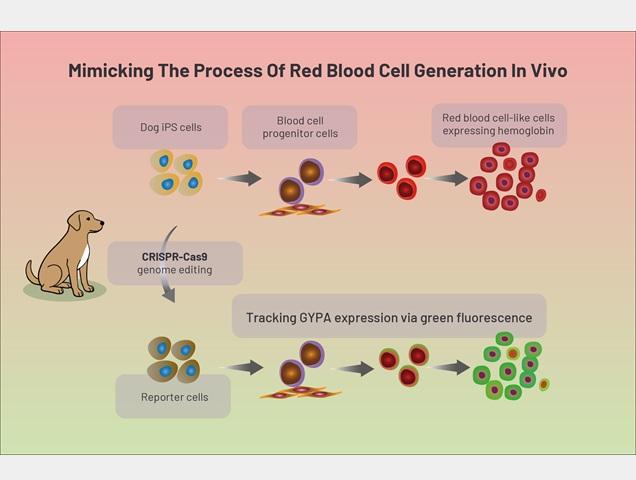
Mimicking red blood cell process
Using dog iPS cells, OMU researchers devised an approach to create red blood cell-like cells and to track GYPA expression.
Credit: Osaka Metropolitan University
Blood transfusions are crucial in human and veterinary medicine, yet human blood reserves are in constant need of donors while blood bank systems in veterinary care are nearly non-existent. This leaves canine transfusions largely reliant on donations from healthy dogs, but securing compatible blood remains a major challenge since dogs also have different blood types.
Fortunately, recent advances in induced pluripotent stem cells (iPSCs) have created new opportunities for producing blood cells in the laboratory. This and the similarities between human and canine health have drawn attention to dogs as translational models that can be used to bring about innovative changes in both fields. However, a method for generating red blood cells from canine iPSCs has not been fully established.
Taking on this crucial challenge, a research group led by Professor Shingo Hatoya at Osaka Metropolitan University’s Graduate School of Veterinary Science used canine iPSCs developed through collaborative research with TOKIWA-Bio Inc. to devise a method for generating red blood cell-like cells. Mimicking the natural process of blood cell development, canine iPSCs were cultured as cell clusters and then induced to develop into red blood cell-like cells. Progenitor cells, the origin of blood cells, emerged during culturing and yielded cells containing hemoglobin, the oxygen-carrying protein found in red blood cells.
Furthermore, using CRISPR-Cas9 genome editing to target glycophorin A (GYPA), a red blood cell marker, the researchers created canine iPSCs that glow green when GYPA is expressed. This allowed the team to visualize and track red blood cell differentiation in real time. Under the optimized differentiation conditions, more than 96% of the analyzed cells expressed GYPA.
“The cells generated in this study are not yet fully mature red blood cells suitable for transfusion,” said Professor Hatoya. “Only about 3% of the cells underwent enucleation, a key feature of mature mammalian red blood cells. Future studies will focus on improving the generation of functional red blood cells and understanding differences among cell lines.”
While this study does not yet provide transfusion-ready red blood cells, it establishes an important platform for generating red blood cell-like cells from canine iPSCs. The findings may also contribute to the development and evaluation of iPSC-derived blood products for human medicine.
Funding
This work was supported by JSPS KAKENHI (Grant numbers JP18H02349, 22J14623, 22H02525, 23K23790, and 26K01900), the 2022 Osaka Metropolitan University (OMU) Strategic Research Promotion Project (Priority Research) and the Research and Development Grant Program of the G-7 Scholarship Foundation (Japan).
Paper information
Journal: Stem Cells Translational Medicine
Title: Red blood cell differentiation using canine induced pluripotent stem cells
DOI: 10.1093/stcltm/szag058
Authors: Kazuto Kimura, Masaya Tsukamoto, Kohei Shishida, Hiroko Sugisaki, Jun Katahira, Miyuu Tanaka, Mitsuru Kuwamura, Amir Kol, Mika Okada, Minoru Iijima, Mahito Nakanishi, Kikuya Sugiura, Shingo Hatoya
Published: 20 July 2026
URL: https://doi.org/10.1093/stcltm/szag058
Contact
Shingo Hatoya
Graduate School of Veterinary Science
Email: hatoya[at]omu.ac.jp
*Please change [at] to @.
SDGs

