Research News
Aug 3, 2026
- Human Life and Ecology
The look and feel of your neighborhood may affect your sleep
The relationship between the look of streets, feelings of safety, and sleep
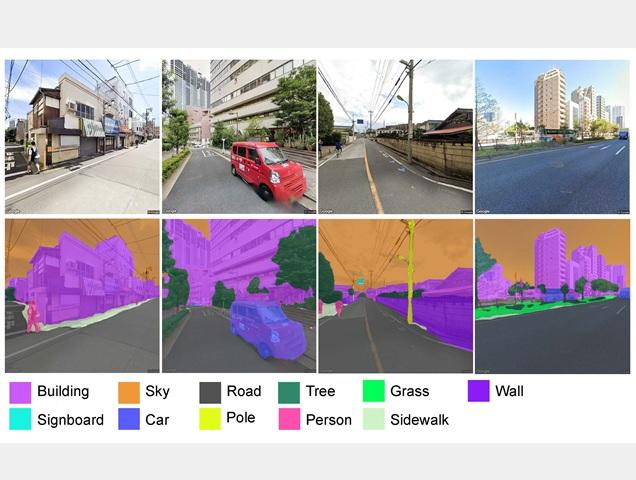
Street view images into detailed maps
This figure illustrates how the researchers transformed ordinary Google Street View images (top) into detailed maps of urban features (bottom) using artificial intelligence. The AI identifies every pixel in an image as a specific object, such as buildings, trees, roads, sidewalks, vehicles, or people, allowing the researchers to automatically quantify the visual characteristics of neighborhoods. These measurements were then used to examine how different street environments relate to sleep health.
Credit: Osaka Metropolitan University and Map Data Copyright Google
Your neighborhood’s “streetscape”—the physical environment of your street—is something that you have probably never consciously thought about, despite seeing it every day. But what if the streetscape was affecting you on a subconscious level and disrupting your sleep?
This intriguing question is posed by the findings of a study led by Professor Daisuke Matsushita of the Graduate School of Human Life and Ecology at Osaka Metropolitan University. The research team used AI to analyze more than 200,000 Google Street View images to identify visual neighborhood characteristics. They then linked these characteristics to the self-reported sleep of 1,089 working adults living on the lower floors of apartments in Tokyo, who were most likely to be affected by the streetscape.
They found that those living in neighborhoods rated as having a stronger sense of safety tended to sleep longer, and that this rating appeared to be shaped by the streetscape. Generally, people slept longer in areas with lots of greenery, such as leafy trees, on the street. Similarly, high “enclosure”—meaning many tall vertical buildings and few wide-open spaces—was also associated with longer sleep and fewer insomnia symptoms.
However, the study also made a surprising finding. The researchers found that highly walkable streetscapes, such as those with more sidewalks and traffic signs, were associated with a lowered sense of safety and shortened sleep duration.
This suggests that walkability does not always represent a reassuring environment. Instead, a possible explanation is that streets with extensive pedestrian infrastructure are often busier, more crowded, and used by more strangers, which may be perceived as less safe or less relaxing than quieter residential streets.
“This study demonstrates the potential for evaluating streetscape characteristics across large geographic areas in a cost-effective manner,” Dr. Matsushita said. “Based on the technique used in this study, cities could potentially measure perceived safety, beauty, liveliness, and enclosure as well as pollution and noise.”
“We hope that opening up this new perspective creates further possibilities for designing healthier neighborhoods,” he concludes.
The findings were published in Building and Environment.
Funding
This study was supported by JSPS KAKENHI [Grant Number 24K01053], and JST SPRING [Grant Number JPMJSP2139].
Paper information
Journal: Building and Environment
Title: Urban eye-level landscapes and sleep health: Cross-sectional evidence from a megacity using machine learning for objective and perceptual assessment
DOI: 10.1016/j.buildenv.2026.114711
Authors: Xiaorui Wang, Jihui Yuan, Weixin Huang, Daisuke Matsushita
Published: 7 May 2026
URL: https://doi.org/10.1016/j.buildenv.2026.114711
Contact
Daisuke Matsushita
Graduate School of Human Life and Ecology
Email: matsushita[at]omu.ac.jp
*Please change [at] to @.
SDGs
