Research News
Aug 27, 2026
- Agriculture
Parasitic plants act like genetic engineers by stealing and remodeling useful genes
How foreign genes become permanent in parasitic plants
A parasitic dodder wraps around a sesame plant
A dodder parasitizes a sesame plant, stealing nutrients and genetic material from its host.
Credit: Osaka Metropolitan University
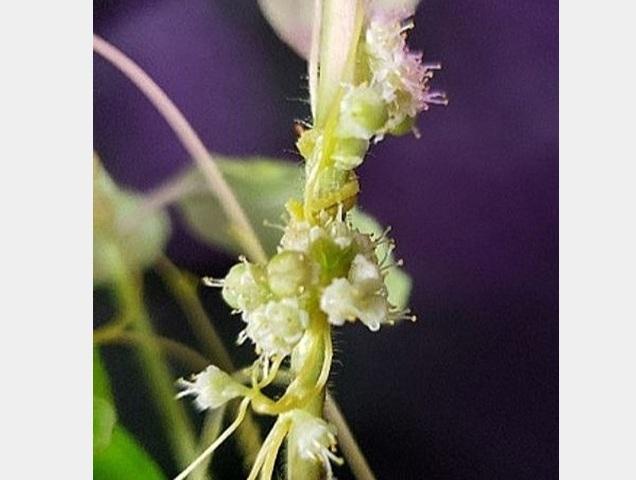
Many plant species parasitize other plants by latching on and taking the nutrition their host needs to survive.
But sometimes, plants steal more than nutrients; they take genes.
A new study shows how one such “stolen” gene was not simply preserved after entering the genome of the parasitic dodder (Cuscuta spp.). Instead, the parasite remodeled the gene over millions of years while keeping its original function intact.
The gene is taken by a process known as horizontal gene transfer (HGT). Unlike ordinary inheritance, in which genes pass from parent to offspring, HGT allows genetic material to move between unrelated organisms.
A research team led by Professor Koh Aoki of the Graduate School of Agriculture, Osaka Metropolitan University, investigated what happens to these foreign genes after they arrive in the parasitic plant. Working with researchers from Suntory Global Innovation Center Ltd., the National Institute for Basic Biology and other institutions, the team traced the evolutionary history of the CYP81Q gene.
They found evidence that CYP81Q originally belonged to another flowering plant in the order Lamiales—which includes many medical and culinary herbs—before being transferred to the dodder lineage in the distant past.
The gene gave dodders something useful, as CYP81Q is involved in producing sesamin, a lignan compound with antioxidant properties. After acquiring the gene, dodders gained the ability to produce sesamin themselves.
Over time, the foreign gene was changed in the dodder genome by pieces of transposable elements called “jumping DNA,” which inserted dodder DNA into CYP81Q.
One of these inserted sequences eventually became part of a newly formed intron, a section of a gene that is removed from its RNA before the genetic instructions are used to make a protein.
Despite undergoing these changes, the gene continued to work. The remodeled CYP81Q still produced a functional enzyme capable of synthesizing sesamin.
“This demonstrated that the gene had retained its biological function despite substantial structural changes,” Professor Aoki summarized.
The finding suggests that HGT is not necessarily the end of the evolutionary story of the gene, instead it can continue to evolve inside the parasite, becoming structurally integrated into its new surroundings while retaining its original function.
“Usually HGT is a process of bacteria,” Professor Aoki said. “Our findings are further evidence that it is found in plants too.”
For parasitic plants, this process may be especially important. Their direct connections with other plants create unusual opportunities for genes to cross species boundaries. Once transferred, those genes may become raw material for further evolutionary change.
The story of CYP81Q goes beyond dodders simply “stealing” a useful gene to the plant making the borrowed genetic material its own.
The findings were published in Plant Physiology.
Funding
This work was supported in part by Grants-in-Aid for Scientific Research (A) (18H03950 and 19H00944, Japan Society for the Promotion of Science to K.A.), Grant-in-Aid for Transformative Research Areas (25A305, Japan Society for the Promotion of Science to K.A.), Research grant from Ohsumi Frontier Science Foundation (to K.A.), and a Grant-in-Aid for JSPS Fellows (19J14848, Japan Society for the Promotion of Science to K.S.).
Paper information
Journal: Plant Physiology
Title: Transposon-colonized intron gain follows parasitism-mediated horizontal transfer of a cytochrome P450 gene
DOI: 10.1093/plphys/kiag335
Authors: Eiichiro Ono, Kohki Shimizu, Jun Murata, Tenta Segawa, Akira Shiraishi, Ryusuke Yokoyama, Hiromi Toyonaga, Masaki Takagawa, Manabu Horikawa, Atsushi Hoshino, Koh Aoki
Published: 30 June 2026
URL: https://doi.org/10.1093/plphys/kiag335
Contact
Koh Aoki
Graduate School of Agriculture
Email: kaoki[at]omu.ac.jp
*Please change [at] to @.
SDGs
