Research News
Aug 31, 2026
- Engineering
Capturing Fleeting Changes in “Nanoscale Light”—Femtosecond Nano-Imaging Reveals Ultrafast Optical Control of Phonon Polariton
Summary
Hyperbolic phonon polaritons (HPhPs) are hybrid light–matter waves that can confine infrared electromagnetic fields to spatial scales far below the corresponding free-space wavelength. Controlling HPhPs on femtosecond timescales could provide a foundation for future ultrafast and ultracompact nanophotonic devices.
However, directly imaging such ultrafast dynamics has remained challenging because HPhPs are strongly dispersive and their wavelength changes markedly with frequency. Broadband femtosecond laser pulses therefore excite HPhPs over a range of wavelengths, causing their interference patterns to overlap and wash out in real-space images.
In this study, researchers developed an ultrafast infrared near-field optical microscopy technique that combines nanoscale spatial resolution and an approximately 150-femtosecond temporal resolution with a spectral resolution of about 10 cm⁻¹. By using a diffraction grating to spectrally resolve the light scattered from the microscope tip before detection, the technique enables frequency-selective imaging without sacrificing ultrafast time resolution.
Applying the new technique to a van der Waals heterostructure composed of tungsten disulfide (WS2) and hexagonal boron nitride (hBN), the researchers revealed how photoexcited charge carriers generated in WS2 transiently modulate HPhPs propagating in the adjacent hBN. The researchers observed changes in the HPhP electric-field amplitude and, in structures containing a relatively thick WS₂ layer, a change in the HPhP wavelength.
The researchers say, “The results establish a new platform for observing and controlling nanoscale light propagation on femtosecond timescales, opening new opportunities for ultrafast nanophotonics”.
Overview
A collaborative research team led by Kazuki Kamada of the Institute for Molecular Science (IMS) and Osaka Metropolitan University, Dr. Jun Nishida (Assistant Professor) and Takashi Kumagai (Associate Professor) of IMS has successfully visualized, in real space, the ultrafast optical modulation of HPhPs in a van der Waals heterostructure composed of hBN and WS2.
HPhPs are hybrid light–matter modes formed through strong coupling between infrared electromagnetic fields and optical phonons in a material. Their hybrid character allows them to coherently transport electromagnetic energy while confining it to spatial scales far below the wavelength of light in free space. These properties make HPhPs promising for nanoscale light manipulation, high-sensitivity spectroscopy, and future nanophotonic technologies. Dynamically controlling HPhPs at ultrafast speeds could provide an important foundation for active nanoscale optical devices.
However, directly observing ultrafast control of HPhPs presents a fundamental experimental challenge. HPhPs are strongly dispersive, meaning that their wavelength changes substantially with the frequency of the incident light. A broadband femtosecond infrared pulse therefore excites HPhPs with many different wavelengths simultaneously. Their interference fringes overlap and become averaged in real-space images, obscuring the underlying propagation patterns. Simply narrowing the spectrum of the incident pulse is not an ideal solution, because doing so would lengthen the pulse and degrade the temporal resolution.
To overcome this trade-off, the team introduced a diffraction grating into the detection path of an ultrafast infrared near-field optical microscope. The grating spectrally separates the broadband infrared light scattered from the probe tip of an atomic force microscope before detection. Because the frequency selection is performed during detection rather than by narrowing the incident pulse, the method preserves an approximately 150-femtosecond temporal resolution while achieving a spectral resolution of approximately 10 cm-1 together with nanoscale spatial resolution.
The team then applied this new ultrafast nano-imaging technique to van der Waals heterostructures composed of WS2 and hBN. Visible-light pump pulses generated photoexcited charge carriers in WS2, while time-delayed infrared near-field pulses probed the resulting response of HPhPs in the adjacent hBN.
In heterostructures containing a thin WS2 layer, the researchers observed a transient modulation that was dominated by a change in the electric-field amplitude of the HPhPs. In structures containing a relatively thick WS2 layer, they also resolved a change in the HPhP wavelength, demonstrating that optical excitation can modify not only the field amplitude but also the HPhP dispersion.
Electromagnetic simulations showed that the experimental observations can be explained by a transient, carrier-induced change in the dielectric response of WS2. This change in WS2 modifies the HPhPs propagating in the adjacent hBN, providing a mechanism for ultrafast optical control across the van der Waals interface.
By combining femtosecond temporal resolution, nanoscale spatial resolution, and high spectral selectivity, this work overcomes a key obstacle in the real-space imaging of strongly dispersive polaritons. The technique provides a new platform for investigating ultrafast polariton dynamics and for developing future ultrafast and ultracompact nanophotonic devices.
The study was published online in Nano Letters on July 27, 2026.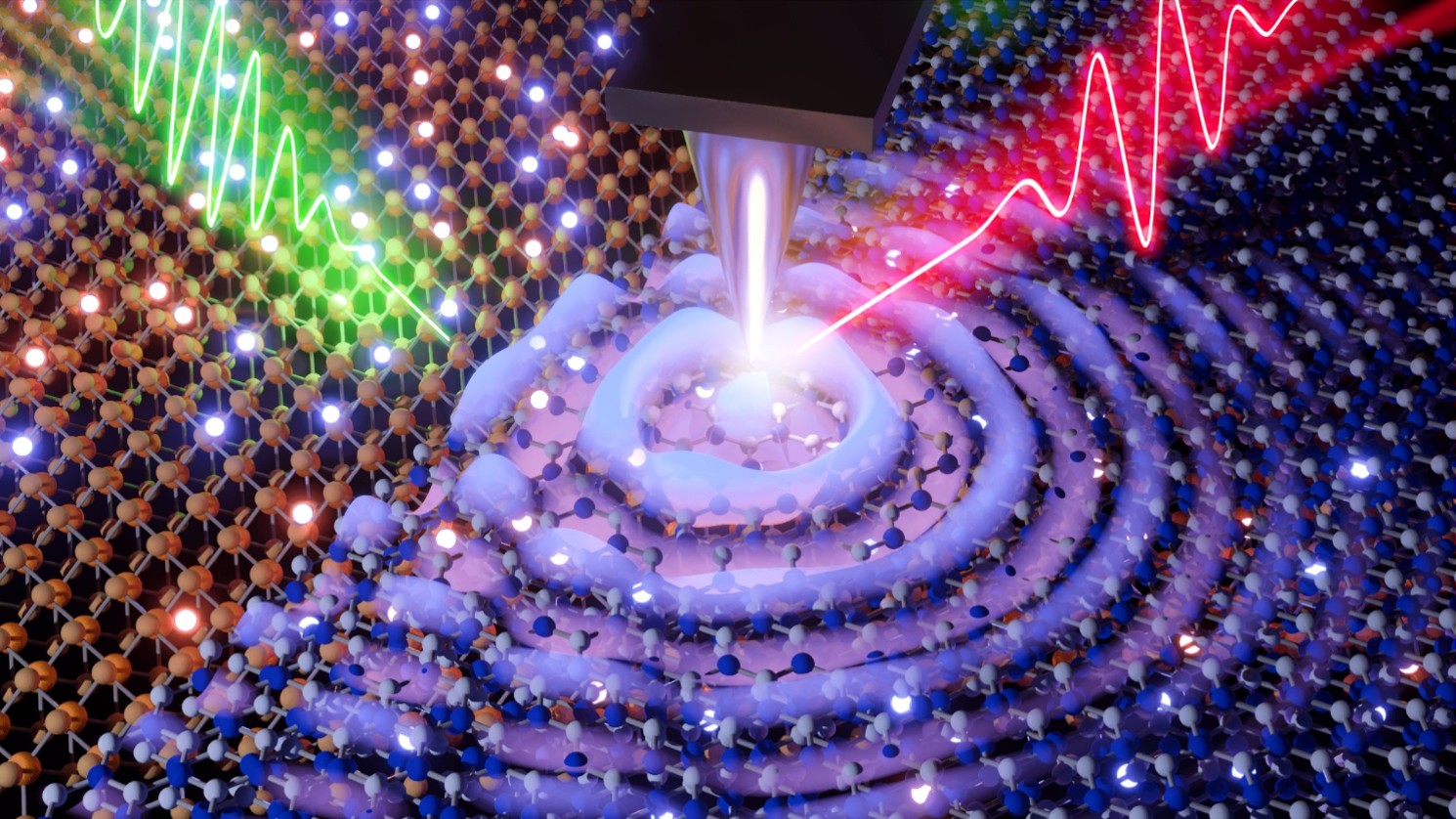
Conceptual illustration of ultrafast nano-imaging and optical control of HPhPs.
Credit:Keisuke Shinokita
Publication Information
Journal Name: Nano Letters
Journal Title: Ultrafast Nano-Imaging and Optical Control of Hyperbolic Phonon Polaritons at hBN/WS2 Heterojunctions
Authors: Kazuki Kamada, Keisuke Shinokita, Fanyu Zeng, Ryo Kitaura, Kenji Watanabe, Takashi Taniguchi, Alexander Paarmann, Masahiro Shibuta, Takashi Kumagai*, and Jun Nishida* (*Corresponding authors)
Publication Date: 2026/07/27
DOI: 10.1021/acs.nanolett.6c02448
Researcher Information
This study was conducted by a research team led by Kazuki Kamada, a researcher at the Institute for Molecular Science (IMS), National Institutes of Natural Sciences, and a PhD student in the Graduate School of Engineering at Osaka Metropolitan University; Jun Nishida, Assistant Professor at IMS; and Takashi Kumagai, Associate Professor at IMS.
Co-authors
- Keisuke Shinokita, Associate Professor (IMS)
- Fanyu Zeng, Researcher (National Institute for Materials Science)
- Ryo Kitaura, Group Leader (National Institute for Materials Science)
- Kenji Watanabe, Specially Appointed Researcher (National Institute for Materials Science)
- Takashi Taniguchi, Executive Vice President (National Institute for Materials Science)
- Alexander Paarmann, Group Leader (Fritz Haber Institute)
- Masahiro Shibuta, Associate Professor (Osaka Metropolitan University)
Research funding
This work was supported by JSPS KAKENHI (Grant Nos. JP25H01395, JP24K01443, JP22K14653, JP26H00400, JP26K00641, JP24H01209, JP25K00936, JP23H05469, JP23H02052, JP21H05233, JP24K01277, and JP23H01939), the Japan Science and Technology Agency (JST) FOREST Program (Grant Nos. JPMJFR236L, JPMJFR201J, and JPMJFR213K), JST CREST (Grant No. JPMJCR24A5), the World Premier International Research Center Initiative (WPI) of the Ministry of Education, Culture, Sports, Science and Technology (MEXT), the MEXT Leading Initiative for Excellent Young Researchers (Grant No. JPMXS0320220123), the Research Foundation for Opto-Science and Technology, the Research Area for Advanced Photon Science of the National Institutes of Natural Sciences (Grant No. 01213008), and the Daiko Foundation.
Contact
Osaka Metropolitan University
E-mail: koho-ipro[at]ml.omu.ac.jp
*Please change [at] to @.
SDGs
