Research News
Dec 12, 2025
- Veterinary Science
Pure bred: New stem cell medium only has canine components
Researchers create a stem cell medium for canine stem cells that doesn’t contain any human components
A stem cell medium made entirely with canine protein
E. coli was used to introduce canine proteins into the medium to act as a scaffold for the stem cells.
Credit: Osaka Metropolitan University
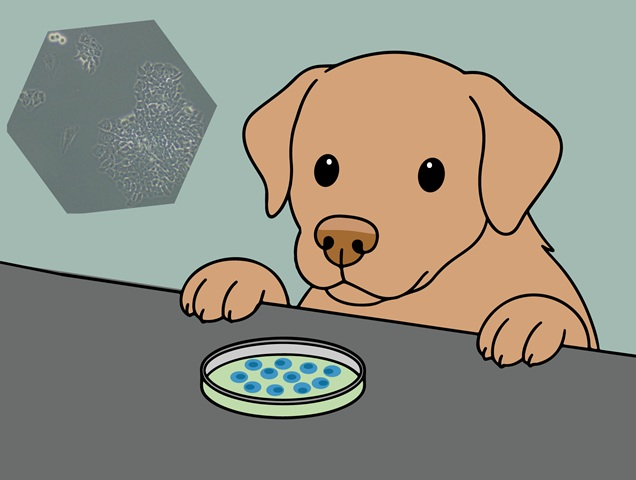
Canine induced pluripotent stem (iPS) cells possess the ability to differentiate into any type of cell, making them a useful tool for investigating common canine diseases and disease states, including those of humans.
When culturing iPS cells, a culture substrate is required to serve as a scaffold for the cells, which adhere to it and proliferate. Without the scaffold, the cells die or fail to differentiate.
Currently, recombinant proteins derived primarily from humans are used as culture substrates for canine iPS cells. However, these human-derived elements are an alien substance for dog cells, leading to immune rejection and making clinical use difficult.
A research team led by graduate student Kohei Shishida and Professor Shingo Hatoya at the Graduate School of Veterinary Science, Osaka Metropolitan University, engineered E. coli with canine-derived genes that made them produce vitronectin (VTN), a dog protein. The E. coli bacteria acted like factories, creating enough VTN to be used as a scaffold to support the growth of canine iPS cells without using any human- or mouse-derived materials.
They found that the canine-derived VTN supported stem cell culture as effectively as the human-derived version. The stem cells also maintained their full differentiation potential, just as they do in the standard medium.
“This achievement is highly significant as it has paves the way for the stable cultivation of canine iPS cells without the use of human components,” Shishida said. “This is valuable because it enables a fully canine culture system, reducing cross-species contamination risks.”
For potential clinical use, the researchers also evaluated a mutant form, VTN-N, generated by deleting a portion of the protein’s N-terminal region to establish whether trimming down unnecessary or potentially problematic parts of the protein hindered its effectiveness. VTN-N demonstrated similar performance to human-derived VTN, functioning adequately even with a simpler structure. Future studies will enable optimization of the manufacturing process using VTN-N.
“This research brings the clinical application of regenerative medicine for intractable diseases commonly seen in dogs, such as heart disease, neurological disorders, and blood disorders, closer to reality,” Professor Hatoya added. “Canine-derived VTN can be produced stably and cost-effectively using E. coli, making it a useful foundational technology with broad applicability from research to clinical use.”
The study was published in Regenerative Therapy.
Funding
This work was supported by JSPS KAKENHI (grant numbers 22H02525), JST SPRING (grant number JPMJSP2139) and the Research and Development Grant Program of the G-7 Scholarship Foundation, Japan.
Paper information
Journal: Regenerative Therapy
Title: Recombinant production of canine vitronectin for optimizing the culture of canine induced pluripotent stem cells
DOI: 10.1016/j.reth.2025.09.002
Authors: Kohei Shishida, Yui Ikuta, Hiroko Sugisaki, Kazuto Kimura, Jun Katahira, Masaya Tsukamoto, Shingo Hatoya
Published: 16 September 2025
URL: https://doi.org/10.1016/j.reth.2025.09.002
Contact
Shingo Hatoya
Graduate School of Veterinary Science
Email: hatoya[at]omu.ac.jp
*Please change [at] to @.
SDGs

