Research News
Dec 19, 2025
- Engineering
Fusion of Nanopores and Nanofluidic Devices Could Transform Medicine and Beyond
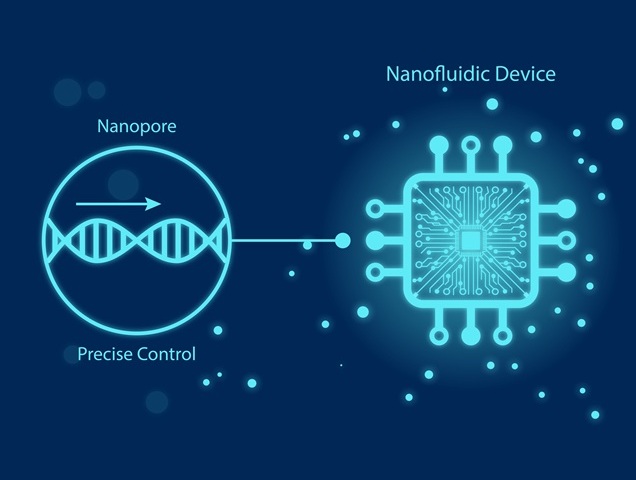
Nanopore and nanofluidic device
Merging nanopores and chip-based nanofluidic devices could transform medicine and data analysis.
Credit: Osaka Metropolitan University
When disease begins forming inside the human body, something subtle happens long before symptoms appear. Individual molecules such as DNA, RNA, peptides, or proteins begin shifting in quantity or shape. Detecting these tiny molecular changes early could dramatically change how cancer, infections, and other conditions are diagnosed.
For years, scientists have dreamed of reading these changes one molecule at a time. Nanopores, nanometer-sized holes that detect single molecules by sensing changes in electric current, have brought that dream closer to reality, but nanopore sensing has hit several scientific walls. Molecules rush through too fast to analyze. Signals drown in electrical noise. Proteins stick to pore surfaces and single pores simply cannot provide the scale required for real-world clinical use. So what would it take to make nanopore sensing fast, precise, and robust enough for society?
Believing they have found the answer, a joint team from Osaka Metropolitan University in Japan and the University of Fribourg in Switzerland conducted a comprehensive review and proposed a strategic solution that integrates nanopores with chip-based nanofluidic devices. Nanofluidic devices contain networks of nanosized channels that allow scientists to precisely control how single molecules move, slow down, separate, or interact. When these devices are linked with nanopores, molecules move slowly enough for accurate readings, noise levels drop dramatically, and surface fouling is greatly reduced. Further, multiple pores can be used simultaneously for high-throughput analysis and automation becomes far easier, thus enabling more stable measurements. This integration would transform nanopores into devices with the precision, stability, and scalability needed for real-world diagnostics.
According to the team, integrating nanopores and nanofluidic systems with AI and extending beyond signal analysis to experimental control, data integration, and decision-making could reshape multiple fields, from ultra-early cancer and infection detection to rapid on-site monitoring of disease biomarkers in blood and environmental surveillance of persistent pollutants such as PFAS. These systems could also bring about next-generation precision medicine, faster, more accurate DNA sequencing, and single-molecule protein sequencing.
“Integrating nanopores with nanofluidic devices could allow us to achieve high-speed, high-precision, and high-sensitivity measurements at the same time, something long considered extremely difficult,” said Prof. Yan Xu from Osaka Metropolitan University. “This review marks an important step in defining the direction of this emerging research field.”
“This combined approach has the potential to transform diagnostics and healthcare,” adds Prof. Michael Mayer from the University of Fribourg. “It could bring us significantly closer to the true practical realization of single-molecule technologies.”
Paper information
Journal: TrAC Trends in Analytical Chemistry
Title: Nanopore sensing: current progress and future challenges tackled by nanofluidic devices
DOI: 10.1016/j.trac.2025.118541
Authors: Wachara Chanakul, Nattapong Chantipmanee, Matthieu Sandell, Rebecca An, Michael Mayer, Yan Xu
Published: 11 November 2025
URL: https://doi.org/10.1016/j.trac.2025.118541
Contact
Yan Xu
Graduate School of Engineering
Email: xuy[at] omu.ac.jp
*Please change [at] to @.
SDGs

