Research News
Jul 10, 2026
- Engineering
Review on Nanofluidic Biosensing Featured on the Cover of “Exploration”
A review article entitled "Biosensing With Nanofluidics" by Professor Yan Xu and colleague Dr. Qun Ma from the Graduate School of Engineering, Osaka Metropolitan University, was selected as the cover article for the June 2026 issue of the international journal Exploration (Wiley).
Professor Xu's research group is pioneering the field of Nano Chemical Systems Engineering through the development of nanofluidic devices. Their research focuses on developing technologies for the precise manipulation, processing, and sensing of nanoscale entities, including nanoparticles, extracellular vesicles (such as exosomes), viruses, DNA, proteins, small molecules, and ions.
One of the group's key directions is the establishment of a nanofluidic biosensing platform. Nanofluidic biosensors leverage nanoscale channels and nanopores to enable highly sensitive, label-free biomolecule detection at the single-molecule level with unprecedented precision. The technology has broad potential applications in DNA sequencing, single-molecule analysis, early disease diagnosis, and precision medicine.
The review provides a comprehensive overview of recent advances in nanofluidic biosensing, covering a wide range of platforms and sensing strategies. It also discusses the current technical challenges and future opportunities that could shape the next generation of biosensing technologies.
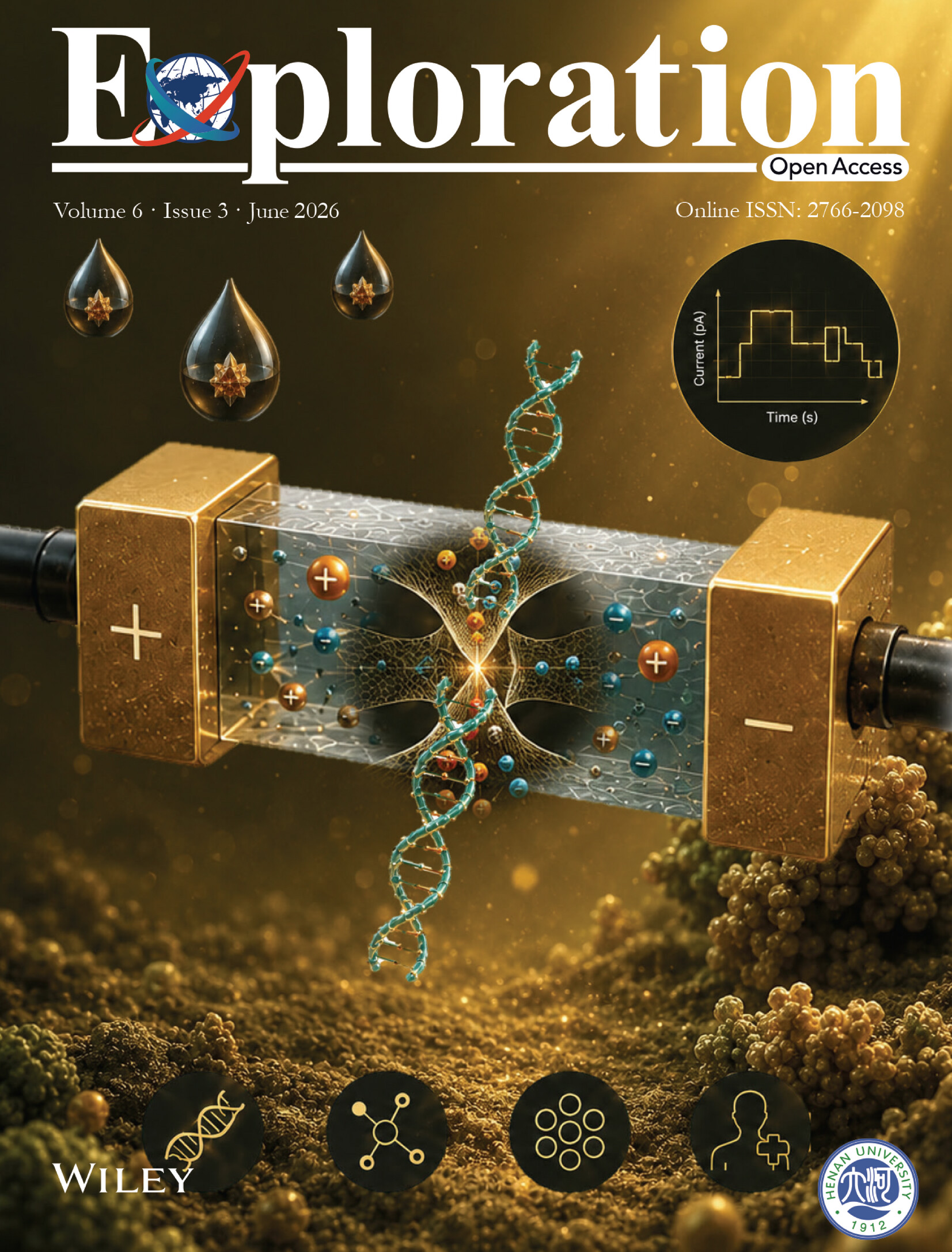
The cover was designed by Dr. Nattapong Chantipmanee, a visiting researcher in Professor Xu's laboratory and a lecturer at Kasetsart University, Thailand. The artwork symbolizes the transformative potential of nanofluidic technologies to redefine label-free molecular diagnostics and next-generation diagnostic intelligence.
The illustration depicts the concept of a new dawn for biosensing enabled by nanofluidic device engineering. Like a molecular gatekeeper, the nanofluidic biosensor translates the passage of DNA, nanoparticles, and biomolecules through nanoconfined spaces into distinctive resistive-pulse signatures, generating unique "molecular fingerprints" in electrical current traces.
Paper information
Journal: Exploration
Title: Biosensing With Nanofluidics
Authors: Qun Ma, Yan Xu
URL: https://doi.org/10.1002/EXP.20240433
Cover Image: https://doi.org/10.1002/exp2.70198
Funding
This study was partially supported by the JSPS KAKENHI (Grant Nos.: JP21H04640, JP23KF0274, JP24KF0160, JP20H00497, JP19KK0129, JP21J14595, and JP26706010), MEXT KAKENHI (Grant No.: JP21H05231, JP19H04678, and JP26107714), JST PRESTO (Grant No.: JPMJPR18H5), JST CREST (Grant No.: JPMJCR18H2), the Asahi Glass Foundation, JSPS Invitational Fellowships for Research in Japan (Grant No.: JPS19151) and the Iketani Science and Technology Foundation (Grant No.: 0381008-A).
Reference
Yan Xu's Nanofluidics Lab
https://www.omu.ac.jp/eng/chemeng8e/
Contact
Yan Xu
Graduate School of Engineering
E-mail: xuy[at]omu.ac.jp
*Please change [at] to @.
SDGs


